 English
  Español de México
  Français
  Deutsch
  Português do Brasil
  Italiano
  한국어
한국어  ไทย
ไทย  Русский
  日本語
日本語  Polski
  Svenska
  Türkçe

What is Ocean Bound Plastic
May 06,2026
When recycled glamour meets purpose—see what is ocean bound plastic and why savvy makeup packaging buyers can’t resist its eco-luxe allure.
What is ocean bound plastic, and why should beauty brands care? With the beauty industry producing over 120 billion packaging units annually, intercepting coastal waste before it reaches the ocean and transforming it into high-grade packaging resin is a critical environmental strategy.
Buyers demand certified supply, consistent quality, and shelf-ready aesthetics. In 2025, Topfeelpack engineers confirmed that authentic Ocean Bound Plastic (OBP) sourcing requires strictly audited recycling partners and absolute traceability.
Quick Insights on What Is Ocean Bound Plastic
➔ Definition: Post-consumer plastic waste collected within 50 km of coastlines—where formal waste management is deficient—intercepted and recycled into resin.
➔ Benefits: Mitigates marine pollution, slashes carbon footprints by up to 79%, conserves petroleum resources, and formalizes local waste economies.
➔ Applications: Processed via injection, extrusion, and blow molding into premium beauty packaging like caps, tubes, jars, and bottles.
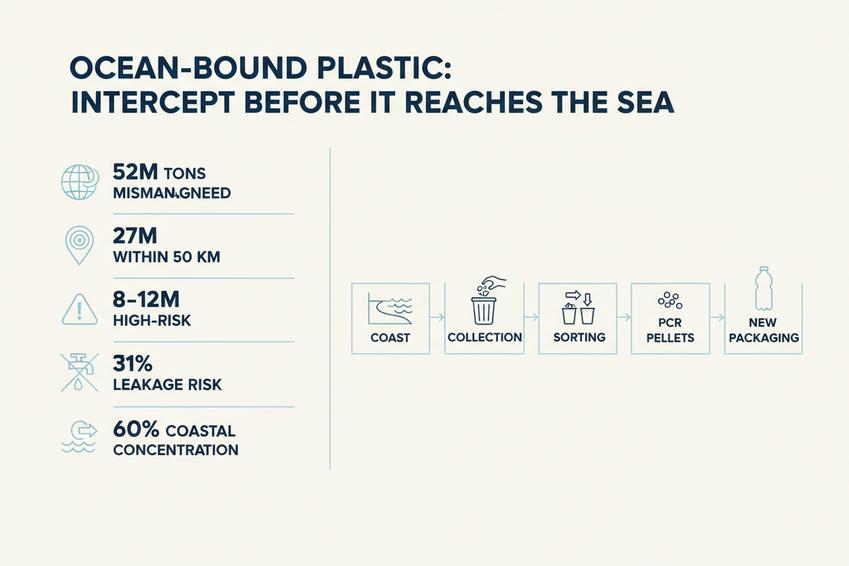
What Is Ocean Bound Plastic: A Quick Overview
Ocean waste requires upstream intervention. Here is a technical breakdown of OBP, backed by data and practical supply-chain insights.
Defining Ocean Bound Plastic and Its Scope
The Zero Plastic Oceans standard provides the definitive criteria for OBP, focusing on mismanaged waste at high risk of marine leakage.
-
Core Definition
-
Geographic Scope
- Within 50 km (30 miles) of shorelines
- Near rivers flowing into seas
- High-risk leakage zones lacking municipal infrastructure
-
Waste Criteria
- Post-consumer plastic
- Uncollected or improperly handled
- At imminent risk of entering marine ecosystems
-
-
Environmental Scope
-
Pollution Prevention
- Targets the 80% of marine plastic originating from land
- Protects coastal biodiversity
- Drives circular material recovery
-
-
Measurable Impact
| Indicator | Coastal Zones (2024 est.) | Leakage Risk % |
|---|---|---|
| Mismanaged plastic waste (million tons/year) | 52 | 31% |
| Waste within 50 km of coast (million tons) | 27 | 60% |
| Potentially ocean-bound fraction (million tons) | 8–12 | 100% high-risk |
OBP is high-risk waste systematically intercepted and commercialized as a sustainable resource.
Sources and Collection Networks Explained
Effective OBP recovery requires examining the upstream waste sources:
- Household packaging waste
- Discarded bottles and flexible films
- Commercial packaging from small retailers
In developing coastal zones, the informal sector is the backbone of recovery. Formalizing these networks can boost local incomes by 20-30%. The verified collection flow follows this path:
- Community pickup or informal collection
- Aggregation hubs
- Sorting centers
- Baling and blockchain/traceability tagging
The Pew Charitable Trusts projects that without improved waste systems, plastic leakage to aquatic environments could triple to 29 million metric tons by 2040, making interception models essential.
Topfeelpack partners exclusively with verified supply chains to guarantee shoreline-to-pellet traceability, ensuring brands avoid greenwashing.
From Reclaimed Plastic to PCR Feedstock
Transforming coastal waste into cosmetic-grade material is a rigorous industrial process.
- Step 1: Collection – Recovered reclaimed plastic is mapped and transported to certified facilities.
- Step 2: Sorting – Optical and manual sorting by resin type, color, and density to maximize manufacturing input quality.
- Step 3: Washing & Shredding – Friction washing removes contaminants; plastics are ground into uniform flakes.
- Step 4: Reprocessing – Flakes are melted, filtered, and extruded into post-consumer recycled (PCR) feedstock.
- Step 5: Compounding & Quality Testing – Additives are introduced to match virgin material performance metrics.
- Step 6: Raw Material Conversion – Pellets re-enter the supply chain as circular materials for molding.
Ultimately, Topfeelpack integrates this verified PCR resin into packaging that meets strict global compliance standards.
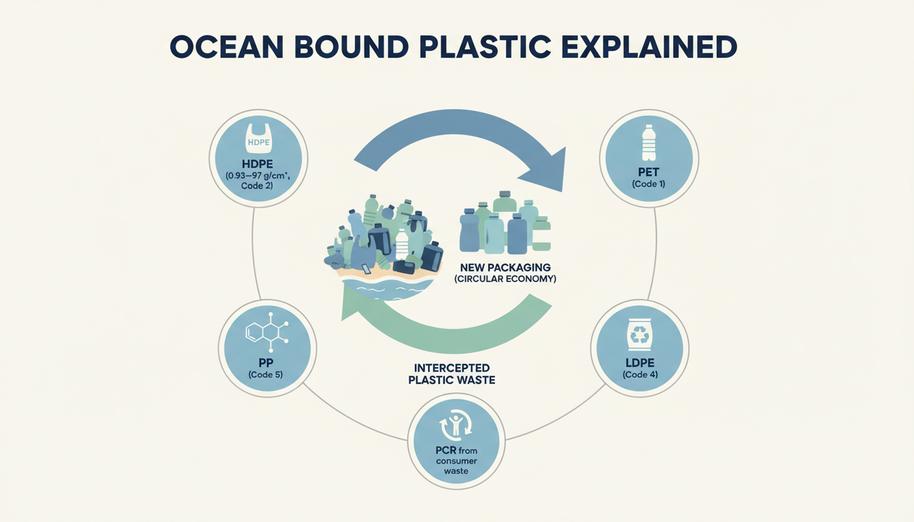
Types of Ocean Bound Plastics Explained
Understanding the distinct polymer types recovered from shorelines dictates their optimal use in beauty packaging.
Post-Consumer Recycled (PCR) Plastic
Recycled material sourced directly from consumer waste forms the foundation of OBP.
-
Source stream
-
Household plastic waste
- Collected from the waste stream
- Reprocessed into recycled content
-
- Collection near coastal zones
- Sorting and washing
- Pelletizing for new packaging
Topfeelpack utilizes PCR to fuel the circular economy and drastically reduce virgin resin dependency.
High-Density Polyethylene (HDPE)
HDPE dominates the rigid container market. Mechanical recycling retains up to 90% of its original tensile strength.
-
Material traits
- Rigid plastic structure
- Strong chemical resistance
- Labeled recycling code 2
| Property | HDPE Value Range | Packaging Use |
|---|---|---|
| Density (g/cm³) | 0.93–0.97 | Bottles |
| Tensile Strength (MPa) | 20–31 | Caps |
| Melt Temp (°C) | 120–180 | Containers |
| Recycle Code | 2 | Household packaging |
Polyethylene Terephthalate (PET)
Widely used for transparent packaging, PET is highly recyclable and energy-efficient.
-
Key features
- Clear plastic clarity
- Lightweight strength
- Recycling code 1
Polypropylene (PP)
Ideal for complex, functional parts due to its high fatigue resistance.
-
Performance layers
- Core: durable body
- Surface: aesthetic finish
- Rating: recycling code 5
Low-Density Polyethylene (LDPE)
LDPE provides the necessary elasticity for squeezable packaging.
-
Structure
- Soft
- Flexible packaging grade
- Marked recycling code 4
By utilizing OBP LDPE, Topfeelpack engineers functional squeeze tubes that actively mitigate coastal pollution, offering a perfect eco-friendly fit for any lip makeup packaging line.
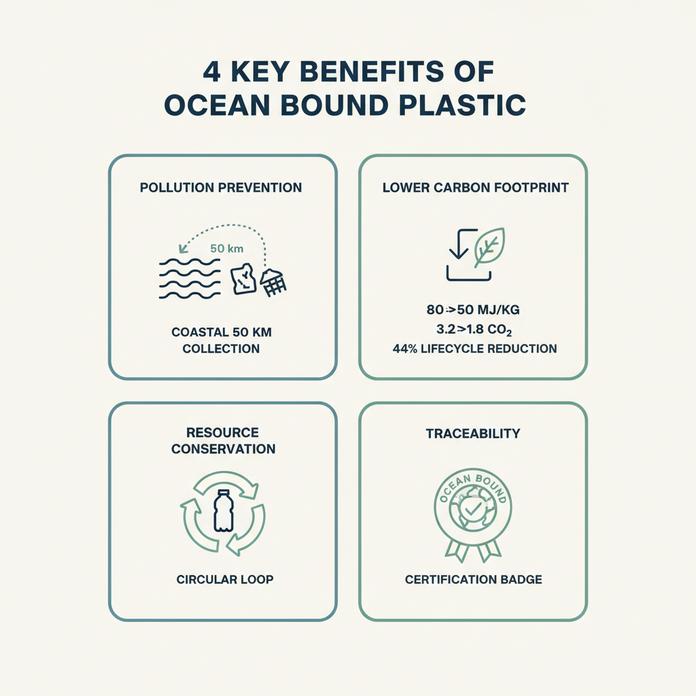
4 Key Benefits of Ocean Bound Plastic
Transitioning to OBP offers multi-dimensional advantages for forward-thinking beauty brands.
Plastic Pollution Reduction and Marine Ecosystem Protection
Intercepting waste at the source is the most efficient pollution control strategy.
-
Source control
-
Coastal collection within 50 km of shorelines
- Reduces leakage into waterways
- Supports local waste reduction systems
-
Community engagement
- Income for coastal communities
- Better pollution control awareness
-
-
Environmental protection
- Safeguards ocean health
- Strengthens wildlife protection
- Cuts long-term environmental impact
Topfeelpack utilizes certified OBP to provide a verifiable solution to marine plastic pollution.
Carbon Footprint Reduction through Circular Economy
Manufacturing with OBP significantly lowers energy consumption compared to virgin petrochemical extraction.
- Replace virgin resin
- Lower energy use during processing
- Reduce total greenhouse gas output
| Material Type | Energy Use (MJ/kg) | CO₂ Emissions (kg/kg) | Recycled Content (%) | Lifecycle Reduction (%) |
|---|---|---|---|---|
| Virgin PET | 80 | 3.2 | 0 | 0 |
| OBP rPET | 50 | 1.8 | 95 | 44 |
| Virgin PP | 75 | 2.9 | 0 | 0 |
| OBP rPP | 48 | 1.6 | 90 | 45 |
| OBP Blend | 55 | 2.0 | 70 | 31 |
Resource Conservation with Waste Diversion
OBP represents advanced resource management by treating waste as a valuable commodity.
-
Waste collection
- Intercepts high-risk waste streams
-
Sorting & cleaning
- Protects raw material value
-
Reprocessing
- Feeds back into manufacturing
This landfill avoidance strategy preserves natural resources. Topfeelpack designs lines specifically engineered to accept this diverted feedstock.
Enhanced Recyclability and Material Traceability
Verified OBP guarantees supply chain transparency.
-
Certification systems
- GRS verification
- ISCC PLUS chain-of-custody
- SCS auditing
-
Operational controls
- Advanced sorting technology
- Digital data tracking
- Clear material identification
-
Supply integrity
- Transparent material flow
- Verified recycled materials content
- End-to-end supply chain transparency
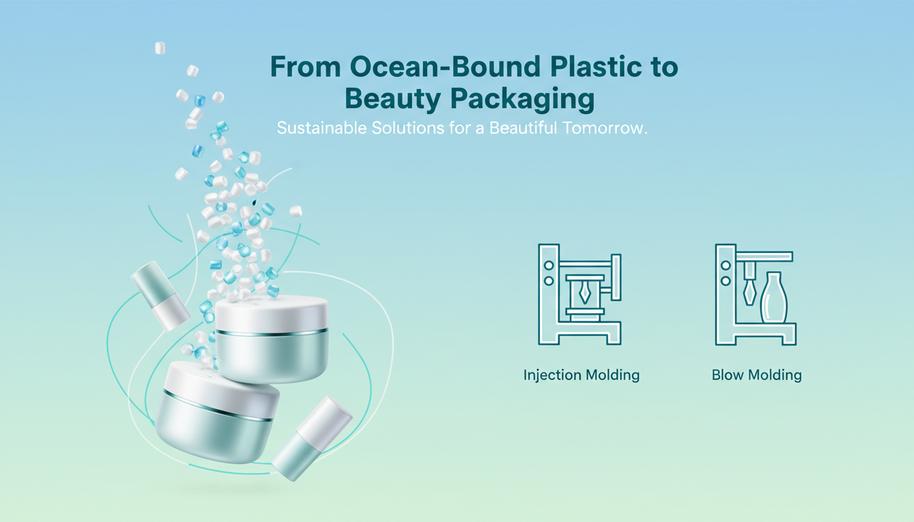
How Makeup Packaging Brands Use Recycled Ocean Plastic
Engineering OBP into luxury cosmetics packaging requires precise manufacturing controls.
Injection Molding of OBP-Certified Caps and Closures
Producing intricate parts requires stable polymer flow.
-
Material preparation
- OBP pellets made from recycled plastic are verified under OBP certification.
- Moisture control improves material flow and avoids structural flaws.
-
Mold stage
- Precision mold tooling defines thread accuracy.
- Cooling time balances strength and production efficiency.
-
Output control
- Torque testing for flip-tops.
- Drop tests for powder compact case containers.
Topfeelpack optimizes cycle times to ensure these closures perform flawlessly without inflating costs.
Extrusion and Blow Molding for Skincare Jars and Tubes
Blow molding requires exact melt flow index (MFI) calibration to prevent wall failures.
- Polymer melting in controlled polymer processing units.
- Parison forming for bottles.
- Air expansion to shape skincare jars and tubes.
- Wall-thickness checks for safe plastic packaging with recycled materials.
Achieving Aesthetic Appeal and Color Consistency in Cosmetics Containers
High-end brands demand flawless finishes, achieved through advanced spectrophotometry.
- Stable pigmentation control
- Smooth surface finish
- Strong design elements
- Masterbatch blending improves color consistency.
- Surface polishing enhances visual quality.
- Design tweaks protect aesthetic appeal across cosmetics containers. With over 270 patents and a decade of expertise, Topfeelpack delivers premium custom molds and surface decorations across our high-quality face makeup packaging and eye makeup packaging lines.
FAQs about What Is Ocean Bound Plastic
What Is Ocean Bound Plastic and Why Does It Matter? Ocean Bound Plastic (OBP) is reclaimed plastic collected within 50 km of coastlines. It is vital because:
- Plastic pollution reduction near vulnerable shores
- Marine ecosystem protection for coastal communities
- Waste diversion into a circular economy
How Is Ocean Bound Plastic Turned into Packaging Materials?
-
Collection networks recover mixed plastics near coastlines.
-
Sorting facilities separate HDPE, PET, PP, and LDPE.
-
Reprocessors handle recycling, compounding, and pelletizing.
-
Certified PCR resin is molded into containers via:
- Injection molding → caps, closures, and empty blush stick components
- Blow molding → skincare bottles
- Extrusion → squeeze tubes
What Types of Plastics Are Common in OBP Packaging?
| Material | Key Properties | Common Beauty Use |
|---|---|---|
| HDPE | Durability, chemical resistance | Bottles, caps |
| PET | Clarity, barrier properties | Jars, containers |
| PP | Heat stability, mechanical strength | Closures, compacts |
| LDPE | Flexibility | Tubes |
| Mixed plastics | Reprocessed blends | Secondary components |
How Does OBP Support Sustainability Goals for Beauty Brands?
- ♻ Carbon footprint reduction through recycled content (up to 79% reduction)
- ♻ Resource conservation by replacing virgin resin
- ♻ Waste diversion into certified recycling streams
- ♻ Support for ethical sourcing in coastal regions
What Certifications Should Buyers Look for in OBP Packaging?
- Ocean Bound Plastic (OBP) certification — confirms pre-ocean recovery
- Global Recycled Standard (GRS) — verifies recycled content levels
- ISCC PLUS — tracks sustainable mass balance material flow
- SCS Global Services or Recycled Content Certification — validates claims
- Cradle to Cradle — supports circular design principles
🌱 Ready to Build Your Sustainable Packaging Line?
Topfeel Makeup (Topfeelpack Co., Ltd) is your trusted OEM/ODM partner for high-quality, eco-friendly cosmetic packaging. Serving over 1,000 global brands, we specialize in private mold development, rapid 3D prototyping, and sustainable materials like PCR and OBP. Whether you are searching for sustainable lip gloss tube designs, reliable lip stick tube packaging, or protective lip balm tube solutions, we have you covered. For eye products, we supply custom mascara tube models and versatile empty palette options to elevate your brand. Contact Topfeelpack today to request a sample or discuss custom packaging solutions for your next green beauty launch!
References
- beauty industry producing over 120 billion packaging units annually – zerowasteweek.co.uk
- authentic Ocean Bound Plastic (OBP) – oceanboundplastic.com
- carbon footprints by up to 79% – plasticsrecycling.org
- Zero Plastic Oceans – zeroplasticoceans.org
- 80% of marine plastic originating from land – unep.org
- Mismanaged plastic waste – ourworldindata.org
- informal sector – worldbank.org
- Pew Charitable Trusts – pewtrusts.org
- Global Recycled Standard (GRS) – textileexchange.org
- ISCC PLUS – iscc-system.org
- SCS Global Services – scsglobalservices.com
- Cradle to Cradle – c2ccertified.org

