 English
  Español de México
  Français
  Deutsch
  Português do Brasil
  Italiano
  한국어
한국어  ไทย
ไทย  Русский
  日本語
日本語  Polski
  Svenska
  Türkçe

Are Lipstick Tubes Recyclable?
May 12,2026
The recyclability of lipstick tubes is no longer a sidebar question; it’s a primary purchasing driver. With the cosmetics industry producing roughly 120 billion units of packaging annually, shoppers actively judge brands on their environmental footprint.
If packaging fails the curbside test, cart abandonment rises. Smart brands are switching to verifiable, recyclable designs to secure long-term loyalty.
Key Points Refrain: Are Lipstick Tubes Recyclable
➔ Materials Matter: Polypropylene (PP) and aluminum are widely accepted; ABS and mixed-resin designs demand complex disassembly.
➔ Brand Spotlight: L’Oréal (aluminum), Bite Beauty (PCR plastic refills), Fenty Beauty (easily disassembled PET), Kjaer Weis (biodegradable/Zamac).
➔ Recycling Steps: Disassemble base, cap, and swivel; clean residue; sort by resin codes; leverage specialty take-back schemes.
➔ Consumer Impact: Post-consumer recycled plastic cuts emissions by up to 70%—seek FDA-compliant, mono-material components with clear labels.
75% Of Consumers Ask: Are Lipstick Tubes Recyclable?
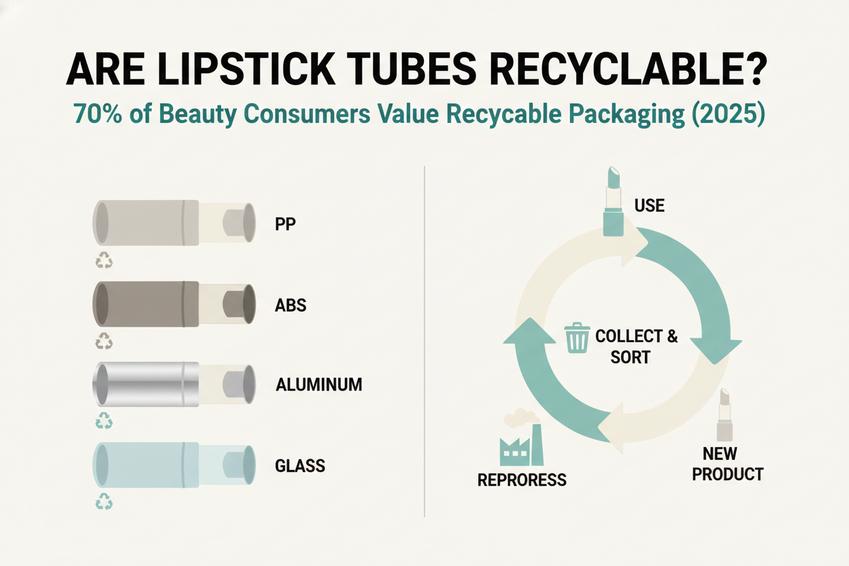
At checkout, shoppers are fundamentally asking if these micro-packages can actually survive the municipal recycling stream without ending up in a landfill.
How Polypropylene and ABS Impact Tube Recyclability
The answer heavily relies on material composition.
-
Plastic lipstick tubes are usually made from:
- Polypropylene (PP – Resin Code #5)
- ABS (Acrylonitrile Butadiene Styrene)
- Mixed Polymer blends
1. If the tube is mainly Polypropylene
-
In tube manufacturing, PP is prized for being lightweight, durable, and chemically stable.
-
In most municipal waste stream systems:
- Rigid Polypropylene is increasingly accepted and recovered.
- Clear labeling improves optical sorting recyclability.
-
Brands that use mono-material PP:
- Eliminate the 15-20% material loss typical of mixed-resin processing.
- Improve real-world recycling rates by up to 30%.
2. If the tube uses ABS
-
ABS delivers a sturdy, premium glossy finish.
-
Yet in local recycling programs:
- ABS is routinely rejected by Material Recovery Facilities (MRFs) due to its density.
- Mixed polymer builds severely lower recovery value.
-
Multi-material injection molding:
- Looks sleek on shelves.
- Complicates mechanical separation.
- Nullifies effective recyclability.
Ultimately, recyclability depends entirely on how cleanly the components can be isolated before entering the waste stream.
Recycling Stream Compatibility of Aluminum vs. Glass Shells
Shell materials drastically alter the sustainability equation.
-
Aluminum
- Highly compatible with global recycling stream systems.
- Nearly 75% of all aluminum ever produced is still in use today.
- Functions flawlessly in closed-loop waste management.
-
Glass
- Technically infinitely recyclable.
- Heavier weight increases transit carbon emissions.
- Requires a strict separation process from glued plastic inner-cores.
- If the packaging uses an aluminum shell and removable PP core, recovery is highly probable.
- If a glass shell is glued to mixed plastics, material compatibility fails immediately.
Tip: • Removable inner cartridges • Clear resin codes • Easy disassembly
At Topfeel, shell material choices are engineered around practical recycling stream realities. We ensure packaging designs match actual waste management infrastructure, not just eco-marketing trends.
💡 Ready to future-proof your packaging? Topfeel engineers mono-material and aluminum lipstick tubes designed for real-world recycling streams. Explore Topfeel’s Sustainable Lipstick Packaging Solutions →
Post-Consumer Recycled Plastic: Consumer Adoption Rates
True sustainability extends beyond disposal, driving the demand for Post-Consumer Recycled Plastic (PCR).
A. Why recycled content matters
- Recycled content directly reduces virgin Packaging material demand.
- It supports a genuine circular economy.
- PCR plastics lower total environmental impact and carbon emissions by 50-70%.
B. What drives consumer adoption
- Transparent labeling regarding sustainability metrics.
- Assurance of cosmetic safety and formula compliance.
- Structural integrity comparable to virgin Polypropylene.
“In 2025, over 70% of global beauty consumers report that packaging recyclability influences purchase decisions,” according to McKinsey’s 2025 Global Beauty Insights update.
C. Brand response
- Increasing Post-Consumer Recycled Plastic ratios (projected 7% CAGR through 2030).
- Proving drop-test performance and leak resistance.
- Aligning with zero-waste consumer behavior shifts.
Topfeel seamlessly integrates PCR Packaging material into premium tubes, ensuring that when shoppers ask about recyclability, the product is already part of the circular solution.
💡 Cut your packaging emissions by up to 70%. Integrate premium, safety-tested PCR plastics into your next product launch with Topfeel’s custom manufacturing. Request a PCR Packaging Sample →
Which Brands Use Recyclable Lipstick Packaging?
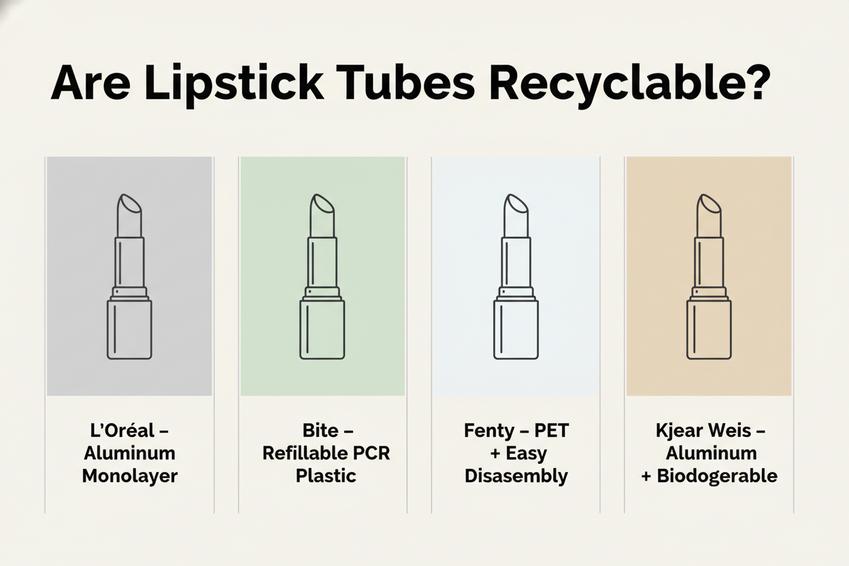
Let’s examine how major brands successfully execute sustainable packaging design in the real world.
L’Oréal: Aluminum Shells with Monolayer Construction
-
Material Strategy
- Outer layer: aluminum
- Structure: monolayer construction
- Focus: simplified packaging material design
-
Why this works
- Fewer mixed plastics mean optical scanners can sort efficiently.
- Aluminum shells easily enter highly profitable metal recycling streams.
- Clean construction prevents landfill diversion.
-
Recycling impact
- Less composite waste
- Easier manual disassembly
- Higher compatibility with curbside systems for brands like L’Oréal
Bite Beauty: Refillable System in Post-Consumer Recycled Plastic
-
Core concept
- Durable outer case
- Replaceable inner cartridge
- Made from post-consumer recycled plastic
-
Sustainability layers
- Refillable system drastically reduces single-use waste.
- Reuse extends the packaging lifecycle indefinitely.
- Lowers demand for virgin plastic packaging.
-
Practical vibe
- Snap out old insert
- Insert new refill
- Keep the premium shell used by pioneers like Bite Beauty
Fenty Beauty: Polyethylene Terephthalate Cases and Disassembly Ease
-
Material choice
- Polyethylene terephthalate (PET – Resin Code #1)
- Clear resin identification
-
Design logic
- Cap, base, and core separate cleanly.
- Easy disassembly guarantees better MRF sorting.
- Highly stable PET cases protect the formula.
-
Recycling reality
- PET boasts global recycling rates exceeding 25-50%.
- Uncontaminated components are highly valued by recyclers processing brands like Fenty Beauty.
Kjaer Weis: Biodegradable Materials and Carbon Footprint Reduction
-
Material path
- Refillable Zamac and aluminum compacts
- Select biodegradable materials for refills
-
Environmental focus
- Lower lifetime carbon footprint
- Elimination of virgin fossil-fuel resources
- Investment in heirloom-quality sustainable packaging
-
Bigger trend
- Compostable elements
- Luxury eco-friendly positioning seen in lines like Kjaer Weis
- Strict regulatory compliance
For manufacturers like Topfeel, blending refill models with mono-material packaging design is the gold standard for creating practical, sustainable cosmetics.
3 Steps To Recycle Your Empty Lipstick Tube
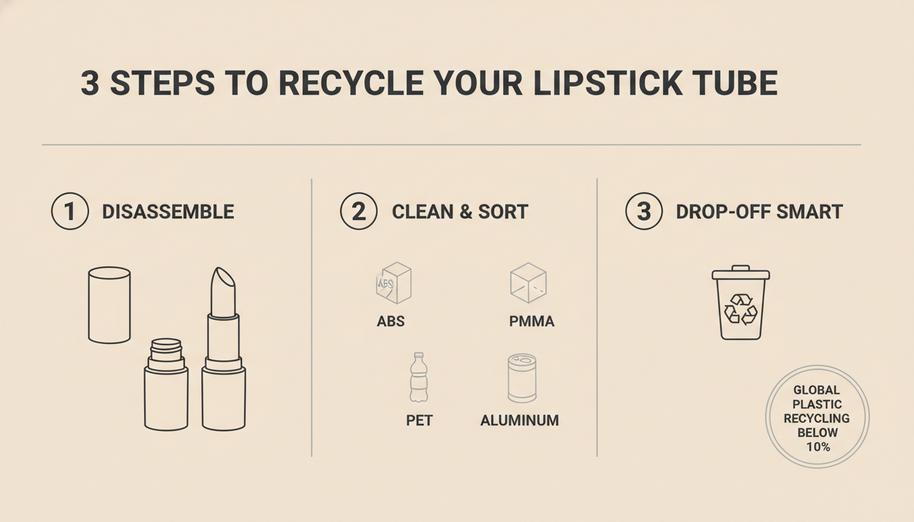
Can lipstick packaging be placed directly in curbside bins? Usually, no. Small items under 2 inches (50mm) often fall through MRF sorting screens into landfill piles. Follow these steps to ensure recovery.
Step 1: Disassembly for Recycling – Base, Cap, and Swivel Mechanism
A typical lipstick tube requires total separation:
- Outer cap
- Inner base
- Rotating swivel mechanism
- Inner cup and decorative shell
For better clarity:
- Twist the product fully down to expose the inner cup.
- Pull apart the cap from the base.
- Pry the swivel mechanism from the outer shell using a small tool if necessary.
Why this matters:
- Mixed materials guarantee the item will be trashed by recyclers.
- Tiny, complex components jam sorting machines.
- Complete disassembly is the only way to ensure recovery.
Brands like Topfeel are engineering friction-fit packaging that allows for instant component release, simplifying this process for the end-user.
Step 2: Cleaning and Sorting by Material Type (ABS, PMMA, PET)
Once separated, execute thorough cleaning and sorting. Residual cosmetic wax ruins recycling batches.
Material breakdown:
- ABS plastic (structural shells)
- PMMA plastic (acrylic/glossy cases)
- PET plastic (transparent covers)
- Aluminum sleeves
Sort like this:
- Plastics grouped by exact resin code.
- Metals isolated for separate processing.
- Unmarked pieces sidelined.
According to the UN Environment Programme, historical plastic recycling rates hover around 9%. Thoughtful consumer sorting is critical to improving this metric. Topfeel’s shift toward mono-material structures directly addresses this bottleneck.
Step 3: Drop-Off in Compatible Recycling Streams or Take-Back Schemes
Proper drop-off dictates the final outcome.
Check:
- Local recycling streams that accept micro-plastics.
- Beauty brand take-back schemes (like Pact Collective).
- Dedicated cosmetic collection points at retailers (e.g., Sephora).
- Mail-in recycling program boxes.
The Ellen MacArthur Foundation notes:
Small-format plastic packaging remains one of the biggest blind spots in household recycling systems, requiring brand-led collection models.
Eco-friendly disposal requires infrastructure. Topfeel designs with these take-back partnerships in mind, ensuring packaging fits seamlessly into specialized recovery networks.
FAQs about Are Lipstick Tubes Recyclable
Are Lipstick Tubes Recyclable When Made from Different Plastics or Metals?
Recyclability is dictated by resin purity and facility capabilities.
- High acceptance materials
- Polypropylene (PP) and Aluminum: Extremely high stream compatibility; aluminum offers infinite reuse without quality degradation.
- Polyethylene Terephthalate (PET): Highly sought after by recyclers when clean.
- Limited acceptance materials
- ABS, SAN, PMMA: While durable and aesthetic, these are overwhelmingly excluded from standard curbside systems.
- Design impact
- Monolayer construction is vital for sorting success.
- Glued or fused mixed materials across the base, cap, and inner tube guarantee the item will be sent to a landfill.
How Do Design Elements Like Magnetic Closures or Decorative Finishes Affect Recycling?
Premium aesthetics often destroy sustainability.
- Magnetic closures → Magnets must be ripped out before aluminum or PET can be processed; otherwise, the whole tube is rejected.
- Heavy surface decoration (metallization, foil stamping) → Corrupts optical sorting sensors and contaminates plastic melts.
- Complex assembly → Requires forceful disassembly, which consumers rarely perform.
Responsible brands simplify assembly and rely on in-mold texturing rather than mixed-material finishes.
Do Refillable and Biodegradable Options Improve Sustainability?
Yes, provided the consumer actively utilizes the refill mechanics.
| Approach | Key Materials | Sustainability Gain | Watchpoint |
|---|---|---|---|
| Refillable system | Aluminum outer shell + PP refill | Massive carbon footprint reduction over repeated use | Relies on consumer participation |
| Compostable packaging | Bioplastics (PHA/PLA) | Reduced long‑term micro-plastic waste | Requires industrial compost access |
| Post‑Consumer Recycled Plastic | Reprocessed PP or PET | 50-70% lower virgin resin demand/emissions | Ensuring formula compatibility |
Refillables keep heavy, durable shells out of the waste stream while minimizing the footprint of the replaceable inner tube.
What Should Brands and Bulk Buyers Check for Compliance and Performance?
True sustainability cannot compromise product safety.
-
Regulatory review
- FDA regulations, REACH compliance, Prop 65 standards.
- ISO certifications and verifiable material safety data sheets (MSDS).
- Strict heavy metal restrictions in PCR batches.
-
Performance testing
- Chemical compatibility to prevent formula leaching.
- Leak, impact, and thermal resistance.
- Dimensional stability during high-volume scaling.
-
Manufacturing controls
- Precision injection molding for tight tolerances.
- Custom tooling dedicated to monolayer construction.
- Prototyping strictly to verify consumer disassembly of the base, cap, and closure.
True recyclability lives at the exact intersection of smart mono-materials, frictionless disassembly, and verified regulatory compliance.
Stop Losing Customers to Unrecyclable Packaging
True sustainability requires expert engineering. Partner with Topfeel to design FDA-compliant, effortlessly recyclable, and beautiful lipstick tubes that your buyers will love.
👉 Contact Topfeel Today to Start Your Custom Packaging Project →
References
- 120 billion units of packaging – zerowasteweek.co.uk
- Polypropylene (PP – Resin Code #5) – epa.gov
- 75% of all aluminum ever produced – aluminum.org
- circular economy – ellenmacarthurfoundation.org
- McKinsey’s 2025 Global Beauty Insights update – mckinsey.com
- L’Oréal – loreal.com
- Bite Beauty – sephora.com
- Fenty Beauty – fentybeauty.com
- Kjaer Weis – kjaerweis.com
- historical plastic recycling rates hover around 9% – unep.org
- Pact Collective – pactcollective.org
- Ellen MacArthur Foundation – ellenmacarthurfoundation.org
- FDA regulations – fda.gov
- REACH compliance – echa.europa.eu
- Prop 65 standards – oehha.ca.gov

