 English
  Español de México
  Français
  Deutsch
  Português do Brasil
  Italiano
  한국어
한국어  ไทย
ไทย  Русский
  日本語
日本語  Polski
  Svenska
  Türkçe

What Is the Standard Lip Balm Tube Volume?
May 13,2026
The standard lip balm tube volume is the mechanical hinge your entire packaging budget swings on. Miscalculate it, and you face mismatched molds, wasted fill, and rejected product runs.
Topfeel Packaging’s 2025 technical documentation lists 4.25 grams as its standard fill weight, perfectly aligning barrel strength, twist-up stability, and high-speed filling-line compatibility.
Stick with this specification to dodge tooling overruns, maintain predictable costs, and scale production seamlessly.
What Is Standard Lip Balm Tube Volume
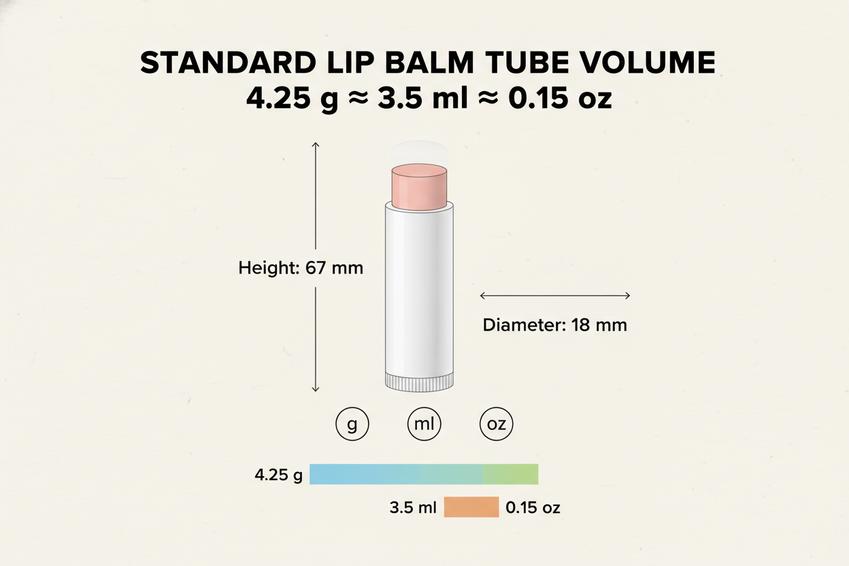
Defining lip balm tube volume dictates both product sizing and precise filling limits.
Industry Benchmark: 4.25 g (≈3.5 ml) in PP Tubes
When standardizing lip balm tube volume, the Industry standard is 4.25 g, equating to roughly 3.5 ml based on a typical balm specific gravity of 0.85–0.95 g/cm³. This Benchmark volume is engineered precisely.
-
Core material
- Most brands utilize Polypropylene (PP) as the primary Tube material.
- PP offers a 1.0–2.0% shrinkage rate, balancing durability, cost, and twist-up action.
-
Capacity logic
- 4.25 g refers to Gram (g), the net product weight.
- 3.5 ml refers to Milliliter (ml), the internal Capacity.
- Actual lip balm tube volume fluctuates with formula density.
-
Why 4.25 g works
- Aligns with FDA “pocket-sized” cosmetic expectations.
- Matches standard hot-pour filling equipment.
- Supports stable injection molding for internal mechanisms.
Manufacturers like Topfeel rely on this benchmark to guarantee their lip balm tube volume performs flawlessly at scale.
Ready to secure your packaging supply chain? Contact Topfeel Packaging today for standard 4.25g lip balm tubes engineered for high-speed, flawless filling.
Comparing Units: Milliliter, Gram, and Ounce Capacities
Evaluating lip balm tube volume requires strict unit differentiation:
-
Measurement types
- Weight measurement → Gram (g)
- Volume measurement → Milliliter (ml)
- Retail display → Ounce (oz)
-
Unit comparison basics
- 1 ml ≈ 1 cc in fluid Capacity units.
- Grams rely entirely on formula specific gravity.
- 0.15 oz universally mirrors the 4.25 g standard.
Always verify whether specifications reference mass (weight) or volumetric capacity.
Tube Dimensions That Define Standard Volume
Internal space is strictly governed by physical geometry. Minor shifts in Tube dimensions drastically alter total capacity.
-
Structural factors
- Tube diameter controls the cross-sectional area (standardized around 15mm for ergonomic thumb fit).
- Tube height defines the Z-axis fill length.
- Wall thickness (ideally 1.0mm–1.2mm) reduces usable Internal capacity.
-
Design hierarchy
-
Form factor
- Slim stick → lower cc volume
- Wide stick → higher balm capacity
-
Base height
- Taller base mechanisms reduce product space.
-
Mold tolerance
- Standard ±0.1mm changes = measurable differences in lip balm tube volume.
-
Precise Packaging design balances grip ergonomics with exact cubic centimeters. Brands like Topfeel engineer this to prevent material waste.
Why 4.25g Is The Benchmark Lip Balm Volume
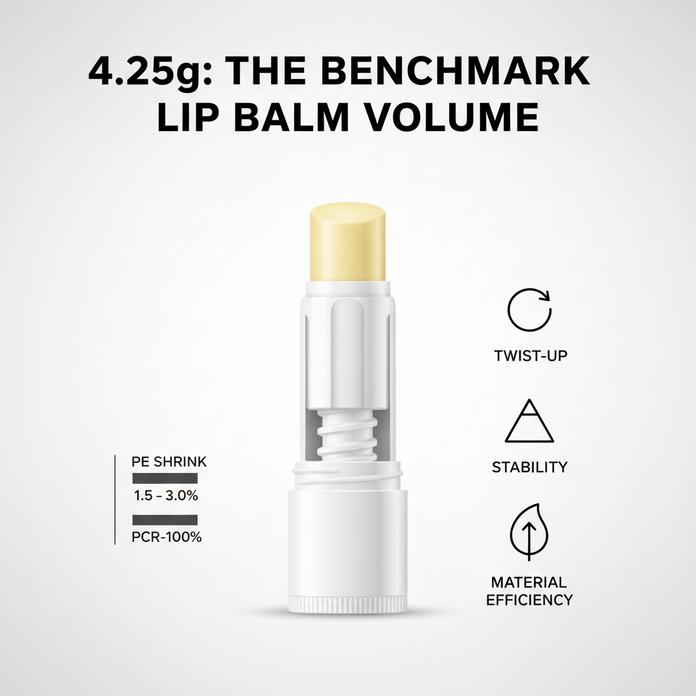
The 4.25g lip balm tube volume balances thermal dynamics and consumer handling, keeping production highly optimized.
Optimal Capacity: Balancing Tube Length and Wall Thickness
Engineers establishing lip balm tube volume prioritize optimal capacity and structural integrity.
-
Core dimensional logic
-
Tube length
- Accommodates exactly 4.25g while retaining pocket-ready dimensions.
-
Wall thickness
- Engineered to 1.0mm–1.2mm to withstand 65°C–75°C hot-pour processing.
- Prevents thermal warping during the cooling phase.
-
-
Structural balance
- Dimensional balance prevents barrel distortion.
- Material distribution ensures rapid, even cooling.
- Volume optimization eliminates air gaps or over-spill.
Topfeel maintains stable molding cycles at 4.25g, guaranteeing consistent lip balm tube volume across millions of units.
Material Efficiency: PE vs. PCR Impact on Net Fill Weight
Polymer selection alters lip balm tube volume stability and final net fill weight.
-
Plastic composition differences
-
Polyethylene (PE)
- Highly predictable melt flow.
- Consistent barrel weight.
-
Post-consumer recycled (PCR)
- Melt flow index (MFI) variations alter density.
- Drives sustainability but requires tooling calibration to maintain environmental impact goals.
-
-
Cooling & shrink comparison
| Material | Density (g/cm³) | Avg. Shrink Rate (%) | Impact on Net Fill Weight |
|---|---|---|---|
| PE | 0.91–0.94 | 1.5–3.0 | Stable |
| PCR-30% | 0.92–0.95 | 2.0–3.5 | Slight variation |
| PCR-50% | 0.93–0.96 | 2.5–4.0 | Moderate variation |
| PCR-100% | 0.94–0.97 | 3.0–4.5 | Needs calibration |
PCR materials exhibit varying shrinkage, directly impacting final lip balm tube volume. Topfeel engineers adjust mold cavity dimensions to ensure the finished lip balm tube volume strictly hits 4.25g regardless of resin mix.
Consumer Convenience: Twist-Up Mechanism and Applicator Fit
Functional mechanics define the user interface.
- Precision-threaded twist-up mechanism
- Reinforced base platform
- Centered dome for seamless applicator fit
The mechanical sequence:
- Rotate base.
- Inner cup elevates via threaded rod.
- Balm surface remains uniformly centered.
Flawless dispensing functionality and packaging ergonomics prevent internal wall scraping. Standard 4.25g lip balm tube volume synchronizes perfectly with these mechanisms, maximizing consumer convenience and reinforcing brand loyalty.
5 Key Factors Impacting Tube Volume
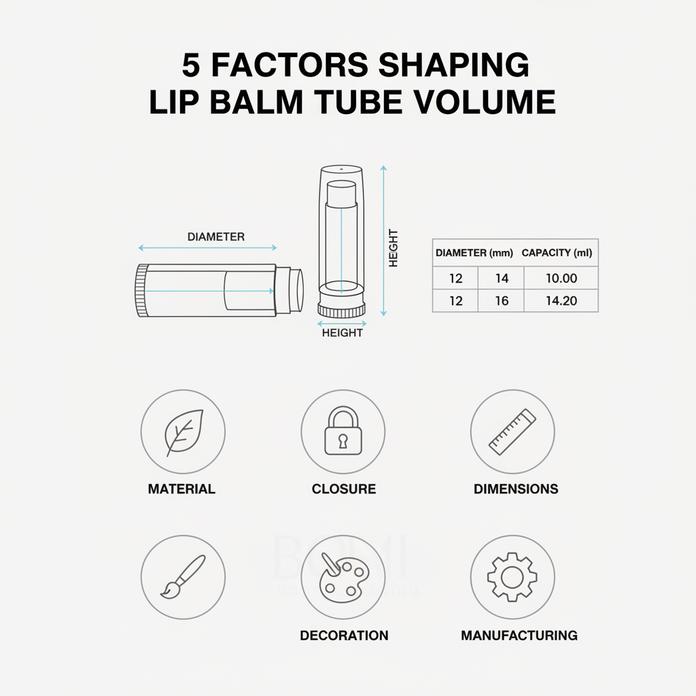
Calculating lip balm tube volume integrates material science with dimensional engineering. These five technical factors actively alter final capacity.
Packaging Material Selection (Plastic, Aluminum, Bioplastic)
Material density and rigidity dictate available Capacity:
-
Plastic
-
Polymer types
- PP: Supports thinner walls, highly stable Resin flow.
- PETG: Offers premium clarity but increases polymer cost by 30-40%.
-
-
Aluminum
- Requires inner plastic sleeves, reducing internal balm tube volume.
-
Bioplastic
- Boosts Sustainable appeal but lower heat deflection temperatures require thicker walls, slightly cutting internal space.
Topfeel recommends PP to maximize fill ratio and maintain standard lip balm tube volume without expanding outer diameters.
Closure Type: Snap-On Cap vs. Child-Resistant Cap
Closure mechanics drastically impact external dimensions and headspace.
-
Snap-on Cap
- Friction-fit Mechanism.
- Minimal headspace waste.
- Optimized Dispensing clearance.
-
Child-resistant Cap
- Mandatory Security lugs.
- Adds 3-5mm to total height.
- Thicker internal Seal cuts into dome space.
Topfeel specifically calibrates fill heights against closure torque specifications to prevent product crushing.
Tube Dimensions: Diameter, Height, and Opening Size
Below is a technical breakdown of how Dimensions scale Capacity:
| Internal Diameter (mm) | Fill Height (mm) | Theoretical Volume (ml) | Wall Thickness (mm) | Effective Capacity (ml) |
|---|---|---|---|---|
| 12.0 | 60 | 6.79 | 1.2 | 6.10 |
| 13.0 | 65 | 8.63 | 1.1 | 7.95 |
| 14.0 | 70 | 10.78 | 1.3 | 9.60 |
| 15.0 | 75 | 13.26 | 1.4 | 11.80 |
| 16.0 | 80 | 16.08 | 1.5 | 14.20 |
Minor Measurement adjustments exponentially alter the final cubic volume.
Surface Decoration: Matte Finish, Hot Stamping, Labeling
Surface Decoration tolerances impact high-speed assembly:
- Matte Finish sprays marginally increase barrel diameter.
- Hot stamping requires substantial wall rigidity to withstand application pressure.
- Labeling relies on absolute Printing alignment to avoid overlap overlap issues.
While purely visual, crisp Aesthetics create the optical illusion of a larger product footprint.
Manufacturing Process: Extrusion, Injection Molding, Quality Control
Tooling precision protects lip balm tube volume.
• Extrusion limits profile variance.
• Injection molding guarantees ±0.1mm tolerance on internal mechanism threads.
• Quality control mandates inline specific gravity checks.
Standard Manufacturing flow:
-
Hygroscopic Resin drying
-
High-pressure Fabrication
-
Automated Cap Assembly
-
Volume verification
- Micro-gram weight testing
- Laser dimensional scans
Rigid Production protocols ensure every unit matches the stated capacity.
Struggling with material shrinkage or capacity tolerances? Let Topfeel’s engineering team calibrate your next mold. Request a custom packaging consultation today to ensure your next production run is mathematically perfect.
Packaging Cost Vs. Tube Volume
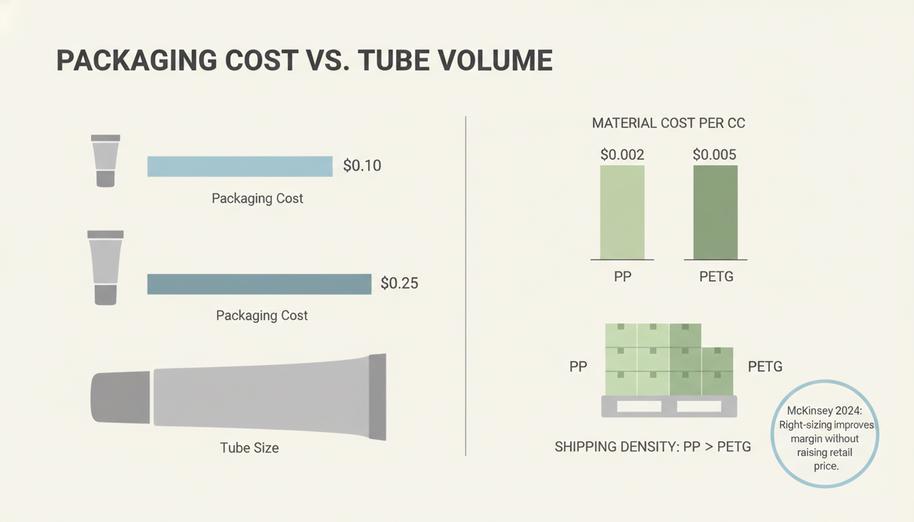
Adjusting lip balm tube volume aggressively impacts your Bill of Materials (BOM) and logistics margins.
Material Cost Analysis: PP vs. PETG Price per Cubic Centimeter
Comparing Polypropylene against PETG reveals steep cost scaling per cubic centimeter.
-
Raw material pricing
- Polypropylene: Lower density, highly cost-effective per gram.
- PETG: Premium optical clarity, but carries a 30-40% higher polymer cost.
Calculating material cost:
- Determine final wall thickness.
- Multiply by targeted tube volume.
- Factor in a 2-4% scrap rate from the manufacturing process.
Topfeel expertly balances material selection to protect margins while hitting target lip balm tube volume.
Tooling and Prototyping Expenses for Various Capacities
Altering capacity necessitates entirely new mold design, with custom injection cavities costing upwards of $10,000–$25,000.
-
Tooling adjustments include:
- Recutting core/cavity steel.
- Thread pitch calibration.
- Ejection pin realignment.
Injection molding impacts:
- Small lip balm tube volume: Faster cycle times.
- Medium lip balm tube volume: Requires thermal flow path adjustments.
- Large lip balm tube volume: Escalates P20 steel costs.
Rapid prototyping mitigates financial risk before committing to full production scale.
Decoration and Assembly Costs by Volume Tier
Larger barrels demand more consumable materials.
- Small lip balm tube volume: High-speed, single-pass printing.
- Mid-tier tube volume: Multi-stage labeling.
- Large lip balm tube volume: Extended UV finishing cycles.
Assembly friction points:
- Automated cap torquing.
- Inner cup snap-fit force.
Topfeel aligns packaging components with existing automation lines to prevent assembly bottlenecks.
Shipping Economics: Weight, Volume, and Bulk Order Savings
Logistical efficiency lives and dies by lip balm tube volume.
- Weight impact: Standard 4.25g tubes easily clear the USPS 1oz lightweight tier.
- Carton efficiency: Shorter bases increase unit-per-box density.
- Freight tiers: Optimized pallets reduce overall transportation spend.
Standard logistics routing:
- Automated tray packing.
- Master carton sealing.
- Palletizing for global distribution.
A fractional millimeter reduction in lip balm tube volume engineered by Topfeel can shave thousands off annual freight costs.
Stop guessing with your lip balm tube volume. Partner with Topfeel Packaging to guarantee predictable tooling costs, flawless filling compatibility, and perfectly scaled logistics. Request a quote from Topfeel Packaging today.
FAQs about Lip Balm Tube Volume
What is the standard lip balm tube volume in the cosmetic industry?
The universal benchmark is 4.25 g (≈ 3.5 ml / 0.15 oz / 3.5 cc).
- Optimized for standard Polypropylene (PP) twist-up formats.
- Requires no custom injection molding tooling.
- Ergonomically scaled for 50th percentile thumb profiles.
Why is 4.25 g considered the ideal fill weight?
It perfectly balances tooling costs, material shrink rates, and structural integrity. Wall thickness is kept thin enough to maximize internal capacity, but strong enough to withstand 75°C hot-pour filling without warping.
How do packaging materials affect lip balm tube volume?
Density directly alters available internal space:
| Packaging Material | Wall Thickness Impact | Net Capacity Effect |
|---|---|---|
| PP / PE | Thin (1.0mm) | Maximizes ml |
| PETG | Rigid, clear | Slight reduction |
| Aluminum | Requires inner sleeve | Lower internal cc |
| Bioplastic / PCR | Varying Melt Flow | Requires fill recalibration |
Which tube dimensions directly determine capacity?
Volume relies on exact geometry:
- Internal Diameter (avg. 15mm) × Z-Axis Height = Core Capacity.
- Base mechanism height subtracts usable space.
- Wall thickness consumes milliliter yield.
How do closure types influence effective volume and cost?
Closures dictate final clearance:
① Snap-on cap: Minimal headspace waste, lowest cost.
② Child-resistant cap: Adds 3-5mm total height, increases secondary packaging costs.
③ Screw-on cap: Demands higher tooling precision for thread alignment.
References
- specific gravity – en.wikipedia.org / Wikipedia
- Polypropylene (PP) – bpf.co.uk / British Plastics Federation
- FDA “pocket-sized” cosmetic expectations – fda.gov / U.S. Food and Drug Administration
- Ounce (oz) – nist.gov / National Institute of Standards and Technology
- Polyethylene (PE) – omnexus.specialchem.com / SpecialChem
- Post-consumer recycled (PCR) – pactcollective.org / Pact Collective
- sustainability – ellenmacarthurfoundation.org / Ellen MacArthur Foundation
- PETG – thomasnet.com / ThomasNet
- Aluminum – aluminum.org / The Aluminum Association
- Extrusion – sciencedirect.com / ScienceDirect
- Bill of Materials (BOM) – investopedia.com / Investopedia
- USPS 1oz lightweight tier – pe.usps.com / USPS

