 English
  Español de México
  Français
  Deutsch
  Português do Brasil
  Italiano
  한국어
한국어  ไทย
ไทย  Русский
  日本語
日本語  Polski
  Svenska
  Türkçe

How to Choose the Body Scrub Containers for Your Brand?
August 25,2026
Choosing body scrub containers at scale affects formula protection, shipping costs, and shelf appeal. Oily or gritty scrubs need a pack selected around the formula, closure, and intended use.
Smart buyers compare decoration, claims, samples, and quantities. For Great Britain, official cosmetics guidance identifies required container and packaging information.
Key Notes on Body Scrub Containers
→ Sustainable Materials : Compare glass, aluminum, plastics, and PCR content against the formula and disposal systems in each market.
→ Durability & Seal : Match caps and liners to the container finish, then test filled samples for leakage and repeated use.
→ Logistics & Decoration : Balance pack weight, carton protection, pallet layout, matte finishes, hot stamping, and color-matched labels around the sales channel.
 Why Sustainable Packaging Trends Elevate Body Scrub Containers
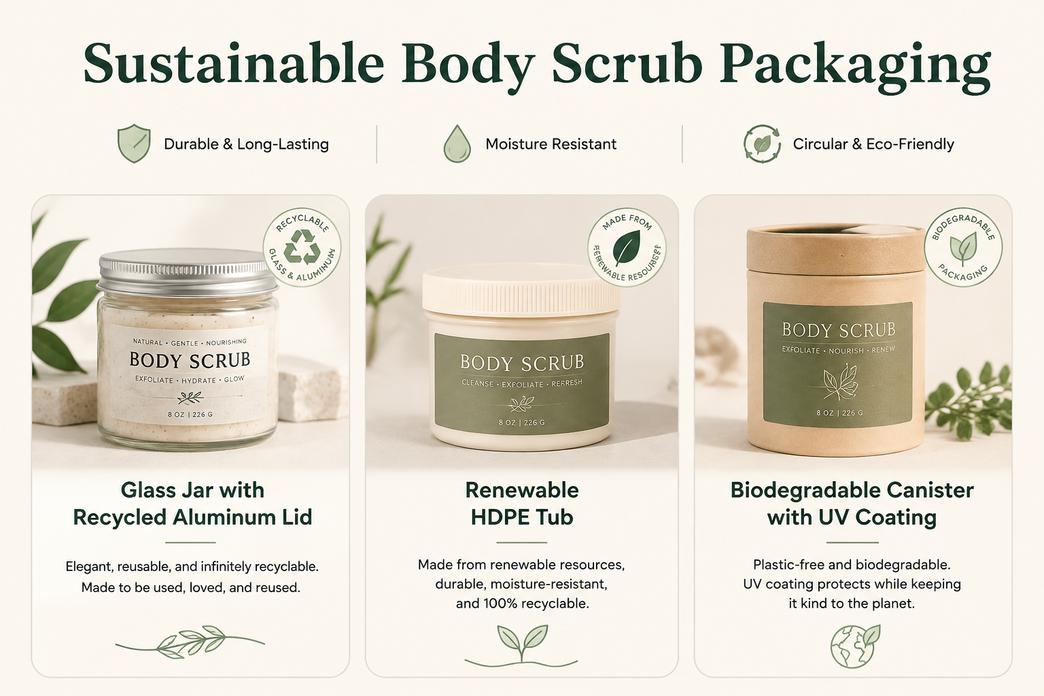
Sustainable packaging is reshaping material and decoration decisions for scrub containers. The FTC Green Guides address environmental marketing claims and their substantiation.
Embracing Glass Jars with Recycled Aluminum Lids
Glass jars paired with recycled aluminum lids can create a polished presentation when the complete pack suits the scrub.
- Packaging value
- Product preservation
- Glass, lid, liner, and decoration should be evaluated with the filled formula.
- Aesthetic appeal
- Printing, frosting, and color treatments support different brand directions.
- Product preservation
- Sustainability value
- Circular economy
- Reusable-pack and recycling outcomes depend on local collection; EPA packaging data provides context.
- Circular economy
Brands can review beauty packaging ideas before defining decoration and closure details.
High-Density Polyethylene Tubs from Renewable Sources
- Choose high-density polyethylene only after confirming the resin grade, any attributed feedstock claim, and the supplier documentation.
- Use durability and moisture resistance as test questions, not guarantees.
- Pair plastic tubs with a lightweight design , then compare filled-pack weight.
For brands balancing cost and material goals, a cosmetic packaging for small business guide can help organize early requirements.
Biodegradable Canisters Featuring UV Coating
Biodegradable canisters require careful wording because bio-based, biodegradable, and compostable describe different attributes. The EU policy framework outlines those distinctions.
- Surface performance
- UV coating is a Topfeel Makeup decoration option; the finished pack still needs wear evaluation.
- Added light protection should be assessed with the formula and storage conditions.
- Brand presentation
- Green packaging works best when claims name the material attribute and expected disposal route.
- Topfeelpack can coordinate structural design and surface decoration for a consistent finish.
3 Key Factors For Picking Containers
Choosing containers requires three connected decisions: material compatibility, user handling, and brand presentation.
Material Durability: From Polypropylene Pots to Glass Vials
Material choice affects the test plan and the customer experience.
- Plastic options
- Polypropylene can be considered for wide-mouth packs, but approval should follow filled-product compatibility and closure testing.
- PET plastic offers clarity and low weight, while acrylic jars create a heavier visual effect.
- Alternative formats
- Glass vials and jars need channel-appropriate drop evaluation.
- Aluminum tins may suit some concepts, though formula, liner, and decoration compatibility remain important.
Topfeel Makeup helps brands compare material options against formula and transport needs. Its beauty packaging guide offers structure and finish references.
User Experience: Dispensing Pumps vs. Flip-Top Lids
A closure should suit scrub viscosity, particle size, dose, and wet-hand use.
- Flip-top lids provide quick access when the hinge, orifice, and sealing surfaces suit the formula.
- Screw caps work naturally with wide-mouth jars and allow direct product access.
- Squeeze tubes can reduce repeated finger contact with the remaining product.
- Airless technology requires the formula and dispenser to be tested together; a tube-format guide shows one packaging route.
Good ergonomics and contamination controls matter when packs sit around a wet shower; the FDA microbiological-safety guidance adds product-safety context.
Brand Aesthetics: Matte Finish, Metallization, and Color Matching
Matte finish, metallization, and color matching can make scrub packaging recognizable. Custom labeling supports artwork, while embossing adds tactile branding. Transparency displays the formula; metallic decoration changes its shelf effect. Topfeel Makeup offers multiple decoration processes.
🎯 Align every decision: When picking containers, weigh material durability against dispensing behavior and color matching. Topfeel Makeup supports 3-day 3D prototyping, helping buyers review the complete pack before production.
🔍 Explore beauty packaging and face packaging formats to build one approval brief.
 Glass Vs. Plastic: Which Wins?
 Glass Vs. Plastic: Which Wins?
Material choice depends on formula and transport. A cosmetic-packaging review discusses compatibility and filling performance alongside material selection.
Glass Jars
Glass containers can create strong aesthetic appeal, and their heavy weight may contribute to a substantial in-hand feel.
- Packaging performance
- Formula protection
- Strong compatibility evidence should cover the oil, fragrance, colorant, and scrub particles.
- A closure and liner should be evaluated as part of the seal system.
- Brand presentation
- Frosted or clear glass offers different shelf effects and label requirements.
- Recyclability claims should reflect the decorated pack and local collection.
- Formula protection
- Practical trade-offs
- The fragile nature of glass makes secondary-pack protection and drop testing important.
- Extra weight can influence freight, so compare filled-pack configurations.
Plastic Tubs
Plastic containers provide lower weight and multiple options for shape, color, decoration, and closure geometry.
- Pick the resin around the formula. Screen candidate grades with the finished scrub.
- Consider daily use. A lightweight design may be easier to handle, but still needs drop testing.
- Balance budget and branding. Tooling, resin, decoration, quantity, and assembly all affect the commercial comparison.
Topfeel Makeup pairs scrub containers with closure, decoration, and resin options. Its container guide covers wide-mouth geometry, while small-brand packaging guidance frames order requirements.
Leaky Lids? Airtight Seals To The Rescue
 Leaky Lids? Airtight Seals To The Rescue
Leak control comes from the finish, closure, liner, torque, and formula working together.
Screw Cap Security with Induction Seal Backup
For parcel distribution, layered closure protection may be appropriate.
- Start with the screw cap.
- Correct application torque should be verified for the selected thread.
- A steady fit should be inspected after filling and storage.
- Add a compatible induction seal.
- Heat-seal foil and process settings must match the container rim.
- This approval plan should treat tamper evidence and leak resistance separately.
Pressure Sensitive Liner for Zero-Drip Performance
A pressure sensitive liner may suit some applications, but formula and channel conditions should determine its use.
- Check the opening and formula.
- Foam backing and adhesive need an even, clean sealing surface.
- Stable torque supports repeatable liner contact.
- Then test real storage conditions.
- Good testing covers upright, inverted, and side storage.
- A test record should cover leakage, liner movement, and opening behavior.
Flip-Top Lid Innovations and Sample Approval
A flip-top lid can support one-handed use, but convenience alone cannot approve the closure. The FDA overview of cosmetic product testing addresses safety substantiation, while EU cosmetics legislation requires a product safety report before market placement.
- Review the dispensing closure and hinged cap for opening force and clean access.
- Run sample testing for leakage, drops, and repeated opening.
- Use prototype evaluation with the actual scrub formula.
- Check orifice size and particle flow.
- Confirm hinge and sealing performance over repeated cycles.
- Assess user convenience before production.
🛡️ Test before scaling: Coordinate screw-cap and induction-seal checks, pressure-sensitive liner evaluation, and flip-top sample approval.
🧪 Topfeel Makeup uses leakage testing within its quality process. Review a wide-mouth jar to define filled-system checks for the screw cap, liner, and flip-top options.
E-Commerce: Lightweight, Shippable Scrub Containers
 E-Commerce: Lightweight, Shippable Scrub Containers
E-commerce adds parcel handling, variable orientation, and warehouse constraints. Compare the primary pack, carton, and identification as one system.
Polyethylene Terephthalate Bottles for Reduced Weight
PET can reduce pack weight relative to many glass formats, but geometry, closure, and filled-product testing still matter; a tube packaging guide provides another lightweight-format reference.
- Material benefits:
- A transparent finish can display the scrub when light exposure and appearance are acceptable.
- Good container durability evidence comes from a channel-matched test plan.
- Shipping benefits:
- Lower bottle weight can reduce shipment weight.
- A package’s dimensions also matter because carriers may apply dimensional-weight rules.
- Recyclability depends on components and local collection.
Compatibility testing still matters because oils and fragrance can affect packaging components.
Protective Partition and Shrink Wrapping Solutions
Containers can rub or shift inside a carton. Select distribution testing from relevant ISTA procedures or the ASTM D4169 framework, as appropriate.
- Fit corrugated dividers between jars or bottles when contact could damage decoration or glass.
- Add cushioning material where empty space permits movement.
- Use film wrapping only where it serves bundle stability or tamper evidence within the pack design.
Evaluate these controls with the finished product and shipping carton.
Optimized Pallet Configuration with Shipping Mark Guidelines
For larger shipments, use a repeatable stacking pattern and validate the unit load.
- Pallet setup:
- Keep carton weight distributed evenly within the approved stacking plan.
- Use pallet optimization to limit overhang and unnecessary empty space.
- Shipping identification:
- Apply scannable barcode labeling ; the GS1 Logistic Label Guideline provides a common framework.
- Add suitable handling symbols for warehouse and transport teams.
- Check carton dimensions and weight before calculating freight.
Careful loading and identification make shipments easier to receive and trace.
🚚 Ready for the channel?
📦 Start with PET weight. Then test carton partitions or wrapping before fixing the pallet-label plan. Functional samples are available from Topfeel Makeup; with a typical MOQ of 10,000 to 20,000 pieces, use the small-business packaging guide and discuss packaging formats with its customer service team.
References
- Green Guides — ftc.gov
- Containers and Packaging Data — epa.gov
- Biobased, Biodegradable and Compostable Plastics — europa.eu
- Microbiological Safety and Cosmetics — fda.gov
- Product Testing of Cosmetics — fda.gov
- EU Cosmetics Legislation — europa.eu
- Shipping Dimensions and Weight — ups.com
- ISTA Test Procedures — ista.org
- GS1 Logistic Label Guideline — gs1.org
- Making Cosmetic Products Available in Great Britain — gov.uk
- Cosmetic Packaging: European Regulatory Aspects and Sustainability — mdpi.com
- ASTM D4169 Shipping Container Performance Testing — astm.org

