 English
  Español de México
  Français
  Deutsch
  Português do Brasil
  Italiano
  한국어
한국어  ไทย
ไทย  Русский
  日本語
日本語  Polski
  Svenska
  Türkçe

Scale Your Brand: Top Wholesale Cosmetic Jars Suppliers for 2026
August 28,2026
Scaling a beauty brand requires suppliers to balance price, compatibility, decoration, documentation, and shipping.
Topfeelpack’s engineers emphasize product compatibility and production needs—not looks alone.
Compare MOQ, lead times, materials, QC evidence, and export readiness before requesting quotes.
Reading Notes: wholesale cosmetic jars suppliers
➔ Material & MOQ: Compare glass, PETG, acrylic, or composite options with order quantities and lead times.
➔ Cost & Compatibility: Review tooling, volume, formula compatibility, and decoration together.
➔ Compliance & Logistics: Check documentation and receiving requirements.
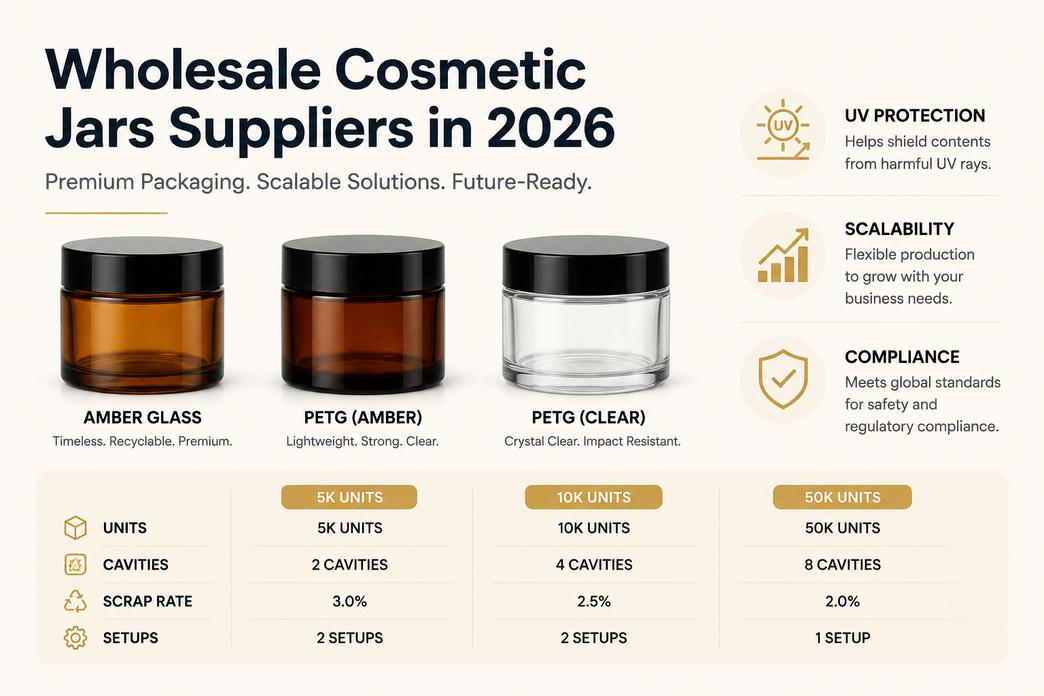 Why Wholesale Cosmetic Jars Suppliers Matter In 2026
In 2026, wholesale cosmetic jars suppliers must connect materials, manufacturing, controls, filling, and distribution.
Future-Proof Packaging with Amber Glass & PETG Polymer
Material choice starts with the formula, decoration, distribution route, and brand position.
- Glass route
- Amber glass can be evaluated for formulas with defined light-protection requirements.
- As the EPA’s glass material data shows, recovery depends on waste-management systems; local rules and shipping weight still matter.
- Polymer route
- PETG polymer offers a clear surface and shape and decoration options.
- For scalable cosmetic packaging, confirm resin grade, wall design, compatibility, and decoration on representative samples.
Driving Down Costs via Injection Molding Efficiency
Topfeelpack uses injection molding and supports multi-cavity production, so align tooling, volume, inspection, and change control before scale-up.
| Production factor | 5k units | 10k units | 50k units |
|---|---|---|---|
| Cavities | 2 | 4 | 8 |
| Runs | 2,500 | 2,500 | 6,250 |
| Scrap target (%) | 3.0 | 2.5 | 2.0 |
| Inspection sample (%) | 2.0 | 1.5 | 1.0 |
| Tool setups | 2 | 2 | 1 |
These are planning examples, not universal factory benchmarks.
- Refine mold design around the approved jar geometry.
- Raise manufacturing efficiency by matching tooling to realistic volume.
- Pursue cost reduction without weakening inspection or change control.
Topfeelpack can support cosmetic jar buyers seeking coordinated production through final inspection.
Trust and Compliance: FDA Compliant & SGS Certified Partners
Good pricing means little without paperwork.
- Verify FDA compliance claims against the applicable product and labeling responsibilities described in the FDA cosmetics labeling guide.
- Request material declarations and relevant records for formula-contact components.
- Check SGS certification or test reports carefully.
- Pair test evidence with a defined quality system; ISO 22716 covers cosmetic good manufacturing practice guidance.
- Judge supplier reliability against the market, formula, filling line, and distribution plan.
For brands comparing suppliers, documented controls make purchasing less of a gamble; review small-business packaging with the same discipline.
🧭 Scale with fewer surprises: Coordinate material and packaging, injection-molding economics, and compliance before approving a jar. Topfeelpack’s integrated production workflow turns those connected decisions into one reviewable path for scale-up.
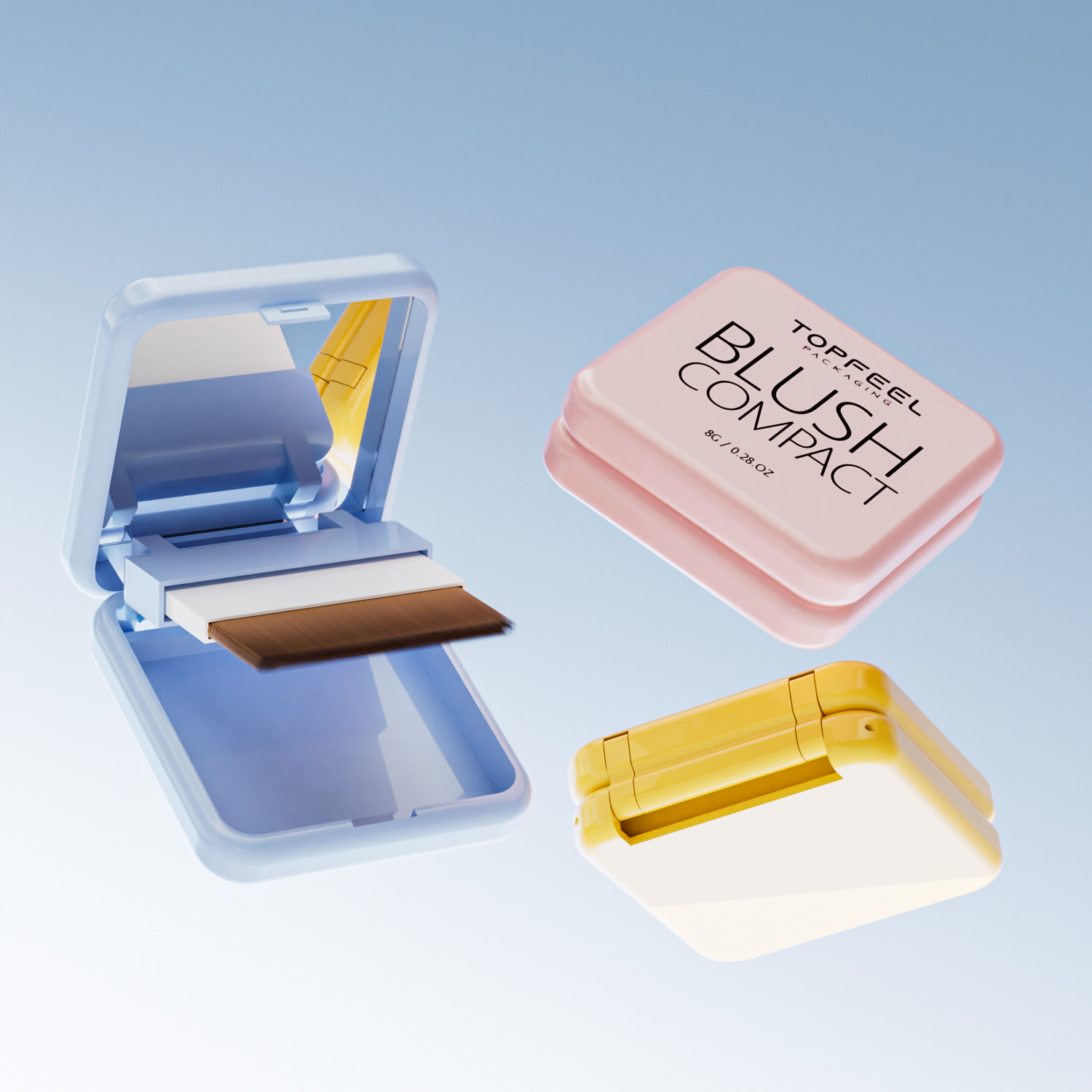
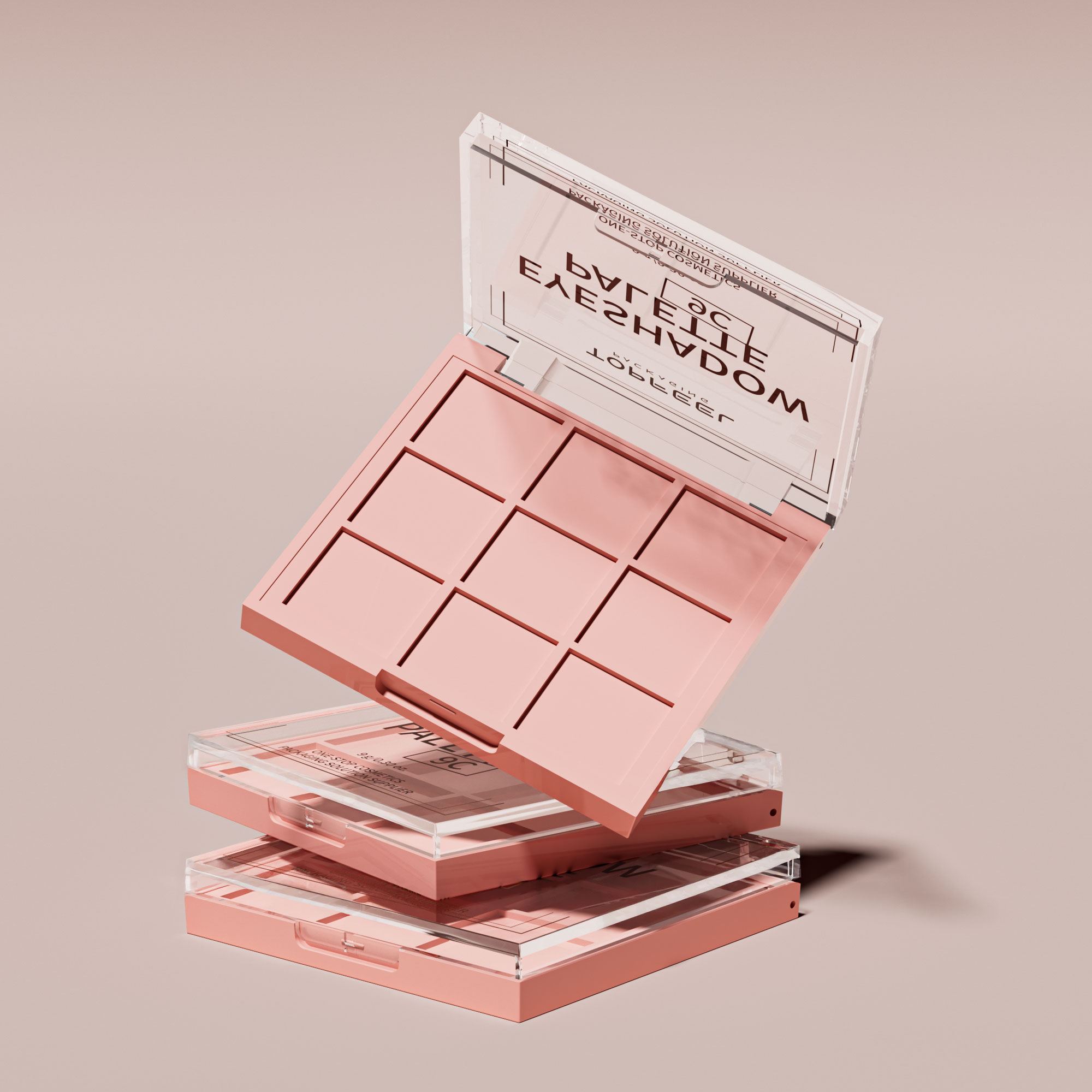
Explore the loose powder jar and face packaging range to compare routes against your formula and volume brief.
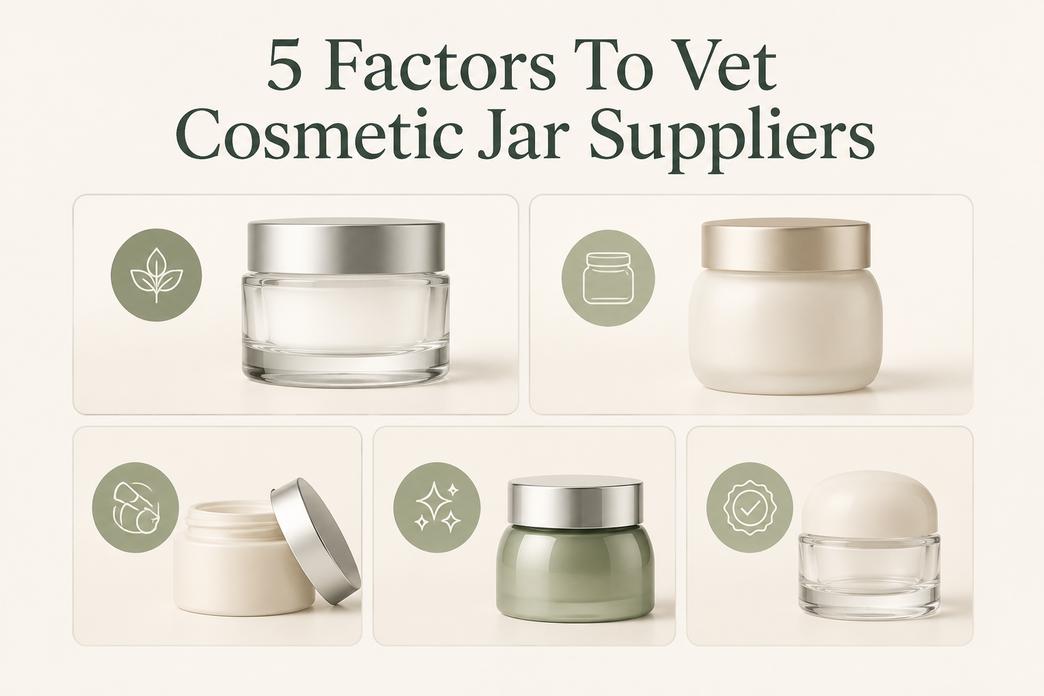 5 Factors To Vet Cosmetic Jar Suppliers
Finding reliable suppliers takes more than comparing unit prices. Buyers need packaging that fits the formula, runs during filling, supports a consistent brand presentation, and arrives with usable documentation.
Factor 1 – Material Selection: Acrylic Plastic vs. Bamboo Composite
Start with the formula and brand position.
- Acrylic polymer
- Offers glass-like clarity and varied decoration options.
- Check thermal stability and the moisture barrier against the actual cream or balm.
- Bamboo composite
- Creates a natural visual direction for eco-friendly packaging.
- Ask what the composite contains; bamboo content alone does not establish biodegradability or recyclability.
Factor 2 – Jar Shapes: Straight Sided, Thick Wall, Low Profile
Straight sided jars provide label space, thick wall designs add visual weight, and low profile formats can suit balms and masks.
Match capacity volume to fill weight, then check stackability, line handling, and the container format.
Factor 3 – Closure Styles and Performance Testing
For wholesale cosmetic jars suppliers, a good-looking lid still has to perform throughout filling, shipping, storage, and consumer use.
- Match the cap’s thread finish to the jar.
- Run torque testing with an agreed method; ASTM D2063/D2063M addresses torque retention for continuous-thread closures.
- Test leak resistance with the intended formula and distribution conditions.
- Evaluate special closures.
- An induction seal requires compatible components and a validated sealing process.
- A dropper cap or child-resistant closure needs application-specific evaluation.
- Use vacuum pressure checks where the agreed leakage-risk assessment calls for them.
Factor 4 – Surface Finishes from Frosted Texture to Hot Stamping Foil
Decoration can turn a basic jar into retail-ready cosmetic packaging. Frosted texture and a matte finish create a restrained look, while hot stamping foil adds metallic detail.
For graphics, compare silk screen printing, UV coating, and embossing. With electroplating, confirm adhesion, color tolerance, MOQ, and samples through a packaging design direction.
Factor 5 – Quality Certifications and MSDS Documentation
Documentation helps buyers compare supplier controls.
- Verify ISO certification and relevant GMP standards.
- Request current certificates covering the facility and activity assessed.
- Review FDA compliance claims for the intended market.
- Keep applicable safety data with material records; OSHA’s Hazard Communication guidance explains standardized safety data sheets for hazardous chemicals.
- Confirm batch traceability and the supplier’s quality assurance process.
- A third-party inspection can add a shipment checkpoint when required.
✅ Vet five supplier factors: Combine material, shape, closure, finish, and quality documentation.
Topfeelpack’s usual MOQ is 10,000 to 20,000 pieces, depending on product complexity. Review a powder compact format to prepare dimensions, tolerances, test conditions, records, and sample sign-offs before approval.
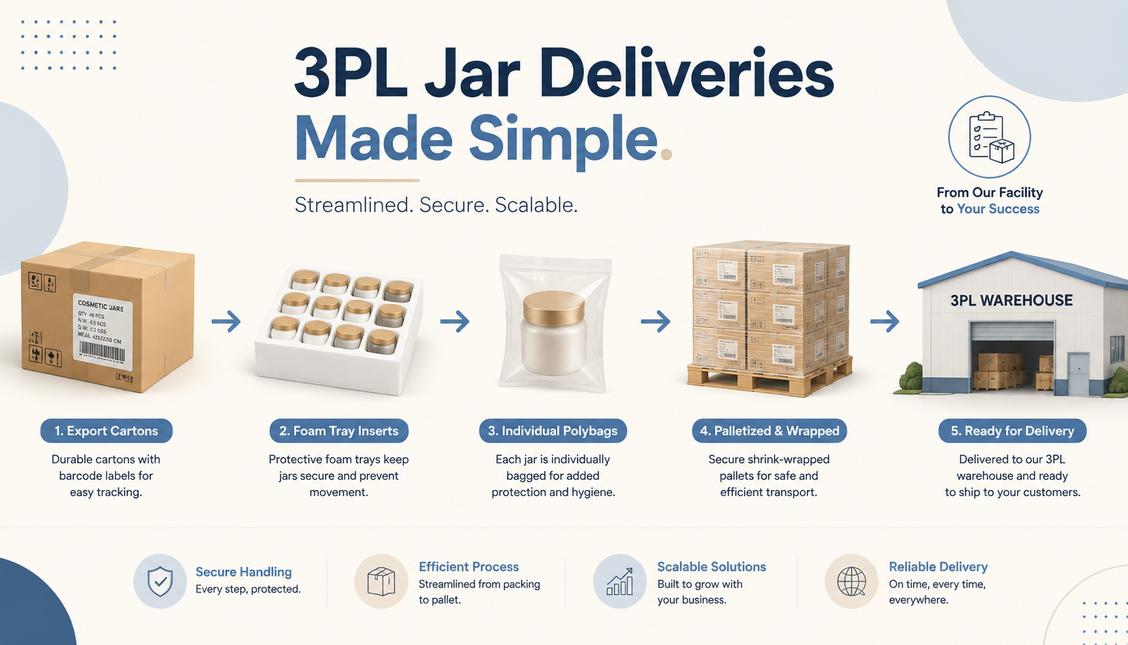 How 3PL Partnerships Streamline Jar Deliveries
Good packing makes 3PL handoffs easier. Confirm pack quantities, labels, protection, pallet rules, and receiving requirements before packing.
Optimizing Inventory Flow with Export Carton Packaging
A consistent export carton setup helps warehouses receive stock.
- Carton-level control
- Strong corrugated boxes protect jars while creating repeatable case quantities.
- Each master carton can carry barcode labeling; the GS1 logistic label guideline covers pallet and logistics-unit identification.
- 3PL benefits
- Predictable dimensions simplify stacking and container planning.
- Better counts support supply chain efficiency when brands serve several markets.
Protective Foam Trays and Individual Polybags for Safe Transit
For decorated jars, protection should match finish sensitivity and distribution risk.
- Jar-level protection
- polybags can reduce rubbing, fingerprints, and scratches on finished cosmetic jar packaging.
- protective foam can separate fragile or highly decorated units.
- Shipment-level protection
- Added protection can be assessed through trial packs and expected handling.
- This layered approach supports damage prevention before the final packing specification is released.
Scalability and Speed: Wooden Pallets & Shrink Wrap Solutions
Bulk orders need packing that warehouse crews can handle with available equipment.
- Faster handling
- wooden pallets used in international trade may need treatment and marking under ISPM 15.
- shrink wrap can stabilize cartons when its application matches the load pattern.
- Easier growth
- Standard pallet footprints can simplify warehouse handling.
- Faster transfers support logistics speed as order volume grows.
For growing beauty businesses, define the pallet, carton, labeling, and receiving plan before shipment.
🚚 Make handoffs warehouse-ready: Align export cartons, protective foam or polybags, pallets, shrink wrap, and receiving labels.
Topfeelpack’s workflow includes a dedicated packing and shipping stage. Review a 10g compact format to document dimensions and pack assumptions, then ask the service team to evaluate samples and your 3PL receiving brief.
References
- Glass: Material-Specific Data — epa.gov
- Cosmetics Labeling Guide — fda.gov
- ISO 22716:2007 — iso.org
- ASTM D2063/D2063M — astm.org
- Hazard Communication — osha.gov
- ISPM 15 — ippc.int
- GS1 Logistic Label Guideline — gs1.org

