 English
  Español de México
  Français
  Deutsch
  Português do Brasil
  Italiano
  한국어
한국어  ไทย
ไทย  Русский
  日本語
日本語  Polski
  Svenska
  Türkçe



Why Packaging Compatibility Testing Is Essential for Product Safety
May 06,2026
Packaging compatibility testing is the quiet hero between your formula and a five-alarm product recall, and skipping it is like playing with matches in a perfume aisle.
One bad reaction can spark leaks, lawsuits, and late-night panic from your biggest buyers when orders hit scale fast.
Why Packaging Compatibility Testing Prevents Product Recalls
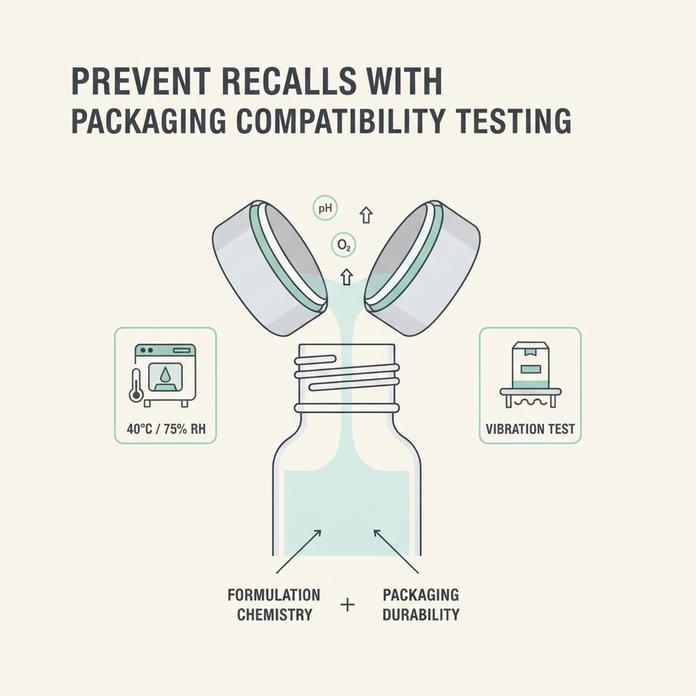
A single leak can wreck years of brand trust. That’s why packaging compatibility testing matters so much. When formulation chemistry meets container materials, small chemical reactions can spiral into recalls. Smart packaging testing, material compatibility checks, and real-world stress validation keep products safe, stable, and ready for shelf life without nasty surprises.
Understanding Leak-Induced Recalls: Chemistry Meets Closure
Effective packaging compatibility testing starts with the connection between formula and container closure. Leaks rarely “just happen.” They usually trace back to chemical interaction and overlooked material compatibility risks.
-
Core Risk Factors
- Seal failure caused by liner swelling
- Volatile ingredients weakening caps
- Pressure shifts compromising product integrity
-
Chemistry-Level Interactions
- Acidic pH softens elastomer liners
- Essential oils extract plasticizers
- Alcohol systems increase vapor pressure, driving leakage
-
Closure Performance Breakdown
- Liner compression loss
- Micro-channel formation
- Torque relaxation over time
A practical approach to packaging compatibility testing includes:
- Matching formulation pH with liner resistance charts
- Measuring torque retention under accelerated aging
- Running inverted storage tests to confirm recall prevention
When brands skip compatibility testing, seal fatigue creeps in quietly. At Topfeel, packaging and formula teams align early, reducing seal failure before production even starts. That early alignment strengthens product integrity and keeps recall headlines away.
How Material Degradation Spurs Regulatory Alerts
Material breakdown isn’t always dramatic. Sometimes it’s a faint odor, a slight yellow tint, or minor wall softening. Regulators notice.
Packaging compatibility testing evaluates how formulas trigger degradation mechanisms inside bottles, pumps, and tubes.
-
Primary Degradation Triggers
- Oxidation of barrier layers
- Solvent stress cracking
- Surfactant-driven polymer swelling
-
Regulatory Impact Chain
- Visual defects → complaints
- Stability drift → failed product stability data
- Documentation gaps → regulatory compliance audits
Nested analysis during packaging testing often follows:
-
Physical Integrity Checks
- Wall thickness variation
- Drop resistance
- Packaging integrity under load
-
Chemical Stability Screening
- Extractables and leachables review
- Headspace oxygen measurement
- Shelf-life projections tied to safety standards
If material breakdown compromises shelf life, alerts can escalate quickly. Ongoing packaging compatibility testing verifies that barrier systems resist permeation and maintain chemical resistance throughout storage.
Stress Testing Scenarios That Foresee Packaging Failures
Real life is rough. Trucks shake. Warehouses heat up. Online orders bounce around. That’s why packaging compatibility testing must simulate actual environmental conditions.
Testing layers typically include:
-
Environmental Stress
- 40°C / 75% RH chambers
- Freeze–thaw cycling
- UV exposure
-
Mechanical Stress
- Vibration platforms
- Repeated pump actuation
- Compression stacking
Failure analysis connects data to root causes:
- Detect leakage points under vibration
- Identify pump clogging due to viscosity shifts
- Evaluate deformation under sustained load
Inside advanced packaging testing labs, engineers build predictive models:
-
Data Capture
- Torque decay curves
- Permeation rates
- Weight loss over time
-
Modeling
- Shelf-life simulation
- Transit risk scoring
- Quality control thresholds
This style of packaging compatibility testing strengthens packaging performance before launch. It turns stress tests into actionable failure analysis, not guesswork. Brands that integrate predictive modeling into compatibility testing often catch micro-cracks and permeation risks long before consumers do.
Aligning Formulation pH and Barrier Properties for Recall Prevention
At the heart of packaging compatibility testing sits one big truth: formulation chemistry and packaging design must speak the same language.
Misaligned pH and weak barrier materials can lead to:
- Oxygen ingress
- Preservative breakdown
- Active ingredient degradation
Alignment typically unfolds in layers:
-
Formulation Review
- Measure pH compatibility with polymer charts
- Map solvent polarity
- Confirm preservative system tolerance
-
Material Screening
- Compare chemical resistance data
- Evaluate multilayer permeation values
- Validate sealing surface interaction
-
Stability Confirmation
- Accelerated aging
- Real-time storage
- Ongoing product stability tracking
Smart packaging compatibility testing balances permeation control and mechanical durability. It ensures oxygen transmission rates stay low enough to protect antioxidants, while seals maintain compression strength.
Compatibility testing also checks how micro-level permeation affects preservative systems over time. Small oxygen gains can quietly reduce efficacy, threatening product stability and triggering recalls.
By embedding packaging compatibility testing early in development, brands transform recall prevention into daily practice. Good packaging testing isn’t just lab work. It’s long-term recall prevention, built on chemistry, data, and disciplined material compatibility review.
Packaging Materials vs. Formulation: Compatibility Explained
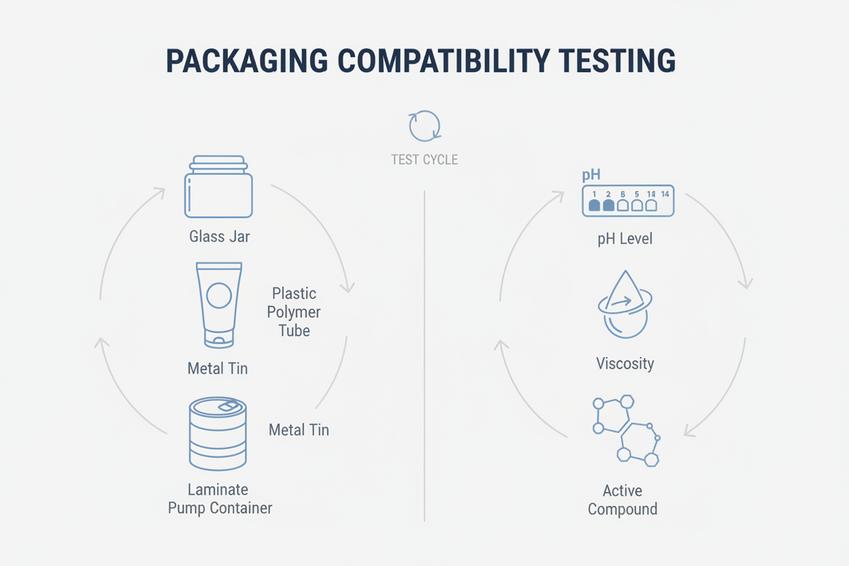
Packaging and formula have to get along, or things go sideways fast. This is where packaging compatibility testing steps in—checking how materials and ingredients behave over time. From Glass jars to Polymer tubes, every Container meets a chemical story inside.
Packaging Materials
When running packaging compatibility testing, material choice drives the outcome.
-
Material Type
-
Glass
- High chemical resistance
- Low moisture vapor transmission rate
- Ideal for volatile Active compounds
-
- Flexible Polymer structures
- Risk of solvent absorption
- Needs barrier property validation
-
Metal
- Strong oxygen barrier
- Possible reaction with low pH formulas
-
Laminate
- Layered barrier properties
- Often paired with pump Closure systems
-
-
Performance Factors
- Barrier properties against oxygen and light
- Surface finish interaction with Solvents
- Seal integrity between Container and Closure
-
Testing Focus
- Migration studies
- Stress under temperature swings
- Long-term packaging compatibility testing cycles
At Topfeel, packaging compatibility testing is built into development, not slapped on later. Material screening, accelerated aging, and compatibility analysis keep surprises off the shelf. It’s practical science, not guesswork.
Formulation
Formulas bring their own drama into packaging compatibility testing.
-
Core Composition
- Ingredients and Excipients define baseline chemistry
- Active compounds may react with Plastic or Metal
- Preservatives shift stability profiles
-
Physical Properties
-
Viscosity
- Impacts pump flow
- Affects air exposure
-
pH
- Low levels stress certain Polymer resins
-
Stability
- Emulsion breakdown can attack internal liners
-
-
Interaction Path
- Assess formula risk points
- Match with candidate Container materials
- Conduct packaging compatibility testing
- Review data and adjust either formula or packaging
Strong packaging compatibility testing connects Formulation science with real-world storage. Topfeel supports brands through packaging testing, compatibility testing, and full packaging compatibility testing validation, making sure the formula and its home stay on good terms.
5 Steps to Conduct Packaging Compatibility Testing
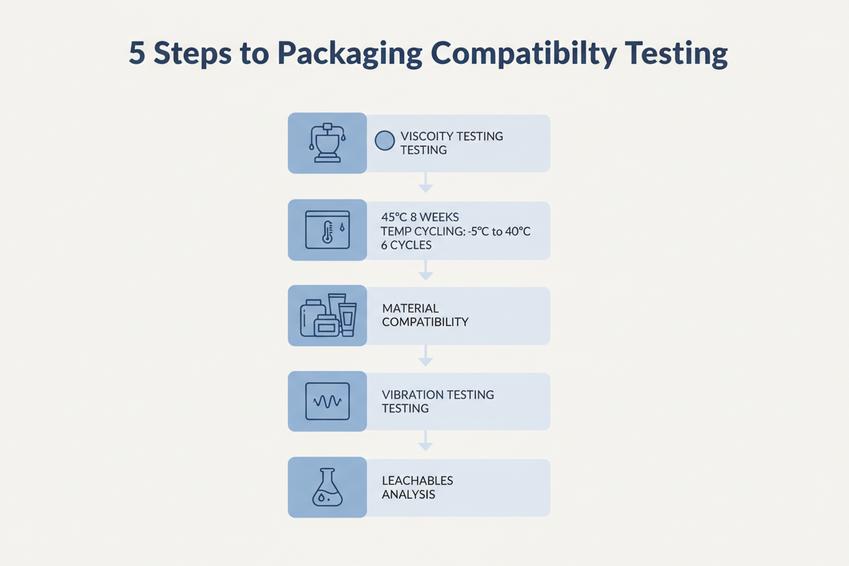
Smart brands know packaging compatibility testing is not just lab work—it’s brand protection. From viscosity issues to chemical transfer, small oversights can wreck product stability and customer trust. By breaking down packaging, compatibility, and testing into clear checks, teams reduce risk early. Here’s how practical packaging compatibility testing keeps cosmetic launches smooth and stress‑free.
Step 1: Assess Cosmetic Viscosity and Surface Finish Interactions
Effective packaging compatibility testing starts with how a cosmetic product physically behaves inside its container.
-
Viscosity vs. Dispensing System
-
High viscosity creams in narrow pumps
- Risk: clogging and uneven flow
- Impact: compromised sensory properties
-
Low-viscosity serums in wide nozzles
- Risk: leakage and overdosing
-
-
Surface Finish & Packaging Interaction
-
Rough internal surface finish
- ↑ friction
- Potential formula drag
-
Smooth coating
- Better glide
- Improved product stability
-
-
Material Compatibility Checks
- Polymer–oil interaction
- Pigment adherence to walls
- Stress cracking over time
This early compatibility testing prevents performance complaints before scale-up.
Step 2: Perform Accelerated Aging for Thermal Stability Insights
Heat and humidity testing simulates long-term storage in weeks. It reveals cracks in thermal stability, discoloration, and weakened packaging integrity.
| Test Condition | Temperature (°C) | Duration (Weeks) | Observed Risk Level |
|---|---|---|---|
| Elevated Heat | 45 | 8 | Medium degradation |
| Freeze-Thaw | -5 to 40 cycles | 6 cycles | Seal stress |
| High Humidity | 40 / 75% RH | 12 | Label lifting |
Under temperature stress, oils may separate and plastics may warp. Strong environmental testing improves predicted shelf life and supports reliable packaging compatibility testing data. Many manufacturers, including Topfeel, integrate this into routine package testing programs to catch product degradation early.
Step 3: Execute Migration Studies on Jar and Tube Materials
Chemical safety drives serious packaging compatibility testing.
-
Jar Materials
-
Glass
- Low chemical transfer risk
- Stable with acids
-
PET
- Lightweight
- Possible fragrance absorption
-
-
Tube Materials
-
PE multilayer
- Barrier enhancement
- Reduced oxygen ingress
-
Aluminum laminate
- High protection
- Dent sensitivity
-
-
Testing Protocol
- Store filled samples
- Monitor product contamination markers
- Compare control vs. aged batches
Careful review of packaging components protects material safety and keeps compliance teams calm.
Step 4: Validate Seal Integrity Under Transportation Vibration
Shipping is rough. Real-world transportation simulation ensures closures survive it.
-
Seal Integrity Evaluation
- Torque measurement
- Liner compression check
- Cap-thread alignment
-
Vibration Testing
- Random vibration cycles
- Drop impact review
- Post-test leakage scan
-
Mechanical Stress Review
- Pump spring fatigue
- Cracked collars
- Compromised product protection
Strong packaging performance means fewer returns and better leakage prevention. That’s a core goal of compatibility testing and shipping validation.
Step 5: Review Leachables and Extractables per FDA Compliance
Chemical analysis ties everything together. Leachables and extractables testing confirms that packaging materials don’t release harmful compounds into formulas. Labs evaluate trace compounds, then align findings with FDA compliance, global regulatory standards, and toxicology thresholds.
A practical flow often looks like this:
- Identify high-risk packaging materials
- Conduct solvent-based extractable screening
- Perform finished-product leachable studies
- Assess toxicology exposure margins
Clear documentation supports product safety and protects brand reputation. Topfeel integrates compatibility testing, regulatory review, and material screening into a streamlined development path—helping brands launch with confidence while keeping packaging compatibility testing front and center.
Packaging Compatibility Testing in Real-World Scenarios
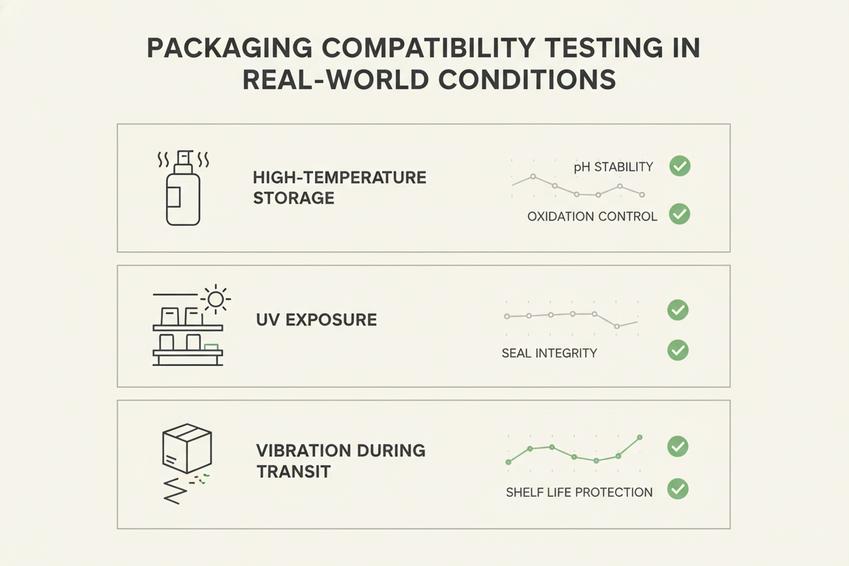
Real life is messy. Heat, light, and constant shaking all test a product’s limits. That’s why packaging compatibility testing matters beyond the lab. True packaging testing checks how formula and pack behave together, protecting shelf appeal, safety, and long-term performance.
High-Temperature Storage: pH Stability and Material Integrity
Effective packaging compatibility testing under heat focuses on how temperature and harsh storage conditions push both formula and container.
-
Formula impact
- Monitor shifts in pH level that signal chemical interaction.
- Track product stability when emulsions thin or separate.
- Assess accelerated material degradation affecting actives.
-
Packaging response
- Check warping that weakens packaging integrity.
- Inspect inner walls for swelling tied to material degradation.
- Evaluate closure stress that shortens shelf life.
-
Integrated validation
- Cross-test formula and resin types.
- Repeat packaging compatibility testing at incremental heat ranges.
- Confirm cosmetic packaging compatibility before scale-up.
Topfeel runs high-temp packaging tests that simulate warehouse spikes, helping brands avoid costly recalls and extend shelf life.
UV Exposure in Retail Displays: Fragrance Compatibility Checks
Retail shelves mean constant UV radiation and strong light exposure. In real retail environment settings, packaging compatibility testing looks at:
- Color shifts from oxidation and product degradation
- Fading tied to weak fragrance stability
- Surface haze and packaging discoloration
- Place filled units under controlled UV.
- Compare scent profile for subtle color change and aroma drift.
- Re-check barrier layers for long-term fragrance stability.
Short bursts. Long exposure. Repeat cycles. That’s how serious packaging testing proves true packaging compatibility. Topfeel fine-tunes resin blends to reduce packaging discoloration without muting fragrance notes.
Vibration During Transit: Preventing Pump Clogging and Leakage
Shipping adds transportation risks that basic packaging testing can miss.
-
Mechanical assessment
- Simulate vibration stress and sudden mechanical shock.
- Monitor pump function after repeated impact.
- Detect early signs of packaging failure.
-
Seal performance
- Inspect seal integrity under tilt and drop.
- Measure micro product leakage around closures.
- Confirm smooth dispensing mechanism flow.
Repeated packaging compatibility testing ensures pumps stay clear, seals stay tight, and cosmetic packaging compatibility holds from factory line to customer vanity.
Costly Leaks? Packaging Compatibility Testing to the Rescue
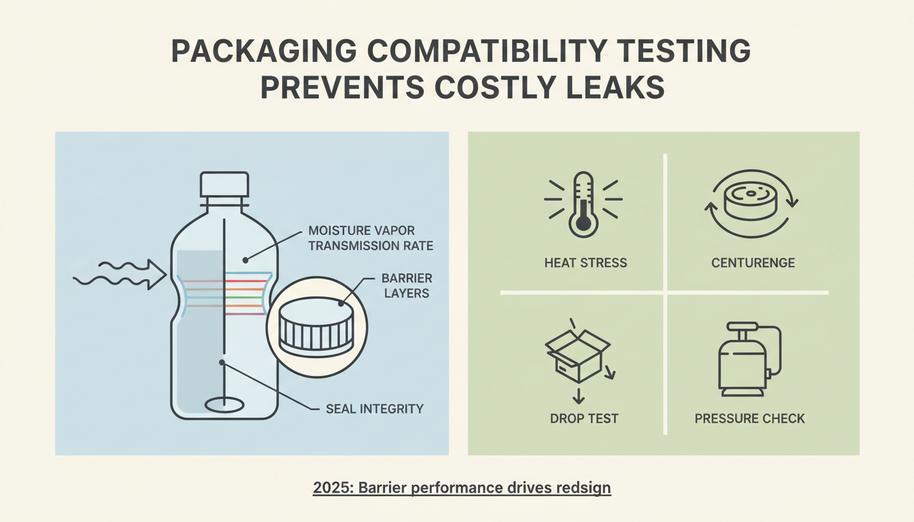
Leaks, sweating bottles, weird smells—yeah, it happens. That’s why packaging compatibility testing matters long before products hit the shelf. By breaking it down into packaging, compatibility, and testing, brands can spot trouble early. Smart packaging compatibility testing protects formulas, keeps customers happy, and saves serious cash in the long run.
Stop Leakage with Moisture Vapor Transmission Rate Analysis
Strong packaging compatibility testing starts with understanding moisture, vapor, and permeation risks.
-
Core focus: moisture vapor transmission rate analysis
- Evaluates barrier strength of packaging materials
- Detects early leakage linked to high transmission rate
- Measures analysis data under humidity stress
-
Material review within compatibility testing
-
Primary pack
- Bottle wall thickness
- Tube layering
-
Secondary components
- Seams
- Crimps
-
-
Risk outcomes in packaging compatibility
- Evaporation
- Oxidation
- Formula shrinkage
Topfeel runs layered packaging compatibility testing protocols so brands see real-world results, not lab-only numbers. In 2025, Smithers noted that barrier performance remains a top driver of packaging redesign in personal care, as brands chase longer shelf stability and fewer returns.
When moisture vapor transmission rate is under control, leakage complaints drop. It’s that simple.
Prevent Ingredient Degradation Through Emulsion Stability Tests
A clean formula can still fail if ingredient balance breaks down. That’s where packaging compatibility testing meets emulsion science.
Here’s what smart stability testing looks at:
- Separation under heat
- Color shifts
- Odor change
- Stress cycles (heat–cool swings)
- Centrifuge checks
- Shelf observation over time
★ Watch preservative performance closely.
Short take: degradation kills trust.
Another short truth: shelf life depends on both formulation and container.
“Stability testing remains a critical control point for cosmetic quality and regulatory compliance in global markets,” noted a 2025 Cosmetics Europe industry update.
Through consistent packaging compatibility testing, brands confirm that actives stay potent and formulation structure holds. Topfeel supports this with real-time compatibility screening, reducing late-stage surprises. Good packaging testing isn’t fancy—it’s protective.
Seal Integrity Testing: From Bottle Closures to Liners
Even the best packaging compatibility testing can’t save a weak seal.
-
Closure system review
- Bottle neck finish
- Cap torque alignment
- Liner compression fit
-
Mechanical validation
- Drop simulation
- Internal pressure check
- Oxygen exposure scan
-
Defect tracing in compatibility testing
- Microscopic crack detection
- Warped closure threads
- Liner displacement
Seal integrity links directly to packaging performance. A tiny defect can trigger slow leakage, air entry, and product spoilage.
With structured packaging compatibility testing, including vacuum and pressure validation, Topfeel ensures closure systems match formula behavior. That’s the real rescue plan—tight seals, stable formulas, and zero nasty surprises.
Packaging Compatibility Testing Cuts Liability by 45%
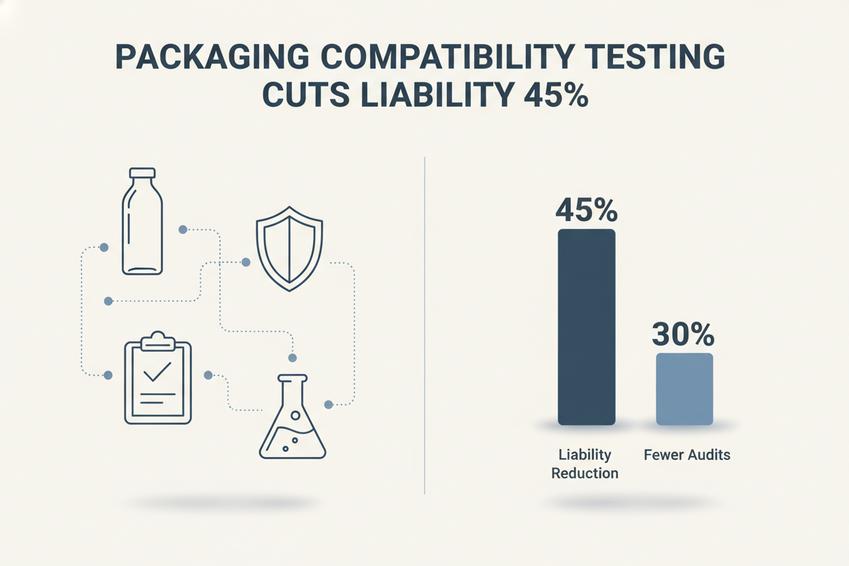
Smart brands don’t leave product safety to luck. Packaging compatibility testing—breaking it down into packaging, compatibility, and testing—checks how materials and formulas behave together over time. Done right, it reduces claims, protects product safety, and keeps your risk profile clean without drama.
Real-Time Stability Testing Delivers Quantifiable Risk Reduction
When real-time stability testing is built into your packaging compatibility testing plan, measurable risk reduction follows.
-
Core Focus Areas
-
Material Interaction
- Chemical migration between container and formula
- Impact on product color, odor, and texture
-
Environmental Stress
- Heat and humidity exposure
- Light sensitivity affecting safety and shelf life
-
Data Integrity
- Continuous data logging
- Documented failure thresholds
-
-
Execution Framework
- Define storage conditions tied to target markets
- Run packaging compatibility and stability testing in parallel
- Record deviations tied to consumer-use simulations
-
Outcome Control
- Fewer leakage incidents
- Lower recall probability
- Clear documentation trail for insurers
Topfeel applies layered packaging compatibility testing protocols so that compatibility testing isn’t a checkbox—it’s proof. Over time, stability and testing data support insurance negotiations and reduce liability exposure in a very real way.
GMP Guidelines Driving 30% Fewer Quality Audits
Strong GMP alignment reshapes how packaging compatibility testing supports quality and audit outcomes.
-
Compliance Structure
-
Manufacturing Controls
- Validated filling lines
- Documented cleaning cycles
-
Material Governance
- Approved supplier lists
- Change-control procedures
-
Regulatory Alignment
- Local regulation mapping
- Internal standards harmonization
-
-
Audit Reduction Logic
- Fewer deviations during compatibility testing
- Better traceability of packaging materials
- Consistent batch-level documentation
When packaging compatibility testing sits inside a GMP framework, audits shift from reactive firefighting to routine confirmation. That’s how brands avoid repeat findings. Topfeel integrates compatibility testing with manufacturing compliance so quality conversations stay calm, not chaotic.
ISO Standards Compliance Minimizes Product Liability Cases
Clear ISO alignment strengthens packaging compatibility testing and lowers product liability exposure.
-
Standards Integration
-
ISO Documentation
- Risk assessment files
- Corrective action records
-
Validation Protocols
- Compatibility and stability validation
- Performance verification of packaging systems
-
-
Legal Shielding
- Structured compliance evidence
- Alignment with international regulations
- Demonstrable commitment to safety
-
Case Prevention Path
- Early detection of incompatibility
- Prevented degradation affecting product claims
- Reduced dispute escalation
Compatibility testing, when tied to ISO standards, creates defensible proof. Packaging compatibility testing is no longer optional—it becomes a liability firewall. Topfeel builds packaging compatibility testing into ISO-driven workflows so brands can move forward with confidence instead of bracing for the next claim.
FAQs about Packaging Compatibility Testing
Why is packaging compatibility testing essential before bulk cosmetic production?
When a formula meets its bottle, small reactions can turn dramatic.
- A mismatch in pH level, active ingredients, or volatile compounds may weaken chemical resistance and trigger material degradation.
- Poor barrier properties increase oxygen exposure, leading to product discoloration or ingredient degradation.
- Weak structural integrity in a bottle, jar, or tube can result in packaging deformation and leakage during shipping.
Through accelerated aging, migration studies, and leachables and extractables analysis, brands verify safety before mass production—meeting ISO standards, GMP guidelines, and FDA compliance requirements with documented validation protocols.
How do formulation properties affect pump and closure performance?
Dispensing failure often begins with overlooked formulation details.
- High product viscosity strains the pump mechanism, increasing the risk of pump clogging.
- Extreme pH levels can corrode a closure or damage a liner, reducing seal strength.
- Poor fragrance compatibility may cause odor transfer inside the applicator system.
Targeted stress testing and seal integrity testing simulate daily consumer use. When surface finish tolerance and thermal stability are validated, each press of the pump feels consistent—even after long storage conditions.
Which environmental stressors create the greatest compatibility risks?
Cosmetic packaging lives a hard life before reaching the shelf.
- Temperature fluctuations challenge expansion and contraction limits.
- Humidity affects the moisture vapor transmission rate, threatening emulsion stability and preservative efficacy.
- UV exposure accelerates formula breakdown and weakens clear bottles.
- Transportation vibration exposes hidden seal failures.
Brands combine drop testing, real-time stability testing, and environmental chambers to confirm that structural integrity survives real-world handling without leakage or delamination.
What tests should be prioritized for sensitive or high-value formulations?
For premium serums or active-rich creams, caution is strategy.
| Priority Test | Purpose | Risk Prevented |
|---|---|---|
| Accelerated aging | Evaluate thermal stability | Discoloration, degradation |
| Migration studies | Detect formula–package interaction | Ingredient absorption, contamination |
| Seal integrity testing | Confirm closure performance | Leakage, oxygen exposure |
| Leachables and extractables | Assess chemical safety | Regulatory non-compliance |
These procedures, aligned with REACH regulations, supported by a clear material safety data sheet, and verified through strict quality control, protect both brand reputation and consumer trust.
References
- Packaging Testing – Smithers
- Cosmetics Guidance & Regulation – FDA
- Extractables and Leachables Testing – Intertek
- Standard Practice for Conditioning Containers, Packages, or Packaging Components for Testing – ASTM International
- Plastics Industry News & Trends – PlasticsToday
- Cosmetics Business News – Cosmetics Business
- Standard Practice for Performance Testing of Shipping Containers and Systems – ASTM International
- Cosmetics Packaging Testing – SGS
- Packaging Market Reports – Smithers
- The Personal Care Association – Cosmetics Europe
- Good Manufacturing Practice (GMP) Resources – ISPE
- International Organization for Standardization – ISO
- Understanding REACH – European Chemicals Agency
- Hazard Communication – Safety Data Sheets – OSHA

