 English
  Español de México
  Français
  Deutsch
  Português do Brasil
  Italiano
  한국어
한국어  ไทย
ไทย  Русский
  日本語
日本語  Polski
  Svenska
  Türkçe

How to Find Reliable Lip Gloss Squeeze Tube Containers?
August 13,2026
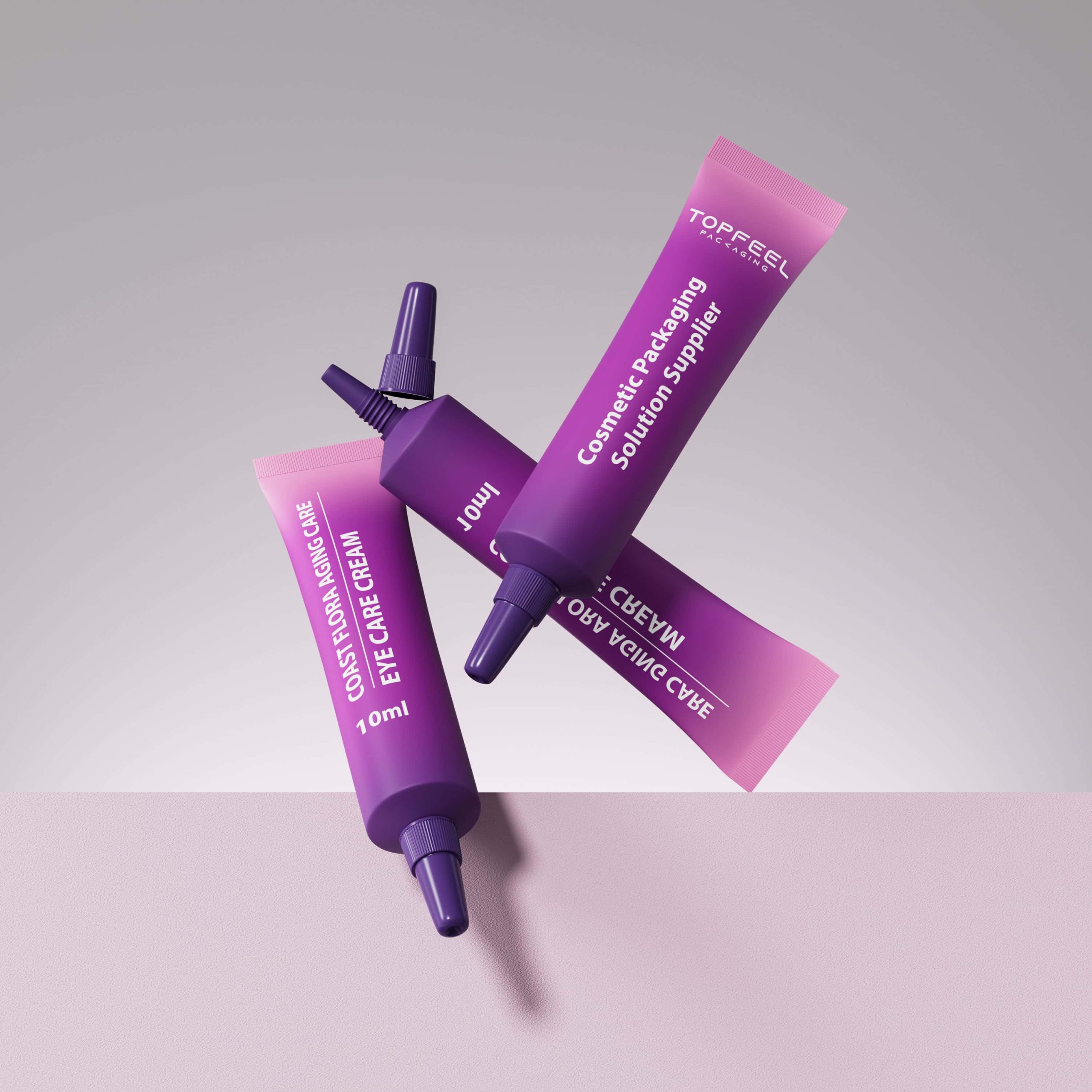
Lip gloss squeeze tube containers can look charming on a desk and turn downright mischievous on a filling line: leaks, crooked caps, weak shoulders, and wandering tolerances can sink a batch fast.
Smart buyers check materials, barriers, orifices, decoration, tamper evidence, formula compatibility, and production-ready samples before signing off.
Plastics Europe’s Fast Facts report circular plastics reached 15.4% of European production, highlighting the shift toward sustainable resin sourcing.
Key Highlights: Lip Gloss Squeeze Tube Containers
→ Material Matters: Compare LDPE, PETG, PCR, bio-based or aluminum for squeezability, barrier and recyclability
→ Leak Prevention: Verify cap fit, shoulder joint strength and inner liner consistency
→ Reliability Tests: Run pressure, drop-impact, UV seal integrity and squeezability assessments
→ Sampling Steps: Approve 5ml/15ml prototypes, screen-print quality and tamper-evident seals before production
 Material Matters: Choosing Plastic Vs. Aluminum Tubes
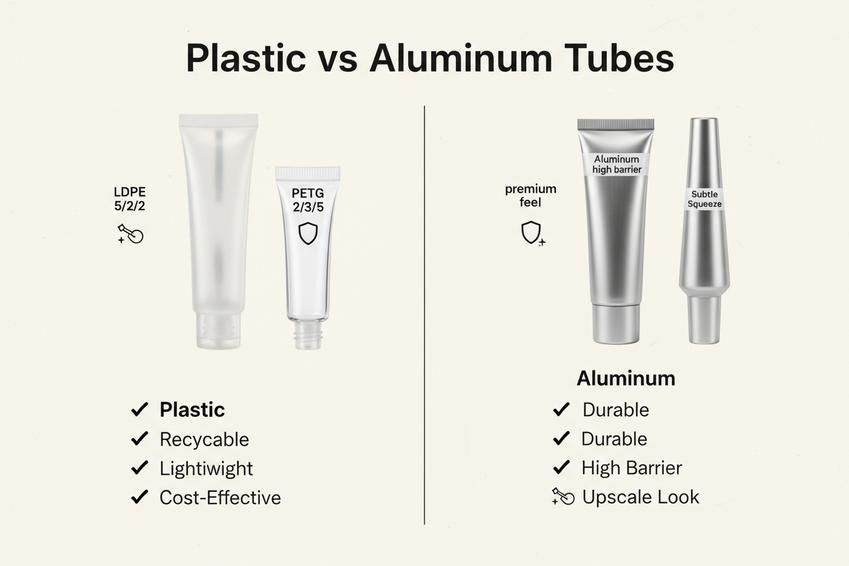
Material choice changes how lip gloss squeeze tube containers feel, protect color, and hold up in a makeup bag. Plastic offers soft handling and decorating freedom, while metal brings stronger barrier protection and an upscale touch. For brands working with Topfeelpack, matching the tube material to the gloss formula is the key practical move. Exploring options in lip makeup packaging ensures optimal compatibility across various formula viscosities.
Plastic Tubes
Plastic lip gloss squeeze tube containers balance everyday user comfort with formula safety.
-
PE choices
- LDPE gives high flexibility and squeezability, making thicker gloss easier to dispense.
- HDPE adds chemical resistance and stiffness while staying lightweight and cost-effective.
-
Specialty plastics
- PETG provides strong clarity for showing shades, although its squeeze feel is firmer. A lip gloss tube clear petg bottle highlights vibrant pigments effectively.
- PCR reduces demand for virgin resin to meet upcoming EU PPWR packaging mandates, while bio-based PE lowers fossil-feedstock dependence. Polymer selection aligns with emerging plastic circularity research.
-
Practical comparison for lip gloss tubes:
| Material | Squeeze rating¹ | Barrier rating¹ | Clarity rating¹ |
|---|---|---|---|
| LDPE | 5 | 2 | 2 |
| HDPE | 3 | 3 | 1 |
| PETG | 2 | 3 | 5 |
| PCR PE | 3–5 | 2–3 | 1–2 |
| Bio-PE | 3–5 | 2–3 | 1–2 |
¹Relative design screening scale: 1 = low, 5 = high; final performance depends on resin grade, wall thickness, and formula testing. Printing, labels, and surface treatments also affect recycling.
Aluminum Tubes
Aluminum lip gloss squeeze tube containers take a different route: strong protection with a crisp, upscale finish.
-
Formula protection
- High barrier protection limits oxygen entry, while full light protection shields sensitive oils and pigments.
- Internal lacquers support chemical inertness where direct metal contact could cause formula instability. Selecting a specialized metal tip tube for lip care offers cooling application alongside high protection.
-
Pack performance
- Greater rigidity creates a premium feel, though repeated squeezing may leave visible creases.
- Good recyclability is possible where metal collection exists, and sealed ends support tamper-evident designs.
For any gloss squeeze tube, compatibility testing matters. Check lacquer stability, crimp quality, shoulder integrity, leakage, and dispensing force before locking in production.
 The Hidden Risk In Cheap Lip Gloss Squeeze Tube Containers
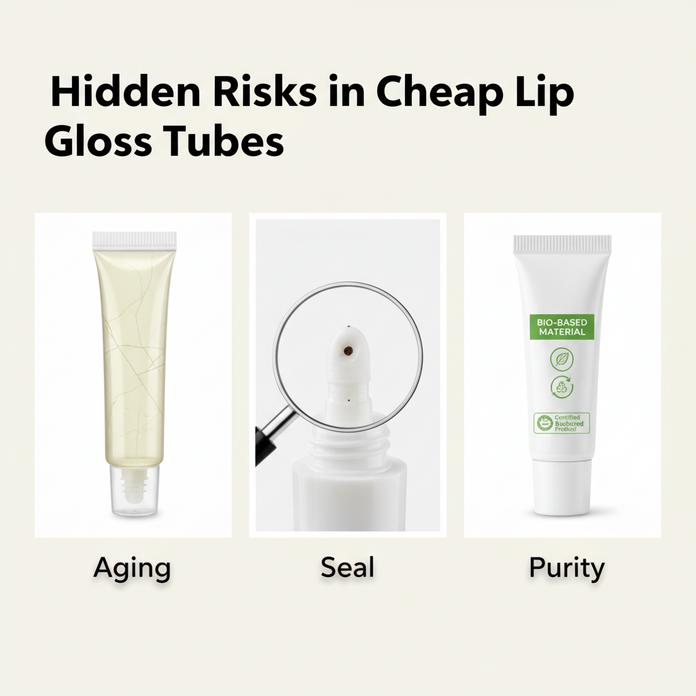
Low prices can make lip gloss squeeze tube containers tempting, but small material flaws turn into messy problems during storage. Checking plastics, seals, and source records helps buyers catch risks before sourcing a standard lip gloss tube.
Soft-Touch LDPE That Ages Poorly
Soft LDPE material gives squeeze tubes their flexible feel, but bargain grades age fast.
-
Watch the tube body:
-
Poor Shelf life stability causes Material degradation, discoloration, or stiffness.
-
Plasticizer migration affects feel and formula safety under US FDA cosmetic guidelines.
- Test aged samples for Tube cracking and lost flexibility.
- Check the Soft-touch coating against 40 back-and-forth frictions (500g load) to prevent peeling.
-
Accelerated aging gives an early check on long-term Container integrity.
Inconsistent Sealed Orifice Contamination
The sealed opening protects clean lip gloss before filling.
-
Check the Orifice seal across production samples per ISO 22716 GMP guidelines.
- Compare opening force and Seal integrity.
- Inspect for Manufacturing defects and optical dome deviations exceeding 0.05 mm.
-
Confirm Hygiene standards during packing.
- Poor seals increase Product contamination risk and Microbial growth.
-
Test Leakage prevention after filling. Choosing a wholesale lip tint container leak proof design minimizes shipment risk.
Reliable containers arrive clean, sealed, and easy to inspect.
Unverified Bio-Based Plastic Impurities
A Bio-based plastic label alone does not guarantee Material purity.
-
Before approving lip gloss tubes:
-
Request Material certification and proof of Regulatory compliance.
-
Screen for Chemical impurities, Trace contaminants, and Heavy metals.
- Conduct migration studies to ensure safety.
- Verify ethical manufacturing through Sedex ethical supply chain frameworks.
-
These checks connect packaging quality directly with Consumer safety.
 Why Your Lip Gloss Squeeze Tube Containers Keep Leaking
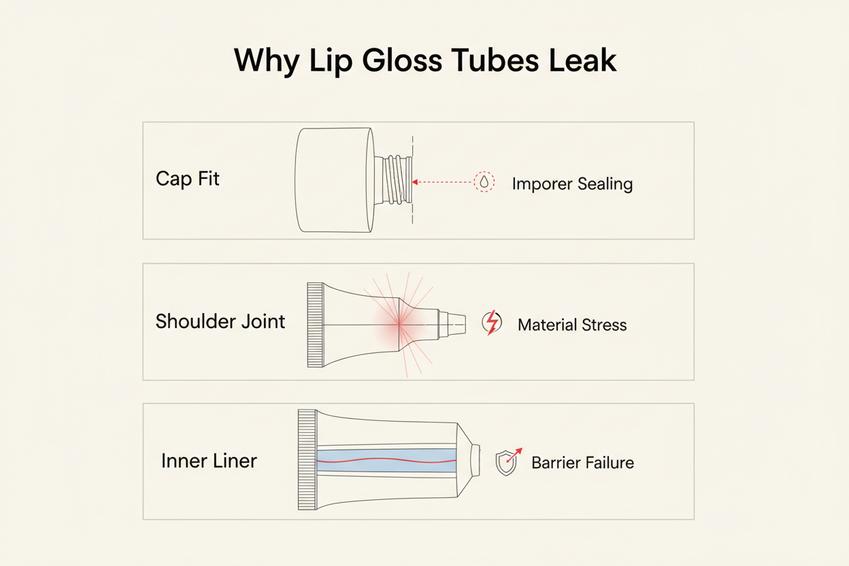
Leaky lip gloss squeeze tube containers create sticky operational headaches. Problems usually stem from the cap, shoulder, or liner. Topfeelpack evaluates these components under strict ISO 9001 certification standards.
Faulty Snap-On Cap Designs
Dependable sealing integrity requires precise cap-to-orifice engagement.
-
Cap checks
- Test the closure mechanism through repeated cycling. Implementing twist cap lip gloss packaging offers a secure threaded seal.
- Look for fitment issues that leave closures feeling loose.
-
Formula checks
- Confirm material compatibility, especially with synthetic oils.
- Screen for manufacturing defects affecting leakage prevention.
Topfeelpack buyers can review closure-fit details before approving lip care tube packaging oem solution for beauty brands.
Weak Tube Body Shoulder Joints
The shoulder takes major strain when users squeeze out gloss.
-
Check shoulder strength.
- Uneven wall thickness creates material stress.
- Poor welding quality reduces tube integrity.
-
Test filled lip gloss squeeze tube containers.
- Squeeze samples repeatedly.
- Inspect for joint failure, structural weakness, or seam leakage.
Good containers stay sealed without requiring careful handling.
Inadequate Inner Liner Barrier Layers
Inner liners prevent active ingredients from migrating into the plastic. An EVOH barrier material limits oxygen ingress.
-
Protection
- Check layer thickness and liner effectiveness for even coverage.
- Confirm permeation resistance and moisture barrier levels.
-
Compatibility
- Test chemical compatibility with the formula to prevent product degradation.
-
Final validation
- Verify liner seal integrity after filling.
Topfeelpack assists with multi-layer barrier selection tailored to specific gloss formulas.
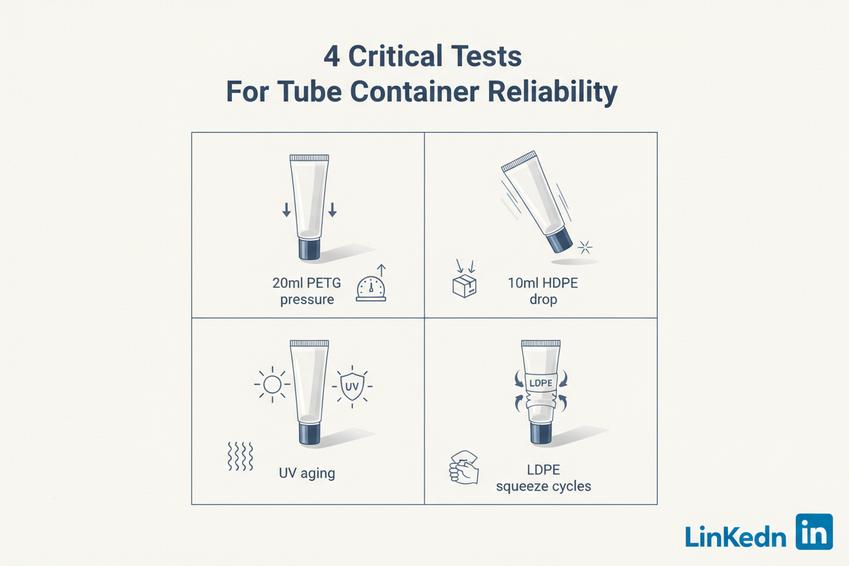 4 Critical Tests For Tube Container Reliability
Reliable lip gloss squeeze tube containers require rigorous physical validation. Topfeelpack tests how each container performs when compressed, dropped, aged, and flexed, aligning with Cosmetics Europe Commit for Our Planet quality metrics.
Pressure Test on 20ml PETG Tubes
A filled 20ml PETG tube undergoes controlled force to simulate transit loads.
-
Body performance
- Compress the container under defined load.
- Watch for structural buckling or cracking.
-
Closure performance
- Inspect shoulder welds and cap joints.
- Check the lip gloss seal using ASTM F2096 leak testing protocols.
This test provides a clear pass-or-fail check before full production runs.
Drop Impact Test for 10ml HDPE Models
For 10ml HDPE models, free-fall testing evaluates durability.
- Drop filled tubes following ASTM D5276 shock impact standards.
- Inspect the orifice after impact.
- Repeat drop cycles across multiple angles.
This confirms package durability during real-world handling.
Seal Integrity Check under UV Protection Stress
Accelerated light exposure evaluates cosmetic stability and joint strength.
-
UV protection exposure
- Expose the filled container to 24-hour UV testing (simulating 2 years of light exposure).
- Track material discoloration and embrittlement.
-
Seal integrity
- Verify layer adhesion and structural shape.
- Check for leakage around closures under thermal-humidity shifts (50°C to -15°C).
Topfeelpack pairs UV testing with pressure trials to verify long-term protection for delicate gloss formulas.
Squeezability Assessment on Recyclable LDPE
Recyclable LDPE tubes must maintain shape recovery without fatigue. Topfeelpack measures squeezability and dispensing consistency across repeated compressions. Brands scaling up can review cosmetic packaging for small business options to balance flexibility and cost.
Maintaining flexibility ensures the tube springs back cleanly for smooth, controlled dosing.
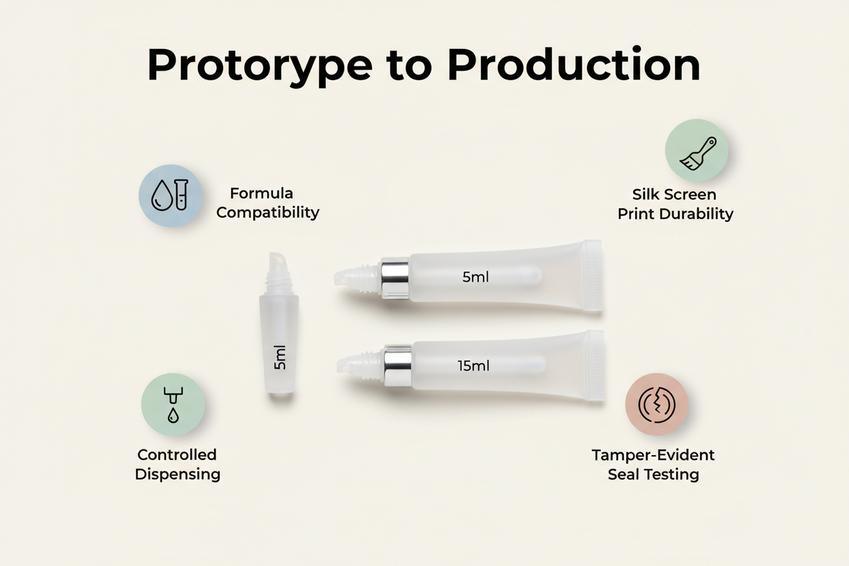 Prototype To Production: Container Sampling Guide
Transitioning from prototype to mass production requires thorough practical validation. Topfeelpack recommends testing physical samples with actual gloss formulations.
Selecting 5ml and 15ml Prototype Samples
Evaluate sample performance under actual filling and handling conditions.
-
5ml prototype
- Confirm volume and net capacity.
- Evaluate squeezability and wall flex.
-
15ml prototype
- Attach a lip tint container with precision tip or a petg lip gloss tube brush applicator to test controlled flow.
- Review overall design, seal tightness, and aesthetic presentation.
Topfeelpack supplies prototype samples for side-by-side comparative testing.
Evaluating Silk Screen Printing Quality
Decoration must withstand friction, squeeze flexing, and formulation contact.
- Inspect silk screen color accuracy using D65 light sources.
- Perform tape-adhesion and abrasion resistance trials.
- Evaluate the finish on soft-touch, matte, glossy, LDPE, HDPE, or PETG surfaces.
This ensures printing stays sharp throughout product usage.
Approving Tamper-Evident Seal Performance
A tamper-evident seal provides consumer security while remaining easy to open.
-
Shipping and storage
- Test seal security during vibration and temperature fluctuations.
- Confirm material compatibility with the tube shoulder.
-
Consumer opening
- Verify smooth peel performance.
- Ensure removal leaves the closure and orifice intact.
Topfeelpack conducts third-party SGS packaging testing to validate seal integrity under mass-production conditions.
Fast Filling Lines Need This Container Feature
High-speed filling lines require uniform packaging tolerances to prevent line jams and fill errors. Topfeelpack designs squeeze tubes for rapid line processing.
Nozzle Tip Orifice for Quick Dispensing
A properly calibrated nozzle design prevents filling bottlenecks.
-
Flow performance
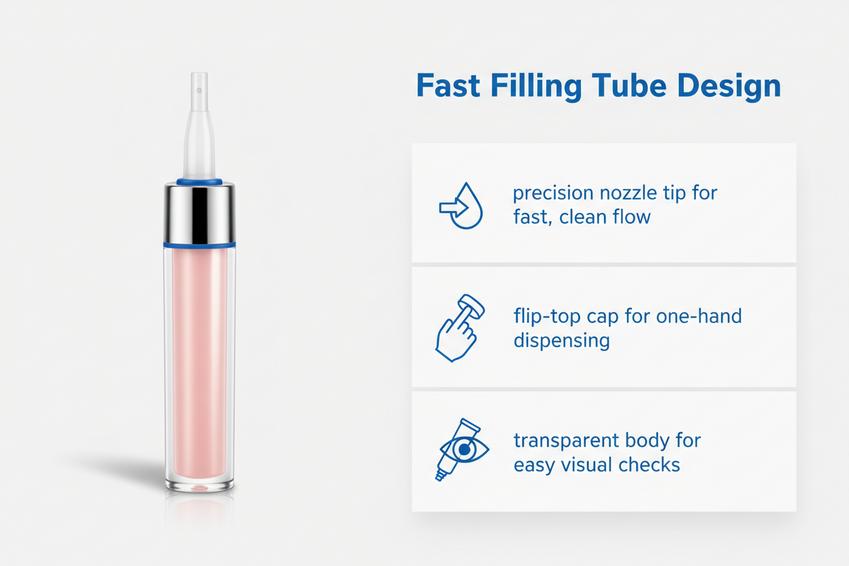
- Match orifice size to formula viscosity to enable rapid flow.
- A precision tip maintains steady dispensing speed and prevents stringing.
-
Production checks
- Verify orifice tolerances across production lots.
- Test for dripping and tailing during high-speed cut-off.
A precise orifice maintains fast, mess-free line speeds.
Dispensing Cap with One-Hand Operation
For consumer convenience, cap mechanics must operate effortlessly. Tubes fitted with a flip-top cap allow convenient single-hand use.
- Check that easy open torque meets ergonomic targets.
- Ensure the closure system clicks firmly closed after repeated use.
- Test ease of handling with wet or oily hands.
This provides convenient dispensing while keeping products leak-free in purse settings. Exploring options like the best tube lip gloss or ordering wholesale lip gloss tube units helps brands identify ideal closure setups.
Transparent Tube Body for Quality Control
A clear tube allows continuous visual monitoring during filling.
-
In-line visual checks
-
Visible contents
- Identify air pockets and fill-level variations immediately.
- Perform rapid contamination check screening.
-
Material clarity
- Support accurate quality inspection.
- Improve product visibility during batch sampling.
-
-
Final checks
- Transparent packaging simplifies shade matching.
- Visual control helps line operators detect defects before final boxing.
Topfeelpack integrates clear viewing options into squeeze tube designs where speed, accuracy, and quality control are essential.
References
- Plastics the Fast Facts 2025 – plasticseurope.org / Plastics Europe
- A Guide to GMP for Cosmetics ISO 22716 – registrarcorp.com / Registrar Corp
- ASTM D5276: Drop Test Methods for Loaded Containers – lso-inc.com / Life Science Outsourcing
- ASTM F2096 Standard Test Method for Detecting Gross Leaks in Packaging – industrialphysics.com / Industrial Physics
- Navigating the EU PPWR: Cosmetic Packaging Compliance Guide – cosmeservice.com / Cosmeservice
- Cosmetics Europe Commit for Our Planet Report – cosmeticseurope.eu / Cosmetics Europe
- ISO 9001 Quality Management Systems – iso.org / International Organization for Standardization
- ISO 22716 Cosmetics Good Manufacturing Practices – intertek.com / Intertek
- Plastic Circularity: Challenges, Opportunities, and Future Pathways – cambridge.org / Cambridge University Press
- Sedex Ethical Trade & Supply Chain Compliance – sedex.com / Sedex

