 English
  Español de México
  Français
  Deutsch
  Português do Brasil
  Italiano
  한국어
한국어  ไทย
ไทย  Русский
  日本語
日本語  Polski
  Svenska
  Türkçe

How to Fill Lip Balm Tubes?
May 14,2026
Mastering how to fill lip balm tubes at scale means prioritizing engineering over guesswork. Sloppy pours and misaligned caps destroy margins instantly. Efficient production lines demand absolute heat control, volumetric piston fillers holding ±0.5% accuracy, and dimensionally stable packaging. Lock in these variables to eliminate costly rework and ship flawlessly.
Selecting The Right Lip Balm Tubes
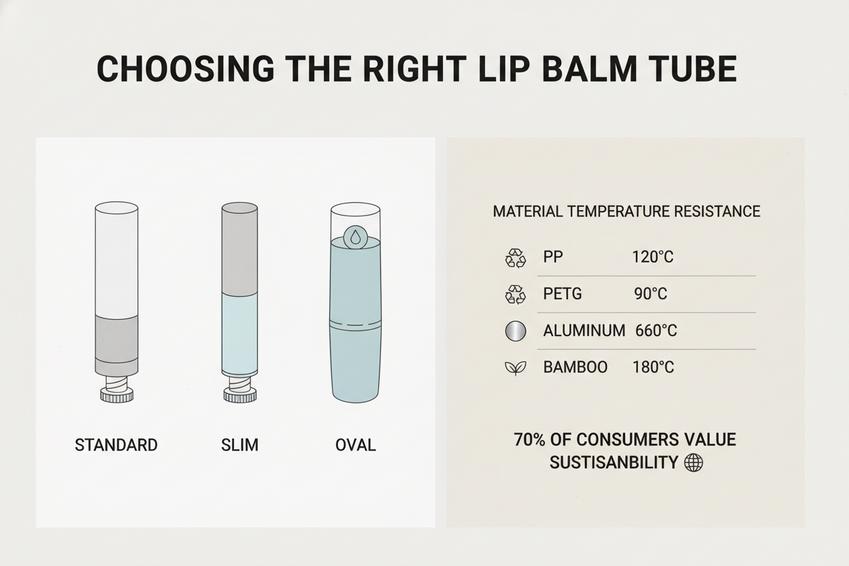
Proper execution starts before the filling line. Tube Shape, Size, and Material dictate machinery settings. Smart packaging choices reduce machine jamming and optimize output speed.
Comparing Standard Lip Balm Tubes vs. Slim and Oval Formats
Tube Format directly impacts conveyor alignment and cooling rates.
-
By Shape
-
Standard round
- Fits automated fillers (handling 40-120+ units/min)
- Stable base during 70°C+ hot pours
- Effortless alignment in cooling trays
-
Slim
- Smaller Dimensions
- Requires micro-dosing precision
- Needs multistage cooling (4°C–10°C) to prevent sinkholes
-
Oval
- Distinct shelf appeal
- Mandates orientation guides on conveyor
- Requires custom nozzle positioning
-
-
By Size
- 4.5g classic
- 3.5g mini
- 5g extended
For maximum throughput, Standard tubes minimize setup time. Slim formats require tighter temperature controls due to rapid volume contraction.
Choosing the Best Packaging Material: PP, PETG, Aluminum or Bamboo
Packaging Material dictates hot-pour shrink rates and barrier protection.
• PP – High heat resistance, cost-effective standard • PETG – Glossy finish, superior moisture barrier (extends shelf life ~15%) • Aluminum – Premium weight, exceptional structural integrity • Bamboo – Natural aesthetic, strong Sustainability profile
| Material | Heat Resistance (°C) | Sustainability Score (1–5) | Relative Cost |
|---|---|---|---|
| PP | 120 | 3 | Low |
| PETG | 90 | 3 | Medium |
| Aluminum | 660 | 4 | High |
| Bamboo | 180 | 5 | Medium-High |
| PP-PCR | 115 | 4 | Medium |
According to McKinsey’s 2024 Global Packaging Survey, over 70% of consumers now consider environmental impact in beauty purchases, pushing brands toward recyclable or refill-ready formats.
Utilizing PP with 30-50% PCR maintains structural integrity during filling while hitting eco-targets.
💡 Upgrade Your Packaging: Looking for high-quality, sustainable materials that withstand commercial hot-pours? Explore Topfeel Makeup’s lip balm tube collection, featuring premium PP, PETG, and PCR options designed for flawless automated filling.
Essential Features: Twist-up Design, Push-up Mechanism and Tamper-evident Seal
Understanding internal Features prevents critical defects.
-
Twist-up system
-
Internal Mechanism
- POM (Polyoxymethylene) screw spindle
- Controls lift height
- Warps if pour exceeds 85°C
-
-
Push-up base
-
Simple structure
- Lower tooling cost
- Manual bottom pressure friction
-
-
Tamper-evident Seal
- Shrink band
- Inner stopper
- Breakable cap ring
Match pour temperature with internal Functionality. Overheating destroys tracks; underfilling ruins Dispensing pressure.
Evaluating Supplier Capabilities: Tooling Development, Lead Time and Production Capacity
At commercial scale, vendor infrastructure is paramount.
-
Tooling Development
-
Custom mold creation
- Micron-level cavity precision
- Uniform wall thickness
- Consistent Dimensions
-
-
Lead Time
- Sample: 7–15 days
- Mass Production: 25–40 days
-
Production Capacity
-
Monthly output benchmarks
- 1M units
- 3M units
- 5M+ units
-
-
Quality & Manufacturing control
- ISO certification
- Raw Material traceability
- In-line vision sensor inspection
Partnering with reliable manufacturers like Topfeel ensures steady Capacity and elite Tooling support, eliminating bottlenecks during high-volume runs.
🚀 Scale Faster with Topfeel Makeup: Need custom tooling on a tight schedule? We offer 1-day design and 3-day 3D prototyping for custom molds. With over 277 patents and a 20,000 ㎡ ISO/GMPc certified facility, we guarantee precision at any volume. Discover our full lip makeup packaging solutions here.
5 Critical Steps: How To Fill Lip Balm Tubes
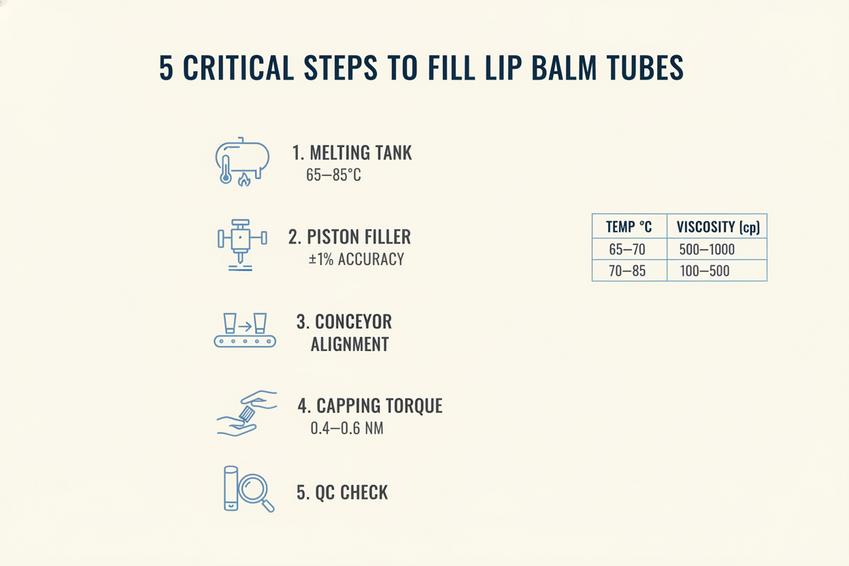
Following strict operational procedures reduces waste and ensures structural integrity.
First, Prepare the Melting Tank and Mixer for Smooth Blends
Raw material rheology dictates the entire process.
-
Core equipment:
- melting tank
- mixer
- heating element
- temperature control
- Load the lip balm base and ingredients into the melting tank.
- Activate the heating element (stabilize between 70–75°C to prevent beeswax crystallization).
- Start blending with the mixer at low RPM to avoid air entrainment.
| Material Type | Melting Temp (°C) | Mixing Time (min) | Viscosity (cP) | Batch Size (kg) |
|---|---|---|---|---|
| Beeswax Base | 70 | 15 | 4,500 | 50 |
| Vegan Wax | 75 | 18 | 5,200 | 50 |
| Shea Blend | 68 | 12 | 4,000 | 30 |
| High Gloss | 72 | 20 | 5,800 | 40 |
| SPF Formula | 80 | 22 | 6,100 | 35 |
Second, Calibrate the Piston Filler for Consistent Fill Volumes
Precision machinery requires micro-adjustments.
- Adjust calibration settings for ±0.5% fill volume accuracy.
- Test dosage through all nozzles.
- Verify accuracy via automated vision sensors.
Nested workflow:
-
Machine Setup
- Align filling machine hopper temperature
- Prime nozzles
-
Volume Testing
- Weigh 10 samples
- Confirm strict consistency
Third, Position Tubes on the Conveyor System for Streamlined Flow
Proper tube loading prevents catastrophic jams.
-
Equipment alignment:
-
conveyor system
- Base holders locked
- Rail width micro-adjusted
-
automated feeding
- Sensor check
- Jam detection active
-
Perfect positioning of lip balm tubes ensures high-throughput velocity without overflow.
Then, Secure Caps with the Capping Machine and Inspect Swivel Mechanisms
Incorrect torque strips threads.
-
capping machine setup:
- Torque range: 0.45–0.55 Nm
- Even cap application
Inspection checklist:
- swivel mechanism rotation validation
- Cap sealing airtight
- No cross-threading
Finally, Perform Quality Inspection, Leakage Testing and Label Application
Rigorous final stage checks protect market integrity.
Quality control layers:
- Visual inspection (0.2mm variance threshold)
- Automated leakage testing
- Randomized defect detection
Packaging stage:
-
Apply labels
- Verify batch number
- Confirm artwork alignment
-
Final label application and outer packaging
Machinery from partners like Topfeel streamlines these steps, making automation predictable.
How To Fill Lip Balm Tubes In Bulk
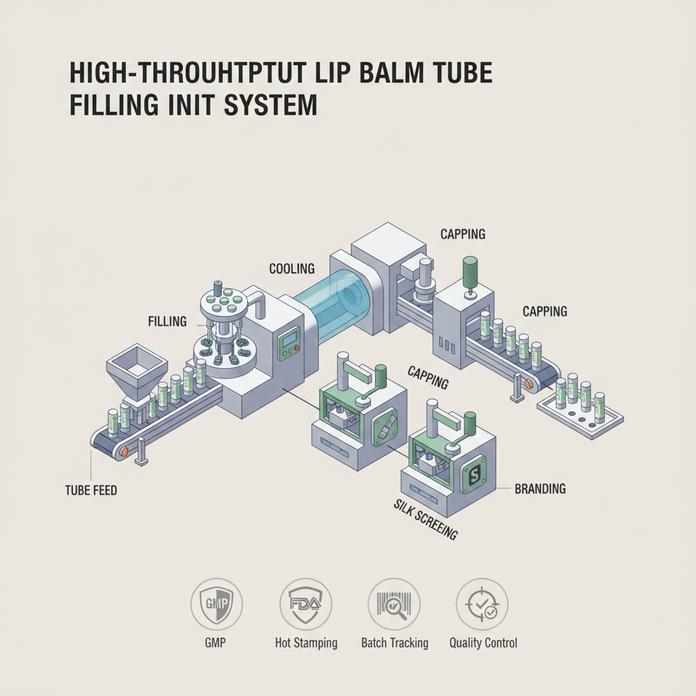
Bulk runs require a shift from isolated tasks to synchronized automation.
Selecting High-Throughput Filling Machines and Conveyor Layouts
Factory topography dictates yield.
-
Core Production Units
-
Filling machines
- Servo-driven systems built for high-throughput
- Heated hoppers maintaining 4,000+ cP viscosity
-
Tube feeding modules
- Automatic orientation
- Jam-detection sensors
-
Cap placement systems
- Torque-controlled tightening
-
-
Conveyor systems Design
-
Linear production lines
- Ideal for long factory spaces
-
U-shaped factory layout
- Saves floor space
- Reduces operator transit
-
Synchronized speed control
- Aligns fill, cap, and multi-stage cooling
-
-
Automation Priorities
- PLC-controlled thermal stability
- Real-time output telemetry
- Rapid tooling changeovers
Integrating Assembly, Hot Stamping and Silk Screening Processes
Decoration must run inline with packaging and process integration.
- Automated assembly processes link filling and capping seamlessly.
- Inline hot stamping applies 40-60 psi of consistent foil pressure.
- Rotary silk screening guarantees uniform ink deposition.
Standard decoration rhythm:
- Tube cleaning
- Filling
- Cooling tunnel (4°C–10°C)
- Cap pressing
- Surface finishing
- Logo labeling
Ensuring GMP, FDA Compliance and Batch Consistency in Large Runs
Regulatory adherence is non-negotiable.
-
GMP Framework
- Raw material quarantine
- Controlled ambient storage
- Cleanroom air filtration
-
FDA compliance Alignment
- 21 CFR Part 211 (CGMP) adherence
- Label accuracy review
- Production record retention
-
Quality control in Large-Scale Production
- In-process statistical weight checks
- Torque testing
- Thermal stability evaluation
-
Batch consistency and Traceability
- Lot coding tied to raw material ledgers
- Digital tracking on production lines
- Archived inspection reports
FAQs about How To Fill Lip Balm Tubes
What equipment is essential when learning how to fill lip balm tubes?
A professional line requires a melting tank + mixer, a volumetric piston filler, an aligned conveyor system, and a calibrated capping machine. All equipment must integrate under GMP standards and precise PLC controls.
Which packaging materials work best for lip balm tubes?
- Polypropylene (PP) → Highly heat resistant, cost-effective.
- PETG → Glossy, superior moisture barrier.
- Aluminum → Premium weight, total oxidation barrier.
- Bamboo → Eco-focused aesthetic.
- PCR material → Balances structural integrity (at 30-50% ratios) with sustainability.
How can you maintain batch consistency during high-volume filling?
Control is maintained through strict operational rhythm: daily filler calibration (±0.5% tolerance), continuous thermal monitoring to prevent viscosity shifts, automated vision inspections, and rigorous ISO-certified leakage testing.
Why is supplier capability critical before scaling production?
A reliable supplier provides exact tooling development, handles aggressive lead times, and enforces strict GMP assembly. Validated vendor selection guarantees every twist-up mechanism and tamper-evident seal performs flawlessly under thermal stress.
Ready to perfect your lip balm production? From stock portable balm sticks to custom PP twist-up lip balm stick packaging, Topfeel Makeup provides industry-leading OEM/ODM cosmetic packaging solutions. Contact us today to secure reliable, leak-proof, and high-throughput packaging for your next big launch. Visit Topfeel Makeup to get started!
References
- volumetric piston fillers – en.wikipedia.org
- cooling rates – en.wikipedia.org
- PP – en.wikipedia.org
- PETG – en.wikipedia.org
- Aluminum – aluminum.org
- McKinsey’s 2024 Global Packaging Survey – mckinsey.com
- POM (Polyoxymethylene) – en.wikipedia.org
- ISO certification – iso.org
- rheology – en.wikipedia.org
- beeswax crystallization – en.wikipedia.org
- automated vision sensors – cognex.com
- Torque range – en.wikipedia.org
- automation – automation.com
- 21 CFR Part 211 (CGMP) – accessdata.fda.gov
- PCR material – plasticsindustry.org

