 English
  Español de México
  Français
  Deutsch
  Português do Brasil
  Italiano
  한국어
한국어  ไทย
ไทย  Русский
  日本語
日本語  Polski
  Svenska
  Türkçe


How Do Airless Pumps Work?
May 11,2026
Stale formulas kill brand loyalty. Airless systems lock out oxygen by utilizing vacuum force to push product upward, eliminating waste and contamination. Topfeel engineers state in 2025 technical briefs that precision pistons protect formula integrity and brand reputation at scale.
How Do Airless Pumps Work?
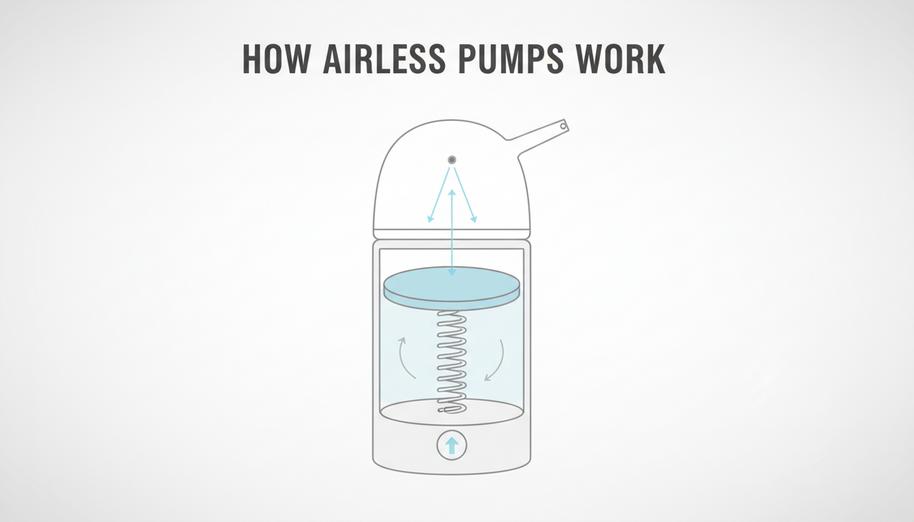
Brands are rapidly switching to airless systems to guarantee clean dispensing, minimal waste, and superior skincare protection. Here is the mechanical reality behind the design.
Vacuum Creation through a Sealed Chamber
The process originates inside the sealed chamber.
-
Core environment
- The airless pump relies on a tightly closed product container.
- No external air penetrates the pump head area.
-
Pressure balance system
- When actuated, internal air pressure drops to a controlled delta (approx. −0.05 MPa).
- External atmospheric pressure pushes the formula upward.
- A vacuum forms beneath the moving base.
-
Why this matters
- Oxidation risk is virtually eliminated.
- Preservative requirements can be reduced by up to 15%.
Piston and Spring Mechanism for Product Evacuation
Once pressure shifts, kinetic action occurs within the pump body.
- A downward press compresses the spring.
- The piston initiates controlled downward movement.
- Release triggers upward movement, pushing product toward the outlet.
Quick facts:
- Achieves 98–99% product evacuation.
- Clean dispensing with zero sputtering.
- Minimal residue left behind.
Topfeel fine‑tunes this internal motion so every actuation feels mechanically consistent.
One-Way Valve and Nozzle Dosing Accuracy
Flow control is governed by strict fluid dynamics.
-
Flow direction control
- The one-way valve blocks reverse product flow.
- The internal valve mechanism entirely prevents backflow contamination.
-
Output precision
- The nozzle shapes the stream for targeted application.
- Delivers precise dosages ranging from 0.15ml to 1.0ml per stroke.
- Dosing accuracy limits deviation to <±3%.
-
Daily user benefit
- Cleaner application surfaces.
- Stable active ingredients.
- Predictable dispensing.
Ready to eliminate formula oxidation and product waste? Contact Topfeel today to request high-performance airless pump samples for your brand.
Airless Pump Components Explained
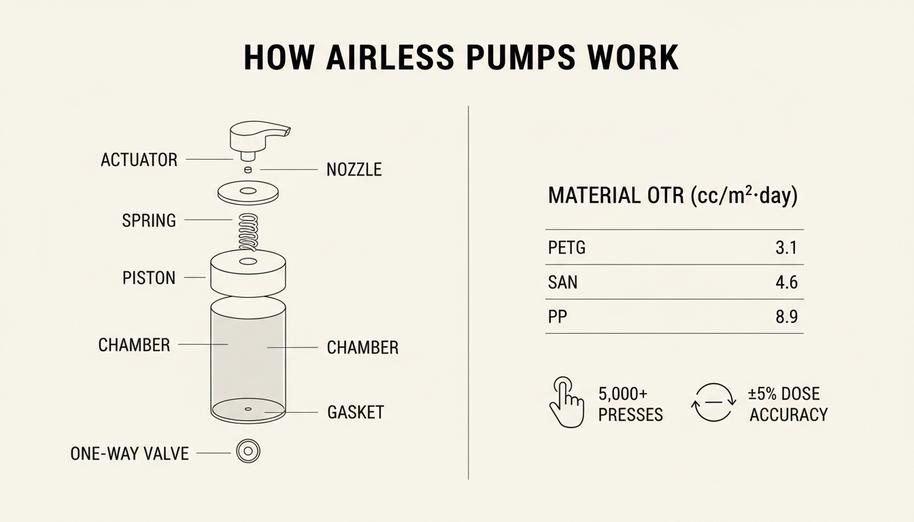
Performance relies on individual mechanisms, from the actuator to the internal valve.
Actuator and Nozzle: Precision Dispensing in Serums
- The actuator transfers mechanical pressure into controlled motion.
- The nozzle ensures precision dispensing for high-value serum.
- The mechanism often features a 100% metal-free fluid pathway to protect reactive ingredients.
Inside the head assembly:
-
External press force
- Pushes the actuator downward.
- Compresses the internal spring.
-
Metering phase
- Calibrated chamber releases the preset volume.
- Nozzle shapes the flow.
-
Reset phase
- Spring rebounds.
- System reseals instantly.
Brands like Topfeel engineer the actuator curve to guarantee one press equals exactly one dose.
Chamber and Gasket Materials: Plasticizer-Free PETG vs. SAN Resin
Within the chamber system:
-
Structural Layer
-
PETG (plasticizer-free)
- High clarity and strong chemical compatibility.
-
- Greater rigidity and enhanced scratch resistance.
-
-
Sealing Layer
-
Gasket
- Maintains the airless barrier.
- Preserves internal pressure balance.
-
Performance comparison:
| Material Type | Oxygen Transmission (cc/m²·day) | Impact Strength (kJ/m²) | Chemical Resistance Rating | Transparency (%) |
|---|---|---|---|---|
| PETG (PF) | 3.1 | 7.5 | High | 90 |
| SAN Resin | 4.6 | 5.2 | Medium-High | 88 |
| PP (Control) | 8.9 | 4.1 | Medium | 75 |
Lower oxygen transmission equals prolonged shelf life. A precisely molded gasket ensures the barrier remains uncompromised.
Spring and Piston Assembly Process and Quality Assurance
Manufacturing flow:
- Precision molding of each component.
- Calibration of spring tension.
- Alignment of piston with chamber wall.
- Automated quality control testing.
Quality testing includes:
- Cycle durability (5,000+ presses).
- Dose deviation tolerance (< ±3%).
- Leak integrity under pressure (viscosities up to 70,000 cps).
Within the internal mechanism:
- The piston rises incrementally as product dispenses.
- Vacuum forms beneath the piston, rendering dip tubes obsolete.
Topfeel utilizes inline optical inspection during the assembly process to ensure zero-defect cosmetic-grade outputs.
Valve Functionality for Contamination Protection
Internal protection structure:
-
One-way valve gate
- Opens during actuation.
- Closes immediately upon release.
-
Airtight seal ring
- Prevents backflow.
- Maintains structural integrity.
-
Enclosed airless channel
- Blocks external exposure.
- Preserves product stability.
“Airless packaging continues to gain share in prestige skincare due to superior product protection and dosing precision,” notes Smithers’ 2025 global packaging market outlook.
3 Steps: How Do Airless Pumps Work
Step 1 – Chamber Sealing with PCR Plastic Construction
-
Sealing & Barrier System
-
PCR plastic acts as the primary Material.
- High-density structure reducing virgin plastic by 30-50%.
- Strong oxygen Barrier (enhanced via EVOH layers).
-
Heat-fitted components protect Integrity.
- Airtight base lock.
- Controlled internal pressure.
-
-
Construction Logic
- Outer shell: prevents photo-oxidation.
- Inner Chamber: collapses upward.
- No dip tube: eliminates microbial risk.
Step 2 – Piston Pump System Activation and Oxidation Prevention
-
Activation Mechanism
-
Press actuator
- Spring compresses.
- Internal Mechanism lifts piston.
-
Product moves upward without drawing air.
-
-
Oxidation Prevention
- Zero air backflow.
- Reduced microbial exposure.
- Maximized Product preservation.
Step 3 – Dosing Accuracy via Nozzle and Valve Coordination
-
Dispensing Control Structure
-
Nozzle
- Shapes output stream.
- Maintains clean cutoff.
-
One-way Valve
- Stops backflow.
- Supports repeatable Dosing.
-
-
Accuracy & Precision Factors
- Calibrated stroke length.
- Stable internal pressure.
- Smooth Coordination between parts.
Topfeel engineers this internal Control system to handle everything from water-light serums to dense balms.
Struggling With Leaks? Airless Pumps Fix It
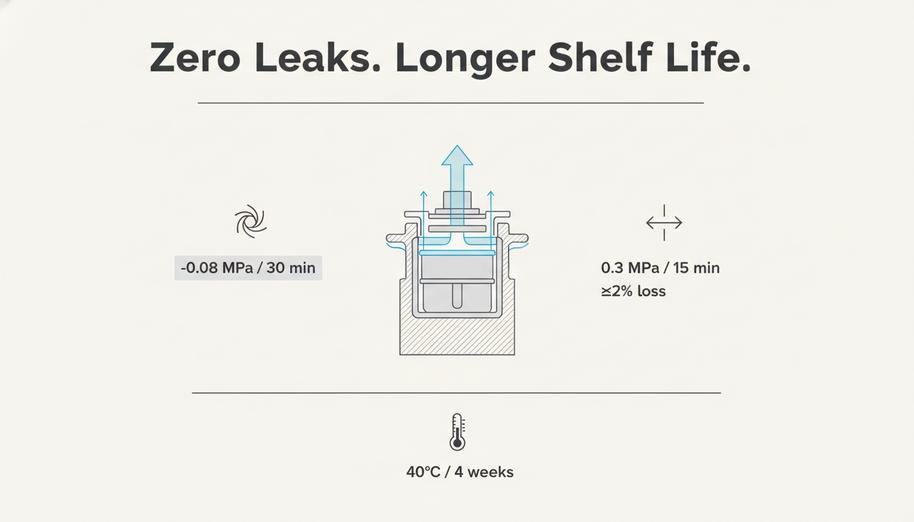
Leak Testing and Compatibility Testing Best Practices
-
Seal Integrity Validation
-
a. Vacuum Simulation
- i. Vacuum testing at −0.08 MPa for 30 minutes.
- ii. Monitor seal integrity and micro air bubbles.
-
b. Pressure Retention
- i. 0.2–0.4 MPa internal pressure.
- ii. Record loss rate under 2%.
-
-
Material Interaction Review
-
a. Formula Soak Trials
- i. 40°C storage, 4 weeks.
- ii. Check swelling, cracking, color shift.
-
b. Chemical Resistance
- i. Analyze material interaction.
- ii. Confirm product stability.
-
-
Testing Protocol Control
- Standardized testing protocols.
- Clear pass/fail benchmarks.
- Batch-based documentation.
| Test Item | Condition معيار | Acceptance Standard |
|---|---|---|
| Vacuum testing | −0.08 MPa/30min | No bubble leakage |
| Pressure retention | 0.3 MPa/15min | ≤2% loss |
| Compatibility soak | 40°C/4 weeks | No deformation |
Gasket Design and Injection Molding for Shelf Life Extension
- Gasket material is formulated to match active chemistry.
- Smart seal design drops oxygen entry to near zero.
- Tight component manufacturing tolerances eliminate micro-gaps.
- Choose high-barrier polymer selection (e.g., EVOH) with strong barrier properties.
- Optimize injection molding process parameters to prevent micro-shrinkage.
- Shape compression ribs into the gasket to enforce oxidation prevention.
- Validate for slowed product degradation.
Topfeel applies clinical injection molding process controls so the theory of leak-prevention is proven in mass production.
Stop letting packaging leaks ruin your brand’s reputation. Partner with Topfeel for clinical-grade, leak-proof airless manufacturing at scale.
Airless Pumps vs. Conventional Pumps
Airless Pumps
-
Core Structure
- Vacuum environment forms during dispensing.
- A rising Piston or Diaphragm pushes formula upward.
- Total Oxidation prevention.
-
Dispensing Logic
-
Functional Benefits
- Up to 99% evacuation rate.
- Stable textures over long durations.
| Feature | Airless System | Benefit Level |
|---|---|---|
| Air Contact | 0–2% exposure | High protection |
| Product Waste | <2% residue | Low waste |
| Shelf Life Gain | +15–30% | Extended |
| Contamination Risk | Minimal | Safer |
Conventional Pumps
-
Internal Mechanism
- A Dip tube draws formula upward.
- Air returns under Atmospheric pressure.
- Repeated Air exposure accelerates Oxidation.
-
Risk Factors
- High Contamination chance.
- Rapid Product degradation.
- Up to 15-20% Product waste trapped at the base.
-
Performance Outcome
- Adequate for basic surfactants.
- Destructive to sensitive actives.
For high-performance formulations, Topfeel engineers universally mandate airless infrastructure.
Luxury Cosmetics: Airless Pump Applications
High-Viscosity Creams in Top-Fill Airless Packaging
-
Core system logic
-
Product sits inside sealed airless dispensers.
- A rising base disc forces dense formulations upward.
- No backflow.
-
Smart dispensing technology powers through up to 70,000 cps viscosities.
-
-
Why top-fill matters
-
- Faster, cleaner filling methods.
-
- Immediate product protection.
-
- Tighter packaging design tolerances.
-
Emulsions and Lotions with Dual-Chamber Custom Colors
-
Dual-chamber architecture
-
Two isolated paths.
- Prevents premature cross-linking of multi-phase formulas.
- Maintains emulsion stability.
- Supports two-part systems (Serum + Activator).
-
-
Visual identity
-
Custom resin tinting.
- Advanced color customization.
-
Creative packaging innovation.
-
McKinsey’s 2024 global beauty insights noted that functional packaging influencing formula stability is becoming a “core purchase driver” in prestige skincare.
Foundations and Gels: Decorative Surface Finish Options
-
Outer shell engineering
- Acrylic clarity for premium surface aesthetics.
- PP structures for durable material textures.
-
Decoration layers
- UV coating (prevents photo-oxidation).
- Metallization.
- Screen print for elevated cosmetic finishes and visual appeal.
Manufacturing Capacity for Acrylic and Polypropylene Designs
-
Material platform
- Acrylic plastics and Polypropylene polymers boasting verified material properties.
-
Production flow
- Injection molding with exacting design specifications.
- Automated assembly via stable manufacturing processes (leak testing, output calibration).
Topfeel’s manufacturing grids align massive production capabilities with zero-tolerance luxury quality control.
FAQs about How Do Airless Pumps Work
How do airless pumps work to prevent oxidation in serums and creams?
Inside a sealed chamber, a piston pump system utilizes vacuum pressure rather than dip tubes. Pressing the actuator compresses a spring, lifting the piston and dispensing product through a one-way valve and nozzle—completely blocking external air. This guarantees oxidation prevention for serums and emulsions, extending shelf life via robust gasket sealing in both top-fill airless and bottom-fill airless formats.
What components ensure dosing accuracy and full product evacuation?
Precision relies on internal geometry:
- Actuator + Spring — Controls pressure for consistent actuation.
- Piston inside Chamber — Rises evenly, achieving up to 99% evacuation.
- Valve + Nozzle geometry — Regulates exact dosing (e.g., 0.2ml per stroke) and prevents dripping. This setup outperforms a conventional pump mechanism, preserving ingredient stability in vacuum dispensers and bag-on-valve systems.
Which materials and manufacturing steps protect formula stability?
Material Protection: Polypropylene (durability), Acrylic/SAN resin (clarity), plasticizer-free PETG (active ingredient safety), and PCR plastic (sustainable option). Manufacturing & Quality Control: Micro-precise injection molding, automated assembly processes, rigorous leak testing, and chemical compatibility testing ensure the packaging materials do not degrade. Enhanced by custom surface finish and molding options, this engineering delivers premium ergonomics and ultimate formulation safety.
Protect your active ingredients and elevate your brand’s shelf presence. Reach out to Topfeel’s packaging experts today for a custom airless solution and wholesale pricing.
References
- atmospheric pressure – education.nationalgeographic.org
- Oxidation risk – sciencedirect.com
- fluid dynamics – grc.nasa.gov
- PETG (plasticizer-free) – omnexus.specialchem.com
- SAN resin – polymerdatabase.com
- cps – en.wikipedia.org
- global packaging market outlook – smithers.com
- PCR plastic – ellenmacarthurfoundation.org
- EVOH layers – kuraray.com
- photo-oxidation – en.wikipedia.org
- injection molding process – ptonline.com
- Retinol – paulaschoice.com
- Vitamin C – lpi.oregonstate.edu
- global beauty insights – mckinsey.com
- Polypropylene polymers – bpf.co.uk

