 English
  Español de México
  Français
  Deutsch
  Português do Brasil
  Italiano
  한국어
한국어  ไทย
ไทย  Русский
  日本語
日本語  Polski
  Svenska
  Türkçe

Top Trends in Custom Lipstick Component Design for 2026
April 30,2026
The custom lipstick component is no longer just a pretty shell; it’s the make‑or‑break detail that decides cost, shelf appeal, and sustainability street cred in 2026.
According to Topfeel’s 2025 product materials, its engineering team prioritizes mono-material PP structures and refillable aluminum systems to balance automation efficiency with eco compliance.
Brands that ignore this shift will bleed margin and relevance; smart buyers lock in partners now before competitors.
Quick Answers: Custom Lipstick Component Essentials
- Prioritize recycled and mono-material PP or PCR shells to boost sustainability and streamline recycling.
- Integrate refillable aluminum caps for premium feel, tamper evidence, and extended product lifecycle.
- Optimize injection-molding tooling and lightweighting for cost efficiency, dimensional accuracy, and torque testing.
- Embrace 3D-printed prototyping and on-demand sealing mechanisms to reduce waste and accelerate innovation.
Why 2026 Demands Sustainable Custom Lipstick Component Design
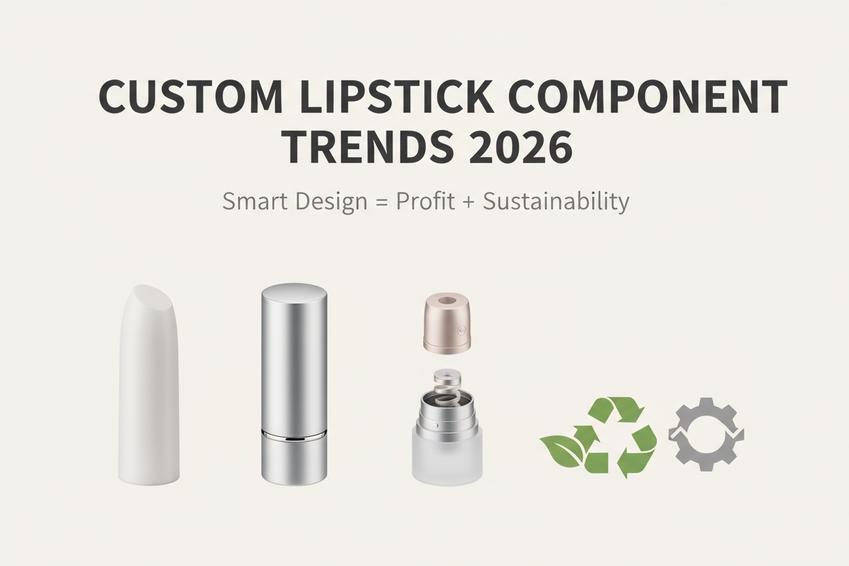
Sustainability isn’t just a buzzword anymore. In 2026, every custom lipstick component tells a story about sourcing, waste, and reuse. Brands that rethink lipstick parts, from outer shells to refill cores, win trust fast. A smarter custom lipstick component design balances cost, performance, and eco goals without making things complicated.
Leveraging Post-Consumer Resin for Outer Shells
When building a custom lipstick component, the outer casing carries most of the environmental load. Switching to post-consumer resin changes the math.
- Material sourcing shifts from virgin plastic to recycled plastic streams.
- The outer casing keeps the same dimensional tolerance.
- lipstick packaging still passes drop and compatibility tests.
For a reliable custom lipstick component, manufacturers focus on:
-
Raw Material Control
- a. Sorting certified sustainable materials suppliers
- b. Verifying melt flow index stability
- c. Testing color consistency for brand standards
-
Processing Stability
- a. Adjusting injection temperature for PCR ABS or PP
- b. Monitoring shrinkage to protect thread alignment
- c. Inspecting surface finish against QC benchmarks
-
Circular Impact
- a. Reducing virgin resin input
- b. Supporting a measurable circular economy model
- c. Lowering carbon footprint per lipstick component unit
| Material Type | Virgin Plastic (%) | PCR Content (%) | CO₂ Reduction (%) |
|---|---|---|---|
| ABS Standard | 100 | 0 | 0 |
| ABS + PCR | 40 | 60 | 28 |
| PP + PCR | 30 | 70 | 35 |
For brands like Topfeel, aligning custom lipstick component design with recycled inputs keeps performance tight while cutting waste upstream.
Monomaterial Collars and Lightweighting Innovations
A smart custom lipstick component avoids mixing too many resins. That’s where monomaterial design comes in.
- Use PP for both collar and inner support.
- Cut unnecessary inserts.
- Optimize wall thickness through lightweighting.
Less resin. Same torque strength. Cleaner recycling stream.
In practical terms, a better lipstick component setup looks like this:
-
Simplify Structure
- Remove metal pins inside lipstick collars
- Replace multi-resin parts with single PP units
- Support component simplification for sorting facilities
-
Reduce Weight
- Thin wall from 1.8 mm to 1.4 mm
- Maintain snap-fit reliability
- Confirm no compromise in rotation smoothness
-
Validate Performance
- Torque test after 500 cycles
- Heat stability at 45°C
- Drop test from 1.2 meters
The result? Real material reduction without cutting corners. Sustainable packaging doesn’t have to feel fragile. It just has to be engineered right.
Integrating Recyclable Aluminum Caps with Refill Systems
A premium custom lipstick component now pairs recyclable aluminum caps with refill cores. That combo feels upscale and cuts long-term waste.
To make it work:
-
Cap Engineering
- a. Select anodized aluminum caps for durability
- b. Ensure tight tolerance with inner PP cup
- c. Add discreet tamper-evident structure
-
Refill System Design
- a. Create click-in refill systems
- b. Standardize inner cup diameter
- c. Enable easy separation for eco-design goals
-
Lifecycle Extension
- a. Keep outer metal shell for 3–5 refill cycles
- b. Reduce total sustainable packaging waste
- c. Encourage reusable packaging habits
This type of custom lipstick component integrates metal and polymer smartly instead of randomly. With proper component integration, brands transform a simple lipstick component into a long-term asset. And in 2026, that’s not extra. That’s expected.
From Metal to Biopolymer: Future Component Materials
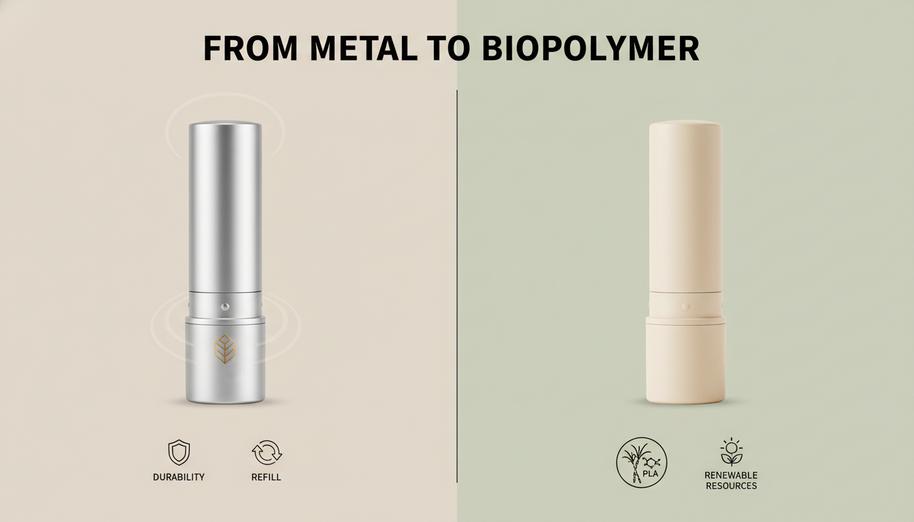
Material shifts are reshaping every custom lipstick component on the market. Brands want lighter impact, sharper looks, and smarter sourcing. From metal shells to plant-based resin, lipstick component choices now define product identity.
Metal
A premium custom lipstick component built in metal still carries serious presence. Weight matters. Finish matters. And the right lipstick component turns a daily cosmetic into something collectible.
-
Core metal options for a custom lipstick component:
-
- Lightweight yet durable
- Supports Anodizing for color depth
- High Recycled content compatibility
-
Brass
- Dense hand feel
- Ideal for detailed engraving
-
Zamac
- Great for complex molds
- Stable during Electroplating
-
Stainless steel
- Corrosion resistant
- Clean, modern aesthetic
-
-
Functional upgrades inside the lipstick component:
-
Magnetic mechanism
- Smooth closure click
- Boosts perceived value of a custom component
-
Precision torque structures
- Reliable twist-up action
- Consistent refill alignment
-
Surface treatment defines shelf impact:
- Electroplating for mirror gloss
- Anodizing for matte color stories
McKinsey’s 2024 global packaging outlook notes that consumers increasingly associate metal packaging with durability and refill potential, especially in beauty categories.
For brands like Topfeel, a metal custom lipstick component balances luxury with long-term reuse. It’s not just a shell; it’s brand attitude in hardware form.
Biopolymer
The shift toward biopolymer is real, and every forward-looking custom lipstick component supplier feels it. Cost, carbon footprint, and sourcing transparency now drive lipstick component design.
-
Plant-based material families used in a custom lipstick component:
-
- Derived from Corn starch-based feedstock
- Suitable for molded lipstick bases
-
- Naturally Biodegradable
- Good for inner cup structures
-
Sugarcane-based polymers
- Renewable origin
- Compatible with injection molding
-
-
Environmental value layers:
- Compostable pathways (industrial conditions)
- Reduced fossil input
- Support for Renewable resources supply chains
- Transition toward Plant-based plastics
Performance checkpoints for a custom lipstick component in biopolymer:
- Dimensional accuracy for refill fit
- Heat resistance during filling
- Surface quality for decoration
In real production, the switch from ABS to plant resin isn’t dramatic. The mold stays similar. The lipstick component geometry holds steady. What changes is the story behind the custom lipstick component—and customers notice.
Topfeel integrates biopolymer options into custom lipstick programs, helping brands move from metal-heavy lines to lighter, smarter custom lipstick component portfolios without losing visual appeal.
5 Emerging Trends in Custom Lipstick Component Design
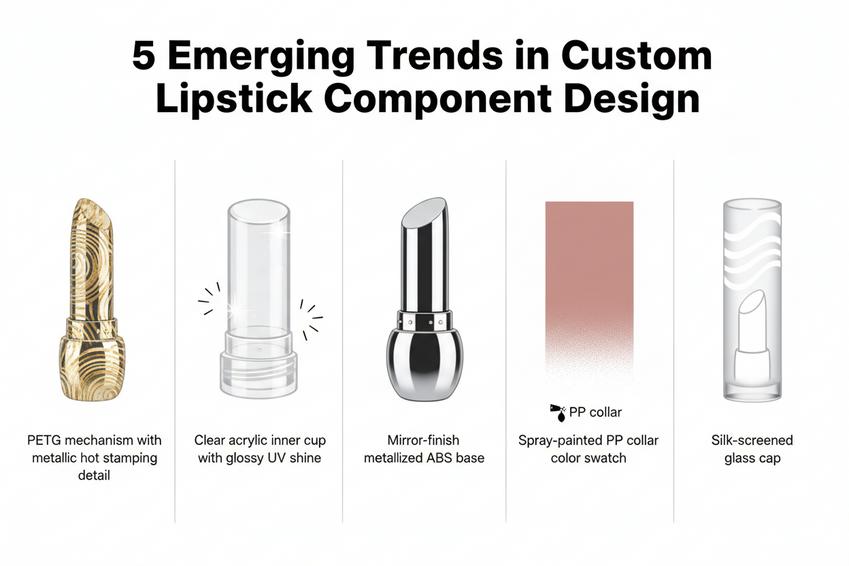
Designing a custom lipstick component today feels less like basic packaging work and more like brand storytelling. From lipstick mechanism tweaks to bold decorative finishes, every lipstick component now carries real weight in product appeal.
Trend 1: Hot Stamping on PETG Mechanisms
When brands refine a custom lipstick component, the hot stamping process on a PETG mechanism often becomes the hero detail.
-
Decoration & Design Integration
-
Surface layer
- Metallic foil transfer
- Controlled heat pressure for stable adhesion
-
Structural layer
- Maintains dimensional accuracy
- Protects internal dispensing alignment
-
-
Plastic Component Performance
- Base plastic stability
- Scratch resistance after repeated cap cycles
- Consistent metallic finish under friction
For a lipstick component supplier like Topfeel, balancing bold metallic finish visuals with mechanical precision keeps the custom lipstick component both flashy and reliable.
Trend 2: Acrylic Inner Cups with UV Coating
An acrylic inner cup changes the vibe instantly. Clear walls. Clean lines. Strong transparency.
Add UV coating, and the material gains extra protection and durability. That glossy finish is not just pretty—it guards against high-pigment formulas that may stain ordinary lipstick packaging parts.
Quick wins brands care about:
- Better chemical resistance
- Longer color stability
- Smoother surface inspection results
For any custom lipstick component, the inner structure matters just as much as the outer shell.
Trend 3: Metallized ABS Bases for Premium Aesthetics
A metallized ABS base pushes a custom lipstick component into premium territory.
-
Visual Impact
- Mirror-like aesthetic
- Uniform reflective finish
-
Manufacturing Logic
- Injection-molded plastic component
- Vacuum metallization layer
-
Performance Checks
- Drop resistance validation
- Adhesion durability
This lipstick component upgrade keeps cost practical while delivering a high-end look brands crave.
Trend 4: Spray-Painted PP Collars for Color Matching
The spray-painted PP collar might look small, yet it ties the whole custom lipstick component together.
-
Color Control
- Pantone-level color matching
- Batch consistency
-
Surface Quality
- Smooth decorative finish
- Adhesion testing on plastic
-
Customization Edge
- Matte, gloss, or soft-touch
- Seamless fit with cap and base
In lipstick packaging design, this tiny component often makes or breaks visual harmony.
Trend 5: Silk-Screened Glass Caps for Luxury Appeal
A silk-screened glass cap adds serious luxury appeal.
• Crisp logo decoration
• Strong ink bonding to material
• Premium tactile weight
The cool touch of glass, paired with precise printing, upgrades the entire custom lipstick component into something that feels intentional. Topfeel refines these details so each custom lipstick component speaks clearly—quality you can see, and quality you can feel.
Custom Lipstick Component Cost Saving Strategies
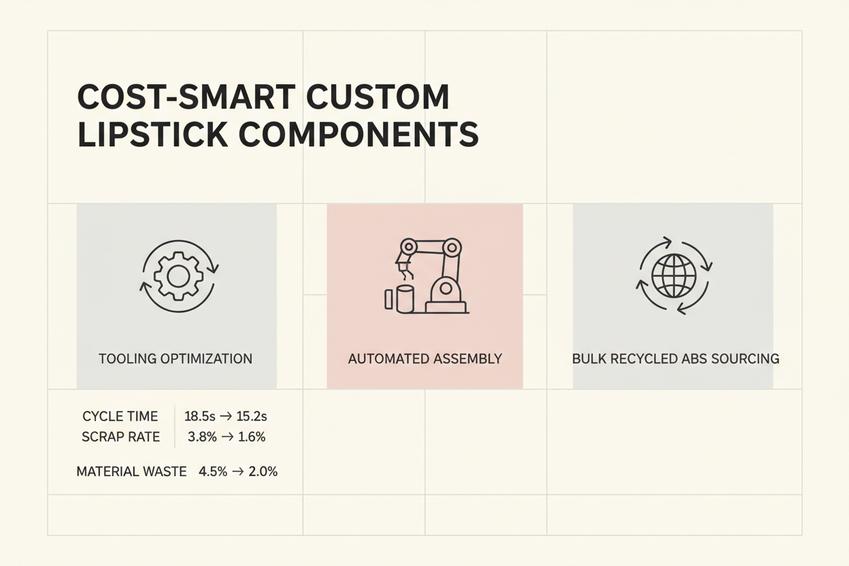
Cost control in a custom lipstick component project is not about cutting corners. It’s about refining lipstick component design, tuning production, and managing material spend so every custom lipstick part works harder for your brand.
Optimize Injection Molding Tooling for PP Collars
In a custom lipstick component, the PP collar quietly carries alignment, torque, and closure stability. Optimizing the Injection molding process starts at tooling.
-
Tooling design refinement
1.1 Gate positioning
- Improve Material flow across thin-wall Polypropylene (PP) collar components.
- Reduce weld lines in visible lipstick component areas.
1.2 Cooling channel layout
- Balance mold temperature.
- Cut deformation risk in custom lipstick collar rings.
1.3 Venting structure
- Minimize burn marks.
- Stabilize dimensional accuracy.
-
Mold optimization for cycle time
2.1 Shorten cooling time without shrinking tolerance.
2.2 Enhance ejection system to protect Collar components.
2.3 Integrate cavity pressure monitoring for scrap control.
| Optimization Item | Before (sec) | After (sec) | Scrap Rate (%) |
|---|---|---|---|
| Cycle time | 18.5 | 15.2 | — |
| Cooling time | 9.0 | 7.1 | — |
| Ejection delay | 2.5 | 1.8 | — |
| Dimensional reject | — | — | 3.8 → 1.6 |
| Material waste | — | — | 4.5 → 2.0 |
For any lipstick component supplier, those seconds add up fast. Topfeel applies this approach to every custom lipstick component mold program, keeping lipstick parts tight, clean, and cost-aware.
Streamline Assembly and Stamping to Cut Labor Costs
A custom lipstick component is only as efficient as its Manufacturing operations. Smooth Process flow trims cost without hurting quality.
• Upgrade to Assembly automation for cap–base fitting.
• Integrate inline torque sensors.
• Sync feeding systems for better Component integration.
-
Standardize Stamping techniques
- Control foil pressure.
- Monitor dwell time.
- Reduce over-stamping defects on lipstick casing shells.
Quick wins show up in small places. Fewer manual touchpoints mean fewer alignment errors. Stable Production efficiency keeps output predictable. Smart Labor optimization frees operators for inspection rather than repetitive pressing.
Add leak testing and torque testing directly into the conveyor path. That way, every custom lipstick part is checked before packing. The vibe on the factory floor changes too—less chaos, more rhythm.
For brands scaling a custom lipstick component line, this keeps margins healthy without sacrificing finish.
Bulk Sourcing of Recycled ABS to Lower Material Spend
Material cost drives every custom lipstick component decision. Smart Material procurement of Recycled ABS changes the math.
-
Supply chain management structure
1.1 Supplier tier classification
- Grade A: Stable monthly volume ≥ 50 tons
- Grade B: Flexible orders, short lead time
1.2 Price lock agreements
- 6‑month indexed contracts
- Resin cost adjustment formula
1.3 Quality checkpoints
- Melt flow index validation
- Impact resistance testing
- Surface finish inspection
-
Material specifications control
2.1 Confirm compatibility with inner lipstick component structures.
2.2 Validate plating adhesion.
2.3 Ensure color masterbatch stability.
-
Environmental impact alignment
- Increase recycled content ratio.
- Support Component sustainability targets.
- Reduce overall environmental impact per lipstick casing unit.
Buying in bulk lowers unit cost. Managing specs protects performance. That balance keeps every custom lipstick component competitive.
With structured Supply chain management and careful resin testing, Topfeel helps brands cut spend while maintaining the look and feel customers expect from a premium lipstick component line.
The Rise of 3D-Printed Lipstick Housings
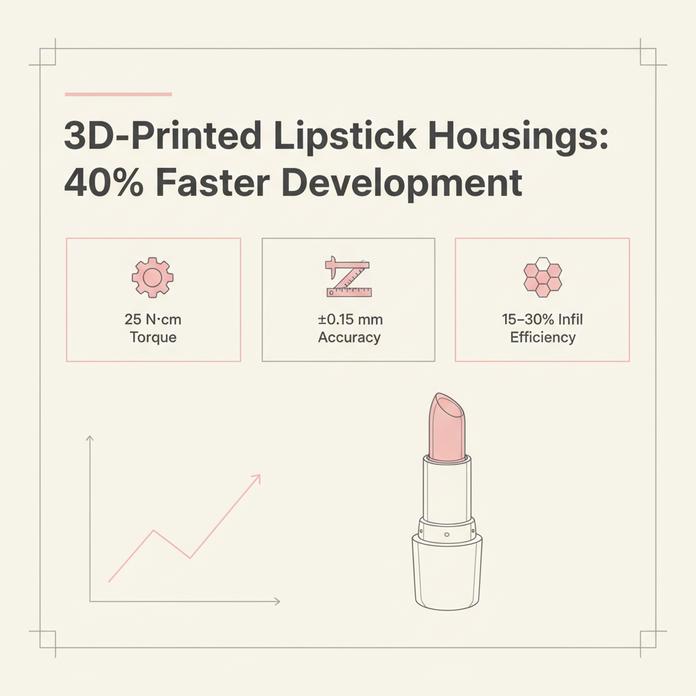
3D printing is changing how every custom lipstick component comes to life. From early sketches to functional lipstick parts, brands now tweak shapes, sealing details, and closure feel in days instead of months. For teams building a standout custom lipstick component, speed, fit, and waste control suddenly feel a lot more doable.
Rapid Prototyping of Ergonomic Closure Types
When building a custom lipstick component, closure comfort is not just about looks. It is about grip, twist torque, and that smooth click users love.
- Rapid prototyping cuts tooling wait time.
- Ergonomic design improves thumb placement and rotation feel.
- Different closure types can be tested in days, not weeks.
- Print multiple lipstick components using 3D printing.
- Adjust material selection for rigidity or flexibility.
- Run torque and drop tests.
- Collect user feedback on user experience.
Technical comparison during prototyping:
| Prototype Material | Avg. Torque (N·cm) | Dimensional Accuracy (mm) | Print Time (hrs) |
|---|---|---|---|
| PLA | 18 | ±0.25 | 3.2 |
| ABS | 22 | ±0.20 | 3.8 |
| Nylon Blend | 25 | ±0.15 | 4.5 |
➤ Higher torque often improves perceived quality.
➤ Better accuracy reduces mold correction later.
Under the hood, teams usually work through layered decisions:
-
Design validation
- Grip curve refinement
- Cap-thread alignment
-
Functional testing
- Torque cycling (500–1000 turns)
- Snap-fit stress checks
-
Pre-mold evaluation
- Shrinkage simulation
- Surface finishing trials
For brands like Topfeel, early validation of each lipstick component lowers risk before committing to steel molds. It keeps the custom lipstick build practical, not guesswork.
On-Demand Customization of Sealing Mechanisms
Leak prevention makes or breaks a custom lipstick component. A loose seal means formula sweating, cap cracks, and returns.
In on-demand manufacturing, sealing structures are adjusted digitally:
- Inner gasket thickness
- Thread pitch depth
- Cap liner compression
Within additive manufacturing, engineers test sealing mechanisms based on real material properties of wax-heavy or oil-rich formulas.
Nested refinement usually flows like this:
-
Seal architecture
- Flat compression seal
- Tapered interference seal
-
Formula compatibility
- High-oil lipstick packaging
- Matte low-oil systems
-
Validation
- Vacuum leak prevention tests
- 48-hour heat exposure at 45°C
Short iterations mean faster customization of each lipstick housing.
“Beauty brands are accelerating packaging iteration cycles through additive methods, cutting early-stage development time by up to 40%,” notes McKinsey’s 2025 Beauty Industry Outlook.
For a lipstick component supplier, that time savings directly supports faster retail launches.
Reducing Waste in Extrusion-Based Production
Waste reduction is not hype; it is math. In extrusion production, filament usage aligns closely with part geometry, which boosts material efficiency.
Key focus areas in sustainable manufacturing:
- Controlled infill ratios
- Recycled polymer blends
- Support-structure minimization
Production optimization often follows layered evaluation:
-
Material stage
- Bio-based filament trials
- Post-industrial recycling input
-
Print configuration
- 15–30% infill for lightweighting
- Shell thickness calibration
-
Lifecycle planning
- Scrap regrinding
- Circular economy material loops
This approach supports eco-friendly materials while keeping early tooling investment low.
For brands scaling a custom lipstick component program, waste control means fewer sunk costs and cleaner sustainability reports. Topfeel integrates process optimization thinking early, so each lipstick component and custom lipstick part moves closer to a circular production mindset without slowing down creativity.
Which Custom Component Styles Dominate Asia?
Across Asia, beauty buyers move fast and expect more from every custom lipstick component. From Seoul to Shanghai, brands tweak each lipstick component to match trends, price points, and vibe. A smart custom lipstick component is not just packaging; it shapes how a custom lipstick feels in hand and online. Let’s see what’s leading the game.
Minimalist Aluminum Caps for Modern Brands
When brands plan a custom lipstick component, the cap often sets the tone.
-
Core material focus
- Aluminum material for lighter weight
- Recyclable structure supporting eco goals
-
Design direction
- Minimalist design with clean edges
- Sleek finish that fits modern aesthetics
-
Application in lipstick caps
- Scratch-resistant anodizing
- Tight fit with inner custom components
For urban labels, a custom lipstick component built around aluminum caps feels cool but practical.
- Define brand mood.
- Match cap thickness to formula weight.
- Test drop resistance for daily use.
Many Asian startups choose suppliers like Topfeel for a custom lipstick component that balances cost and refined texture without overdoing it.
Decorative Electroplated Collars in Luxury Lines
Luxury lines go bold with decorative elements around the neck of the tube.
- Electroplating finish adds mirror shine.
- Surface treatment ensures even color.
- lipstick collars highlight brand identity.
High-end cosmetics rely on this small detail to upgrade a custom lipstick component into a statement piece. A refined collar transforms a simple lipstick component into premium luxury packaging with strong aesthetic appeal.
McKinsey’s 2025 global beauty update notes that premium beauty in Asia continues to outpace mass growth, driven by “elevated packaging cues and visible quality details.”
That insight explains why many brands refine every custom lipstick component layer, especially the collar, to signal value at first glance. Topfeel often pairs ABS or PP collars with precise plating controls for consistent gloss.
Functional PETG Bases with Torque Testing Standards
A reliable custom lipstick component must perform, not just look good.
-
Material logic
- PETG material for clarity
- Strong chemical resistance
-
Structural role in lipstick bases
- Stable snap-fit with inner cup
- Smooth rotation during filling
-
Quality control
- Torque testing benchmarks
- Ongoing durability testing aligned with quality standards
For brands scaling up, this kind of functional design keeps each custom lipstick component consistent. A steady torque range protects formula shape and improves long-term component performance.
In short, a smart custom component for lipstick blends style and engineering, and that balance is exactly what today’s Asian market expects.
FAQs about Custom Lipstick Component
What materials are most sustainable for custom lipstick component design in 2026?
Sustainability now shapes every custom lipstick component decision, from the Cap to the Inner cup.
A smart material mix often includes:
- Post-consumer resin (PCR) PP or ABS for the Outer shell and Collar to increase recycled content.
- Recyclable Aluminum Caps paired with a refill system to extend product life.
- Monomaterial PP structures that simplify recycling after disassembly.
Lightweighting through precision Injection molding reduces Plastic use without sacrificing Torque testing or Drop testing performance. The result is packaging that feels refined, looks modern, and carries real environmental weight.
Which decoration techniques enhance branding on custom lipstick components?
A custom lipstick component lives or dies by its surface story.
- Hot stamping on PETG or ABS — sharp metallic logos without affecting Dispensing accuracy.
- Silk screening on Glass or Acrylic Caps — crisp detail with reliable adhesion.
- Spray painting + UV coating on PP Collars — precise Color matching across Cap, Base, and Mechanism.
- Metallization or Electroplating on Aluminum or ABS Bases — mirror finishes that demand strict Surface finish inspection.
Behind every glossy finish stands disciplined Tooling, controlled Stamping, and careful Assembly. Beauty draws the eye; Dimensional accuracy keeps the structure intact.
What quality control parameters matter most when selecting a supplier?
Choosing a supplier for a custom lipstick component is a test of discipline and detail.
Core checkpoints include:
- Dimensional accuracy of the Mechanism, Inner cup, and Closure type for smooth rotation.
- Compatibility testing with various lipstick formulas to protect the Sealing mechanism.
- Leak testing and Drop testing for real-world handling.
- Torque testing to ensure the Cap and Base lock securely.
Strong Prototyping and controlled Injection molding processes reduce surprises later. When Aesthetics, Ergonomics, and performance align, the packaging stops being just Plastic or Aluminum—it becomes a statement.
References
- What Is PCR Plastic? The Pros and Cons of PCR Packaging – The Cary Company
- POST-CONSUMER RESIN (PCR) – TricorBraun
- The Circular Economy | Definition & Model Explained – Ellen MacArthur Foundation
- What is Anodizing? – Aluminum Anodizers Council
- How is Aluminum Anodized? – Kloeckner Metals Corporation
- Electroplating – Wikipedia
- Polylactic acid – Wikipedia
- Polyhydroxyalkanoates – Wikipedia
- Hot stamping – Wikipedia
- Polyethylene terephthalate – Wikipedia
- Poly(methyl methacrylate) – Wikipedia
- Injection moulding – Wikipedia
- 3D printing – Wikipedia
- Additive manufacturing – Wikipedia
- Plastics extrusion – Wikipedia

