 English
  Español de México
  Français
  Deutsch
  Português do Brasil
  Italiano
  한국어
한국어  ไทย
ไทย  Русский
  日本語
日本語  Polski
  Svenska
  Türkçe

Essential Checklist for Buying Wholesale Empty Lipstick Tubes
August 24,2026
An empty lipstick tube is not merely a decorative shell. It is a coordinated pack comprising a bullet cup, twist mechanism, cap, base, and supporting parts. A poor choice can leave the bullet loose or broken, make rotation rough, loosen the cap, damage a coating, or prevent reliable filling. When comparing wholesale empty lipstick tubes, follow the purchasing sequence: confirm formula and dimensions, examine the component structure, test user experience, control customization, verify the supplier, and lock a measurable pre-production sample.
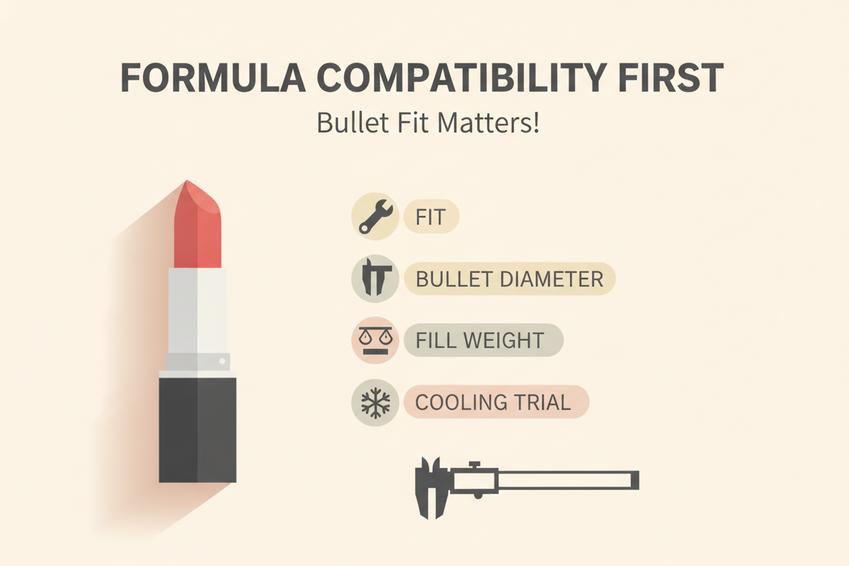 Start With Formula Compatibility
Match the Tube Format to the Lipstick Formula
Traditional solid lipstick, softer balm, lip-and-cheek sticks, and slim bullets place different demands on a package. Hardness and melting point affect bullet support, while filling method influences cup geometry and usable space. A slim bullet can become fragile with a soft formula; a broad stick may need a deeper cup. Treat photographs as style references, not proof of lipstick formula compatibility. Even a guide to formula and lipstick-tube compatibility cannot replace final-formula trials.
Confirm Bullet Diameter, Fill Weight, and Cup Fit
Ask the formulator or filler for the lipstick bullet size, target fill weight, mold dimensions, and filling process. Compare them with cup diameter, lifting travel, insertion depth, and usable volume. Keep nominal capacity separate from compatible capacity: listed grams are a reference, not a guarantee for every density or mold. Approve empty lipstick containers for solid formulas only after the actual formula can be filled, cooled, raised, lowered, and used without cup release, scraping, wobble, or breakage.
 Compare Lipstick Tube Materials and Component Structures
 Compare Lipstick Tube Materials and Component Structures
Understand Which Components Affect Packaging Performance
The outer shell provides shape and a decorated surface. The cap protects the bullet and controls opening force. The inner cup supports the formula; the spiral or elevator converts rotation into vertical travel. The base provides leverage and stability. Seals, cushions, and weights affect retention, tactility, and transport protection. Review the system together: a premium shell cannot compensate for an unstable cup or mechanism.
Choose PP, ABS, PET, or Aluminum According to the Project
PP can support lightweight, simplified structures. ABS or ABS/AS suits projects needing rigidity, molded color, and decoration. PET may fit transparent or replaceable-cartridge concepts, such as the current MA-169 refillable lipstick tube. Aluminum can improve appearance and hand feel, but plastic parts may remain beneath the shell.
At Topfeelpack, we distinguish exterior material from the full bill of components. Source data lists MA-13 and MA-14 as PP-led structures with silicone seals. MA-15 uses aluminum-shell parts alongside a PP inner cap, POM screw and bullet carrier, ABS base and tail cap, and an iron weight. Material declarations should identify the complete assembly.
Decide Between Mono-Material, Mixed-Material, and Refillable Designs
A mono-material direction can simplify declarations and the intended recycling pathway. Mixed materials may deliver required mechanics or finish, but need a specific declaration. For refillable designs, test insert retention, removal, alignment, and repeated replacement. Do not assign either label from appearance alone.
Test the Mechanism, Closure, and Everyday User Experience
Check Twist-Up Movement and Bullet Stability
Cycle the mechanism through its full travel. Rotation should feel smooth, and the cup should rise and return without free spinning, binding, jumps, or fallback. Check lateral movement at several heights because a stable bullet may wobble when extended. Repeat after filling, conditioning, and drop testing; empty-component movement does not represent the loaded pack.
Evaluate Cap Retention and Travel Durability
Measure whether the cap is too loose or uncomfortably tight and whether snap, friction, or magnetic closure force is consistent across samples. Place conditioned packs in realistic handbag and transport simulations. After drops and temperature changes, confirm that the cap stays closed, the bullet remains protected, and the mechanism still turns.
Look for Small Details That Affect Daily Use
Record grip, opening effort, weight balance, base stability, scratches, and fingerprints. These details determine whether an attractive tube feels dependable after daily handling.
Plan Customization Without Increasing Production Risk
Choose Between a Stock Mold and a Private Mold
A stock mold usually shortens development and lowers first-order risk. A private mold is more appropriate for a proprietary structure, distinctive silhouette, or long-term product family. Before tooling, complete a structural review and approve a physical prototype. Put tooling cost, ownership, maintenance, modification rights, storage, and future-use terms in writing.
Match Decoration Methods to the Tube Surface
Injection color, spray coating, silk screen printing, hot stamping, metallization, and matte or gloss treatments behave differently on PP, ABS, PET, and aluminum. Topfeelpack’s source materials also list UV coating, electroplating, and laser etching as available directions. For a shaped option such as the MA-10 4.6G custom multi-color empty lipstick tube, confirm the printable area and curved-surface limits. Test adhesion and abrasion on the actual resin or metal finish instead of approving only a digital rendering.
Define Color and Artwork Approval Standards
Supply Pantone references and vector artwork, agree on acceptable color difference, and approve color on the real material and surface treatment. Lock the logo’s location, direction, dimensions, clear space, and print tolerance. The approved standard should also define how batch consistency will be judged under an agreed light source.
 Verify the Supplier Before Placing a Bulk Order
 Verify the Supplier Before Placing a Bulk Order
Review Manufacturing and Quality-Control Evidence
Ask which stages the supplier controls and which are outsourced. Topfeelpack’s documented process covers demand analysis, mold making and sample confirmation, raw-material inspection, molding, surface treatment, assembly and function testing, quality inspection, packaging, and logistics. Use that sequence as an audit map and request evidence for the steps relevant to the order.
Review material documents, test reports, and target-market certificates. Verify each certificate’s holder, scope, issuer, and validity.
Clarify MOQ, Samples, Lead Time, and Reorders
Define whether MOQ applies per model, molded color, artwork, or total purchase. Source materials distinguish stock samples, custom samples, and an optional pre-production sample (PPS). One page quotes 12,000 pieces per model, about seven days for samples, and about 45 days for mass production; other materials give broader ranges. Reconfirm the model, color split, decoration, first-order and reorder schedules, and change cutoff.
Agree on Defect Standards and Inspection Responsibility
Set defect limits for color variation, print misalignment, scratches, coating loss, loose caps, rough rotation, cup wobble, and carton damage. Topfeelpack’s materials describe final and optional third-party inspection. Agree on the inspector, sampling plan, release evidence, and rejected-lot remedy.
Use a Final Pre-Production Checklist for Wholesale Empty Lipstick Tubes
Information to Include in the Initial RFQ
• Formula type, bullet diameter, mold specification, and target fill weight
• Preferred tube shape, material direction, closure type, and quantity per SKU
• Number of colors or artworks, decoration requirements, target market, and required delivery date
Tests to Complete Before Mass Production
• Filling compatibility, twist-cycle movement, bullet stability, and cap retention
• Drop or transport simulation, temperature stability, and carton fit
• Decoration adhesion, abrasion, and color comparison on the actual finished surface
Topfeelpack’s customer materials list mechanical, hot-and-cold, aging, abrasion, color-calibration, and coating-consistency test directions. Request only the tests relevant to the selected structure and record the method and acceptance limit.
Details to Lock in the Approved Sample
Record the component and material list, dimensions, weight, tactile target, color standard, logo position, finish, closure force, packing method, and defect tolerance. Sign the PPS or golden sample and link it to the final specification. A reliable bulk order rests on measurable, recorded, reproducible sample standards, not renderings or verbal confirmation.
FAQ
Q: What Is the Typical MOQ for Wholesale Empty Lipstick Tubes?
A: MOQ varies by model, color, decoration, and mold route. One source quotes 12,000 pieces per model; confirm SKU-level terms.
Q: Which Materials Are Best for Wholesale Empty Lipstick Tubes?
A: No material is universally best. Choose PP, ABS, PET, aluminum, or a mixed structure by formula, mechanism, finish, refill strategy, and market requirements.
Q: Can Wholesale Empty Lipstick Tubes Be Customized With Logos and Brand Colors?
A: Yes. Options include molded color, spraying, screen printing, hot stamping, metallization, UV finishes, and laser details, subject to surface trials.
Q: How Should Wholesale Empty Lipstick Tubes Be Tested Before Bulk Production?
A: Complete filling, twist-cycle, bullet-stability, cap-retention, transport, temperature, decoration-adhesion, color, and carton-fit checks before approval.
Q: How Can Wholesale Empty Lipstick Tubes Be Matched to a Lipstick Formula and Bullet Size?
A: Confirm hardness, melting point, bullet diameter, fill weight, mold, cup dimensions, lifting travel, and filling process, then approve filled samples.

