 English
  Español de México
  Français
  Deutsch
  Português do Brasil
  Italiano
  한국어
한국어  ไทย
ไทย  Русский
  日本語
日本語  Polski
  Svenska
  Türkçe

Stop Product Waste with a High-Quality Glass Airless Pump Jar
May 13,2026
Product waste leaks revenue. airless pump jar glass packaging stops that leak entirely.
Luxury formulas degrade in open jars that invite air, microbial contamination, and unreachable bottom-jar residue. Precision vacuum pistons push every drop outward, maintaining formula freshness and profit margins.
Topfeel engineers emphasize in 2025 technical materials that controlled dispensing fundamentally protects active formulations from oxidative damage.
Reading Notes: airless pump jar glass Essentials
- Maximizes product protection using leak-proof vacuum technology to prevent oxidation.
- Ensures consistent, hygienic dosing via precision metered pumps and upward-moving pistons that eliminate residue.
- Shields photosensitive formulas using UV-resistant glass coatings for maximum shelf stability.
5 Reasons To Choose Airless Pump Jar Glass
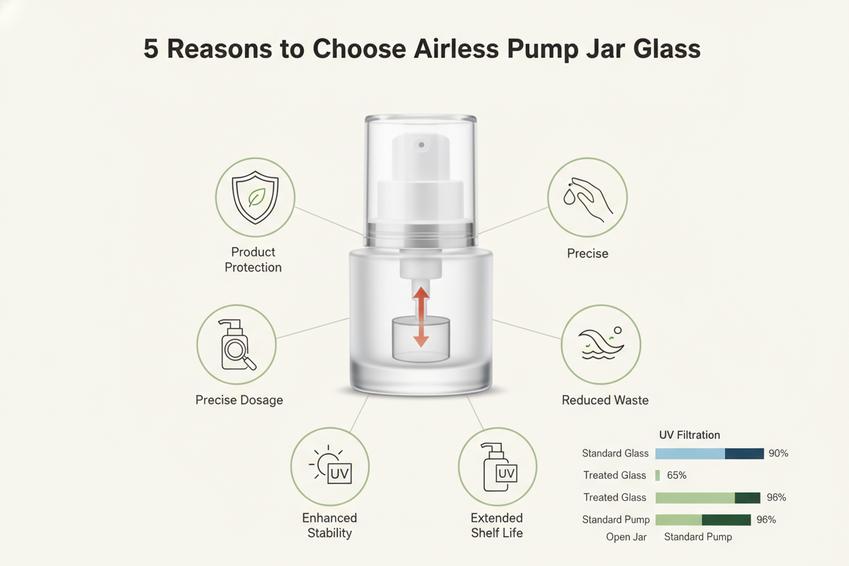
Selecting the right airless pump jar glass transcends aesthetics. It guarantees ingredient freshness, precise dosing, and maximum evacuation. Here is why industry leaders like Topfeel recommend it.
Leak-Proof Airless Technology for Zero Waste
The efficiency of an airless pump jar glass relies on advanced internal engineering:
-
Core Protection System
-
Vacuum chamber
- Creates an airtight seal via 0.1-0.2 bar pressure differentials
- Blocks oxygen entry completely
-
Precision valve
- Controls upward fluid flow
- Ensures spill prevention
-
Sealed actuator
- Maintains strict leak-proof performance
-
-
Product Safety Benefits
- Halts rapid oxidation
- Extends product preservation
- Achieves true zero waste
Hygienic Dosing Pump Ensures Consistent Serum Delivery
A premium airless pump jar glass functions as an exact serum dispenser:
- Delivers an accurate dosage (typically 0.2ml to 1.0ml per stroke)
- The hygienic pump prevents the thousands of bacterial CFUs introduced by finger-dipping
- Built-in systems guarantee contamination prevention
How it operates:
- Press actuator
- Internal pressure rises proportionally
- Product lifts seamlessly
- User receives controlled dispensing
For skincare brands utilizing Topfeel packaging, this ensures repeatable performance without over-pumping.
UV-Resistant Glass Protects Cosmetic Integrity
Premium glass prevents chemical leaching, but UV-resistant glass specifically shields active formulas from damaging 10nm-400nm light wavelengths, locking in ingredient stability.
| Material Type | UV Filtration (%) | Stability Retention (6 Months) |
|---|---|---|
| Standard Clear Glass | 20% | 72% |
| Frosted Coated Glass | 65% | 88% |
| UV-Resistant Glass | 90% | 96% |
Optimal UV filtration keeps product integrity intact, crucial for photosensitive peptides in a glass airless pump jar.
Upward Moving Piston Eliminates Product Residue
The upward piston modernizes the traditional dip tube mechanism.
- Eliminates tube clogging and high-viscosity “tunneling”
- Continuous vacuum lift mechanism
- Achieves 98-99% complete evacuation (compared to 70-80% in standard tubes)
Result?
- Minimal product residue
- A residue-free user experience
- Maximum full product usage
Durable 50ml Glass Outer Jar for Bulk Orders
The 50ml glass jar provides a thermal insulation barrier and premium density, often allowing brands to command a 15-20% retail premium.
Structure overview:
-
Exterior
- Thick durable glass wall
- Premium finish
-
Mid-layer
- Secure PP collar
-
Closure
- Tight cap seal
This sturdy design withstands bulk shipping stresses. Topfeel delivers airless pump jar glass in wholesale formats that perfectly balance durability with premium aesthetics.
🚀 Ready to eliminate product waste and elevate your brand’s unboxing experience? > Contact Topfeel’s engineering team today to request a sample of our premium glass airless pump jars and discover the zero-waste difference for your product line.
Stop Waste: Seal Cosmetics In Glass Pumps
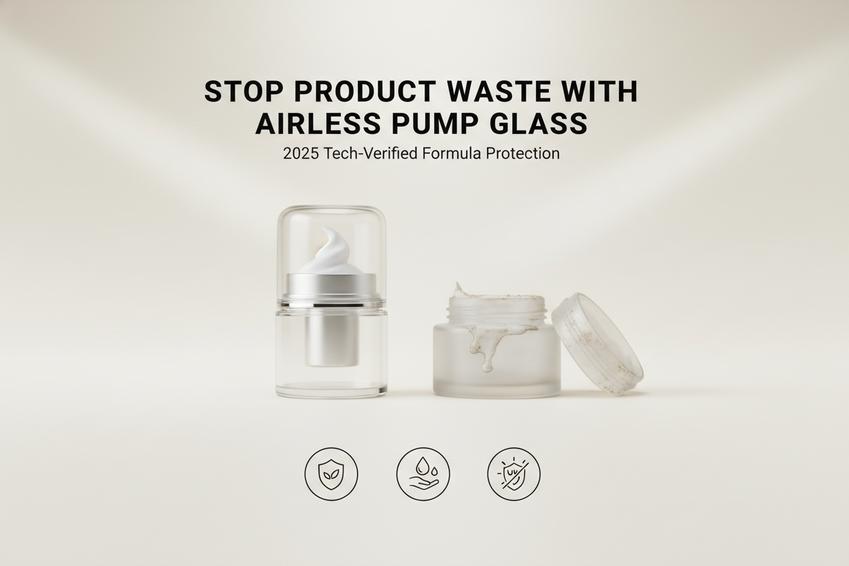
Intelligent packaging blocks light and pushes formulas upward. An airless pump jar glass protects sensitive chemistry while driving waste down to near zero.
How Airless Seals Prevent Oxidation and Contamination
An airless pump jar glass acts as a fortress for volatile actives.
-
Core Protection Logic
- Airless seal creates an absolute protective barrier.
- Vacuum technology lifts product without ambient air return.
- Oxygen starvation prevents up to 40% of the oxidation seen in open jars (crucial for Vitamin C/Retinol).
- Allows brands to reduce chemical preservatives by 20-30% due to lower contamination risks.
-
Impact on Formula
- Locks in product integrity.
- Prolongs botanical shelf life.
- Stabilizes emulsion textures.
-
Measured Performance Data
| Test Condition | Traditional Jar (O₂ %) | airless pump jar glass (O₂ %) | Bacterial Growth (CFU/g) |
|---|---|---|---|
| Day 0 | 21% | 2% | <10 |
| Day 7 | 18% | 2% | <10 |
| Day 14 | 15% | 3% | 15 |
| Day 30 | 12% | 3% | 18 |
| Day 60 | 10% | 4% | 25 |
Minimal oxygen means minimal degradation. This is why Topfeel champions the airless pump jar glass for high-value formulations.
Protect Your Lotion with UV-Resistant Glass Packaging
UV radiation accelerates light degradation, destroying active ingredients and product stability.
• Matte/coated glass packaging neutralizes sun damage. • Tinted airless pump jar glass preserves volatile colorants and fragrance profiles. • Thick-wall glass ensures thermal lotion protection during display.
A UV-coated airless pump jar glass mitigates temperature spikes, preventing emulsion separation.
Eliminate Residue: No Dip Tube Design Advantages
Legacy pumps rely on a dip tube, leaving expensive product clinging to the bottom.
-
Structural Upgrade
- No internal tube in the airless pump.
- Rising piston yields complete evacuation.
- Scraped inner walls mean zero product residue.
-
Daily Use Benefits
- Enhanced hygiene via sealed delivery.
- Highly efficient dispensing.
- Achieves corporate waste reduction metrics.
- Secures formula integrity.
Topfeel refines this architecture so brands secure beauty, chemistry, and efficiency in one glass airless pump jar.
Airless Jar Vs. Traditional Packaging: Comparison
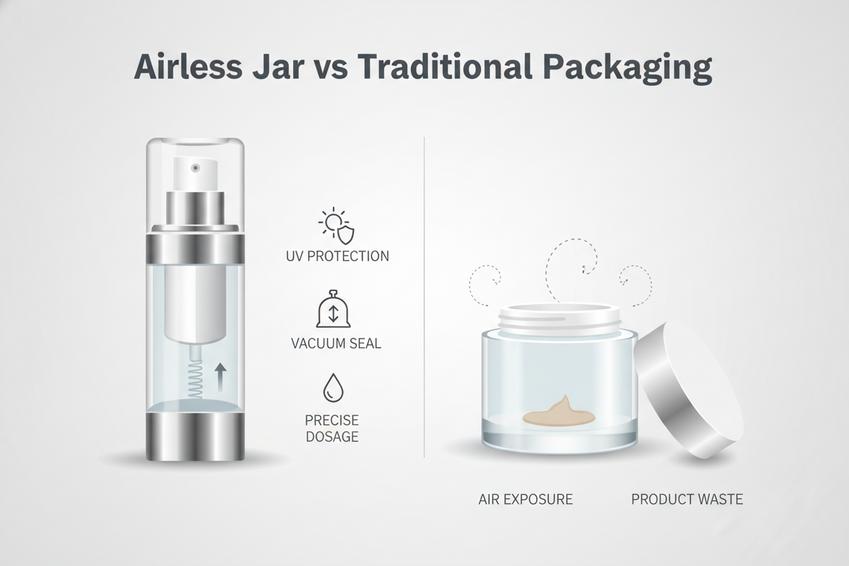
The cosmetic industry is seeing a 6.5% CAGR shift toward airless pump jar glass packaging to maximize product preservation.
Airless Jar
The airless pump jar glass integrates Glass material, a sealed chamber, and a precise Pump mechanism powered by Airless technology.
-
Core Structural Design 1.1 Outer Protection
- Glass material blocks UV/thermal damage.
- Guarantees Extended shelf life. 1.2 Internal System
- Vacuum piston prevents ambient air return.
- Ensures rigorous Contamination prevention. 1.3 Dispensing Head
- Pump mechanism delivers exact Precise dosage.
-
Functional Advantages 2.1 Product preservation
- Negligible oxygen contact.
- Stops formula breakdown. 2.2 Waste reduction
- 99% evacuation.
- Zero pooling residue.
-
Practical Impact for Brands 3.1 Premium Look
- Heavyweight tactile luxury. 3.2 Hygiene
- Zero touch-contamination. 3.3 Cost Efficiency Over Time
- Drastically fewer spoilage returns.
Topfeel engineers the airless pump jar glass to seamlessly marry performance with prestige.
Traditional Packaging
Older formats utilize the Open-jar design or plastic dip tubes.
-
Structural Features 1.1 Open Access
- Constant Air exposure. 1.2 Tube-Based Pumps
- Draws air internally post-dispense.
-
Risk Factors 2.1 Product degradation
- Accelerated Oxidative damage. 2.2 Hygiene Concerns
- Massive risk of Bacterial contamination. 2.3 Performance Issues
- Inconsistent dispensing (sputtering).
- Up to 25% Material waste.
-
Long-Term Effects 3.1 Shorter usability window
- Severely Shorter shelf life. 3.2 Brand Perception
- Lacks the technological prestige of an airless pump jar glass.
FAQs about Airless Pump Jar Glass
Why is airless pump jar glass preferred for serum and cream packaging? It merges a protective outer glass wall with a vacuum piston system, isolating sensitive actives.
- Airless technology blocks oxygen contact
- Glass provides structural UV protection
- Metered actuators deliver exact microliter doses
- Leak-proof seals prevent daily-use oxidation
How does the no dip tube system reduce product waste? An upward-moving piston drives the formula.
- Eliminates tube clogging
- Pushes high-viscosity gels upward evenly
- Achieves 98-99% evacuation
What materials are used in airless pump jar glass construction? Components are selected for chemical inertness:
- Outer jar: Glass (prevents chemical leaching)
- Pump/Actuator: PP or POM
- Collar: PP or ABS
- Inner bottle: PP or AS Glass heavily outperforms PET/Acrylic in UV resistance and tactile premiumization.
How does airless technology protect cosmetic formulas? It forms a vacuum chamber that dispenses product while simultaneously blocking backflow. ✓ Halts oxygen exposure ✓ Mandates hygienic dispensing ✓ Secures fragrance/color stability ✓ Drastically extends emulsion shelf life
What customization options are available for different capacities? Sizing, treatment, and components are fully adaptable to brand aesthetics.
| Capacity | Common Use | Decoration Options |
|---|---|---|
| 15ml / 1oz | Eye serum, essence | Silk screen printing, hot stamping |
| 30ml | Serum, gel | Frosted finish, spray coating |
| 50ml | Cream, lotion | Metallization, matte finish |
| 100ml / 2oz | Treatment cream | Clear finish + custom collar |
Flexible sizing maintains leak-proof integrity while allowing for highly customized, clinical, or luxurious retail presentations.
📦 Protect your formulas and your profit margins. Whether you need 15ml eye serum pumps or 100ml treatment cream jars, Topfeel delivers customizable, wholesale packaging solutions engineered for ultimate performance. Get a Custom Wholesale Quote from Topfeel Today
References
- microbial contamination – fda.gov
- oxidative damage – ncbi.nlm.nih.gov
- photosensitive formulas – dermatologytimes.com
- shelf stability – cosmeticsbusiness.com
- pressure differentials – engineeringtoolbox.com
- bacterial CFUs – cdc.gov
- chemical leaching – niehs.nih.gov
- thermal insulation barrier – energy.gov
- retail premium – forbes.com
- volatile actives – allure.com
- chemical preservatives – ewg.org
- UV radiation – who.int
- light degradation – springer.com
- waste reduction – epa.gov
- Glass material – cmog.org

