 English
  English (UK)
  English (Australia)
  English (Canada)
  العربية
  Deutsch
  Italiano
  Español de México
  Tiếng Việt
  ไทย
ไทย  Português do Brasil
  Français
  Български
  Čeština
  Dansk
Dansk  Ελληνικά
  Eesti
Eesti  Suomi
Suomi  Magyar
  Bahasa Indonesia
  Lietuvių kalba
  Latviešu valoda
  Norsk bokmål
  Nederlands (Formeel)
  Polski
  Română
  Русский
  Slovenčina
  Slovenščina
  Svenska
  Türkçe
  Українська
  简体中文
简体中文  日本語
日本語  한국어
한국어  繁體中文
繁體中文 

Are Sunscreen Bottles Recyclable
March 20,2026
Are sunscreen bottles recyclable? That question pops up right when you’re locking in a bulk order and your sustainability team starts circling like hawks. One wrong resin choice and suddenly your “eco-friendly” launch feels like showing up to a beach cleanup with a plastic straw. Buyers aren’t just picking colors and pump styles anymore—they’re guarding brand reputation, regulatory checklists, and long-term supply contracts all at once.
The pressure’s real. According to the 2024 U.S. Plastics Pact report, brands are accelerating commitments to recyclable or reusable packaging by 2025–2030 targets, and retailers are watching closely. As one Topfeelpack senior engineer shared in a 2025 supplier briefing, “Mono-material design isn’t a trend—it’s risk control.” Short, blunt, and true.
So before signing that next PO, it pays to know which bottles actually make it through the recycling stream—and which ones just look the part on Instagram.
Which Sunscreen Bottle Plastics Are Recyclable?
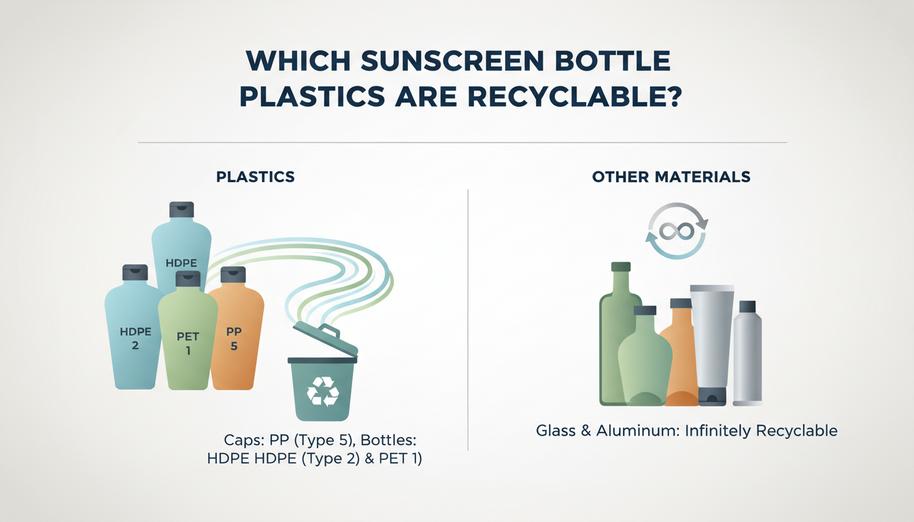
If you’ve ever stood over a recycling bin asking, are sunscreen bottles recyclable, you’re not alone. The answer depends on material, local systems, and design choices. Let’s break down how HDPE plastic, PET plastic, PP plastic, glass, and aluminum perform—and how smart packaging makes sunscreen bottles recyclable in real life.
HDPE plastic and PCR content: a recycling win
When people ask, are sunscreen bottles recyclable, HDPE plastic often leads the conversation.
-
Material type
-
HDPE plastic (#2)
- Common in lotion-style sunscreen bottles
- Accepted in most curbside recycling streams
-
-
Sustainability upgrade
-
Post-Consumer Recycled (PCR) resin
- Reduces virgin resin use
- Supports brand sustainability goals
-
-
System impact
- Strong demand in material recovery markets
- Stable feedstock for new bottle manufacturing
In simple terms, sunscreen bottles made from HDPE are recyclable in many cities. Add PCR, and sunscreen bottles recyclable claims become more credible. Brands like Topfeelpack help clients design HDPE bottles that align with traceability rules while keeping performance solid.
PET plastic’s lightweighting edge in recyclability
Still wondering, are sunscreen bottles recyclable when made from clear plastic? PET plastic (#1) is a big player.
-
Lightweighting through blow molding
- Less resin
- Lower transport emissions
-
High global recyclability
- Widely collected
- Strong secondary market demand
-
Smart packaging design
- Clear labeling
- Easy-to-remove sleeves
Because of its resource efficiency, PET keeps sunscreen bottles recyclable across many consumer goods supply chains. Topfeelpack often recommends PET for brands shipping globally, where recycling sunscreen bottles depends on standardized material flows.
PP plastic vs. Biodegradable polymers: which is better?
The debate gets real here. Are sunscreen bottles recyclable if made from PP plastic (#5)? Sometimes yes, sometimes tricky.
-
PP plastic
- Used for caps and pumps
- Recyclable in selected regions
-
Biodegradable polymers
- Marketed for compostability
- Limited industrial compost access
- Risk of contaminating recycling loads
From a material science view, end-of-life options matter more than marketing buzz. If infrastructure is weak, biodegradable options may reduce actual recycling sunscreen bottles rates. In contrast, PP components designed for easy separation improve real environmental impact outcomes.
Glass containers and aluminum tubes in closed-loop systems
If someone keeps asking, are sunscreen bottles recyclable, glass and aluminum bring strong answers.
-
- Part of mature closed-loop systems
- High reuse in refillable packaging
-
Aluminum tubes
- Infinite material reuse potential
- Core to the circular economy
Trade-off?
- Heavier weight
- Higher shipping emissions
Yet collection rates are high, and quality loss is minimal. In regions with solid recycling infrastructure, sunscreen bottles recyclable claims are strongest when tied to glass or aluminum. For brands serious about recycling sunscreen bottles at scale, Topfeelpack explores these formats while balancing cost, weight, and shelf appeal.
So next time someone asks, are sunscreen bottles recyclable, the honest answer is: yes—if the material, design, and recovery system all line up.
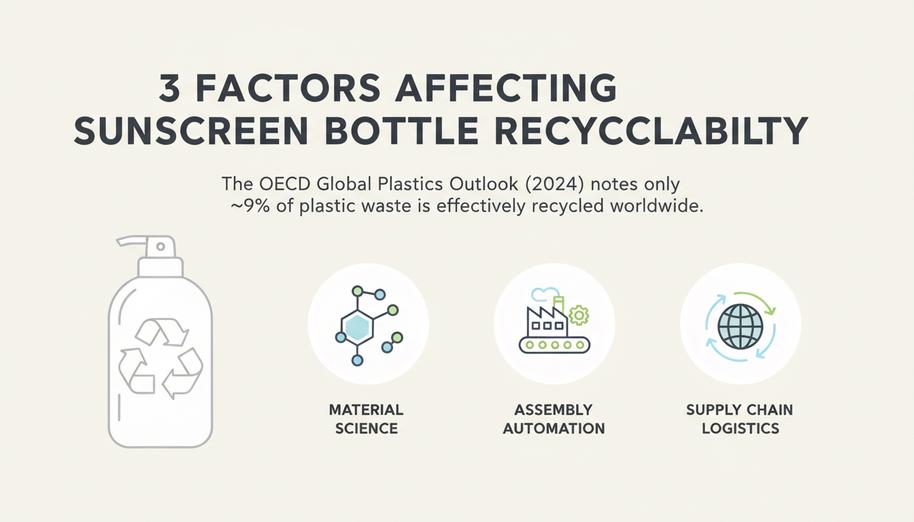
3 Factors Affecting Sunscreen Bottle Recyclability
People keep asking, are sunscreen bottles recyclable or just trash in disguise? The answer depends on material, design, and logistics. If you’ve ever wondered are sunscreen bottles recyclable in real life, not just in theory, these three factors make all the difference.
Packaging material choice and blow molding impact
When brands ask, are sunscreen bottles recyclable, the starting point is material science.
-
Plastic resin type
-
PET
- High clarity
- Widely accepted in curbside recycling
- Compatible with many Recycling facility capabilities
-
HDPE
- Strong chemical resistance
- Popular in sunscreen packaging
- Performs well in standard recycling streams
-
LDPE and Polypropylene
- Flexible but often face limited sorting acceptance
-
-
Blow molding process
-
Controls Bottle wall thickness
- Thin walls reduce Material density
- Over-lightweighting may affect detection in Sorting technology
-
Impacts shape recognition during automated scanning
-
If the wrong Plastic resin type is paired with complex molding, people will still ask, are sunscreen bottles recyclable, and the honest answer might be “not easily.”
The OECD Global Plastics Outlook (updated 2024) notes that only about 9% of plastic waste is effectively recycled worldwide, largely due to material complexity and sorting inefficiencies.
Smart manufacturers like Topfeelpack evaluate resin compatibility before mass production, keeping recyclability realistic, not just a marketing line.
Mono-material construction with assembly automation
A quick checklist brands follow when debating, are sunscreen bottles recyclable:
- Use a Single polymer type for bottle and Cap material.
- Avoid mixed Pump mechanism springs unless detachable.
- Select washable Label adhesive.
• Cleaner Material compatibility means higher Recycling stream purity.
• Automated assembly improves Manufacturing efficiency and traceability.
• Better design reduces manual disassembly at recovery centers.
Short version? Fewer material mixes, fewer headaches. If sunscreen packaging recyclable design is done right, facilities don’t need to guess what goes where. Topfeelpack often promotes mono-structure packaging so when customers ask, are sunscreen bottles recyclable, the answer is clearer and more confident.
Supply chain logistics: collection, sorting, and lead times
Even if design is perfect, logistics decide the final outcome.
-
Collection infrastructure
-
Urban areas
- Higher Recycling rates
- Lower Transportation costs
-
Rural areas
- Limited access
- Higher contamination risk
-
-
Recycling facility capabilities
- Advanced optical Sorting technology
- Adequate Processing capacity
- Strict contamination thresholds
-
External variables
- Geographic location
- Material contamination
- Long international lead times affecting PCR integration
So, are sunscreen bottles recyclable in theory? Often yes. Are sunscreen bottles recyclable in practice? That depends on how smoothly this whole chain runs. When brands align material, automation, and logistics, recyclability stops being a buzzword and starts becoming normal.
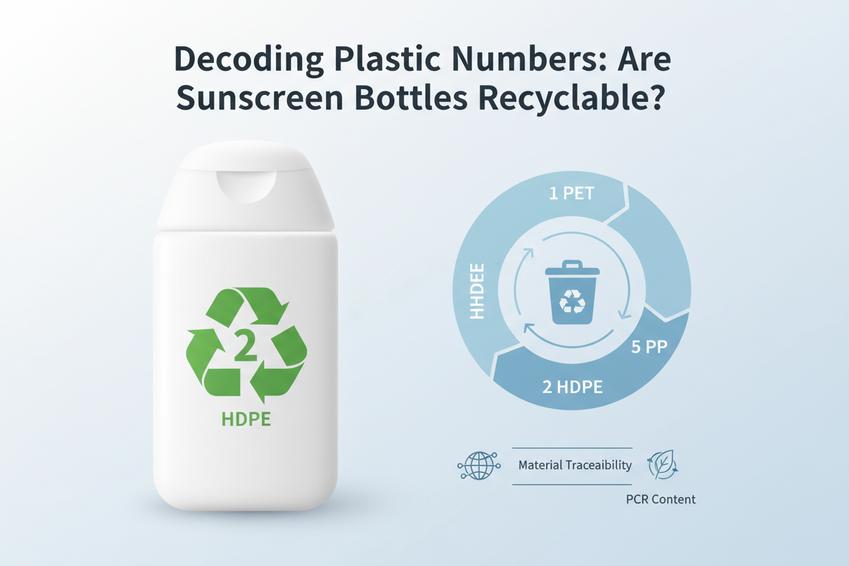
Recycling Labels: Decoding Plastic Numbers On Bottles
Are sunscreen bottles recyclable? It’s a fair question, especially when empty SPF containers pile up after summer. To answer “are sunscreen bottles recyclable,” you need to read the fine print—those tiny numbers and symbols. Once you get the hang of resin codes and certifications, sunscreen bottle recycling feels way less confusing.
Understanding resin identification codes for HDPE, PET, PP
When people ask, “are sunscreen bottles recyclable,” the real clue sits in the Resin Identification Code.
-
#1 PET (Polyethylene Terephthalate)
- Common use: lightweight sunscreen spray bottles
- Marked with Recycling Symbol and Number Codes “1”
- High acceptance in curbside programs
-
#2 HDPE (High-Density Polyethylene)
- Opaque squeeze tubes and lotion bottles
- Strong chemical resistance
- Widely processed in municipal streams
-
#5 PP (Polypropylene)
- Flip caps and pump components
- Higher heat tolerance
- Sometimes recyclable, depending on local rules
If you’re still wondering, are sunscreen bottles recyclable, check the base. The Plastic Type matters more than color or brand. Some parts recycle easily; mixed materials make sunscreen bottle recycling harder.
Material traceability and PCR content disclosures
To understand are sunscreen bottles recyclable, look beyond the number.
-
Material Traceability
- Tracks resin origin
- Links suppliers across the Supply Chain
-
PCR Content (Post-Consumer Recycled)
- Verified % of Recycled Content
- Clear Disclosure builds Transparency
Brands that publish PCR data make it easier to answer, are sunscreen bottles recyclable in real systems, not just in theory. Topfeelpack supports audited sourcing so recycled inputs are documented, not guessed. That kind of openness turns “are sunscreen bottles recyclable” into a confident yes for many formats.
Regulatory compliance and ISO certification marks
If you’re asking are sunscreen bottles recyclable, certifications offer backup.
-
Regulatory Compliance
- Meets local Environmental Regulations
- Follows strict Labeling Requirements
-
ISO Certification
- Environmental management (ISO 14001)
- Quality control systems
- Verified through third-party Auditing
-
Certification Mark
- Confirms tested materials
- Aligns with recognized Standards
In short, are sunscreen bottles recyclable? When the right Plastic Type, verified PCR data, and clear certification marks line up, the odds improve. Topfeelpack integrates compliance and recyclable design, helping brands answer the big question—are sunscreen bottles recyclable—with clarity instead of confusion.
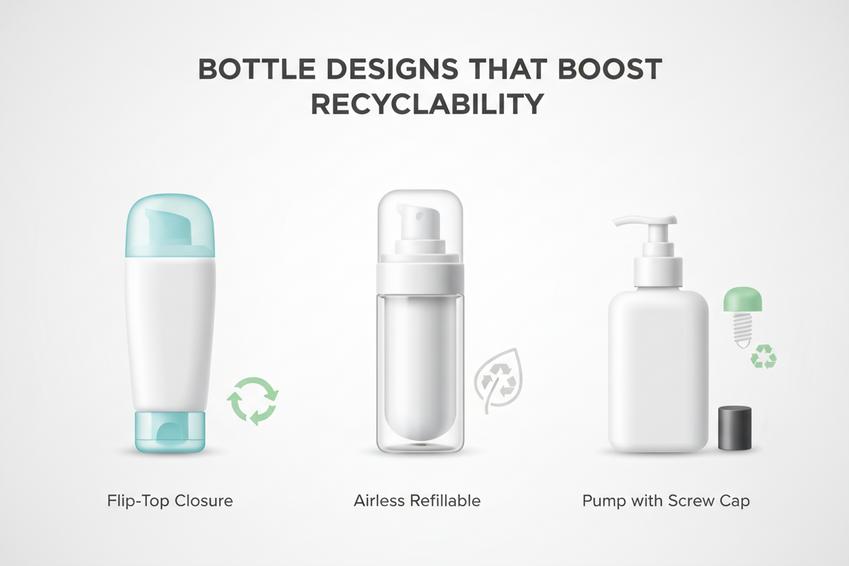
Bottle Designs That Boost Recyclability
Sunscreen is a daily essential, but many people still ask, are sunscreen bottles recyclable? Break that down—are sunscreen bottles recyclable, are sunscreen bottles reusable, can sunscreen bottles be recycled—and the answer depends heavily on smart packaging design. Let’s unpack what actually makes bottles easier to recycle.
Flip-top closures on mono-material bottles
When brands ask, are sunscreen bottles recyclable, the design of a flip-top closure matters more than most expect.
-
Material alignment
-
Mono-material bottle
- Same PP resin in bottle body and cap
- Improved material compatibility in the recycling stream
-
Result: fewer sorting errors
-
-
Recycling efficiency
-
- Reduced need for disassembly
-
- Cleaner recyclable plastic output
-
- Higher acceptance in curbside systems
-
-
User experience
- Easy squeeze
- Snap-shut lid
- Better ease of use
A tight resin match means less contamination. If sunscreen bottles are recyclable in theory but use mixed polymers, recovery rates drop. Brands working with Topfeelpack often shift to PP-only systems to answer clearly: yes, are sunscreen bottles recyclable? With mono-material design, much more likely.
“Design for recyclability is moving upstream, with mono-material packaging gaining measurable traction in personal care,” noted Euromonitor International in its 2025 beauty packaging update.
Pump dispensers paired with recyclable screw caps
A pump dispenser feels premium. Still, when consumers wonder, are sunscreen bottles recyclable, pumps complicate things.
Here’s the issue:
- Mixed springs, elastomers, and housings interrupt the recycling stream.
- Poor material separation lowers recovery value.
A smarter route blends formats:
- Detachable pump
- Replaceable recyclable screw cap
- Streamlined component design
In real-world product lifecycle planning:
- Keep the pump reusable.
- Make the bottle mono-material.
- Allow easy twist-off before disposal.
Short answer to are sunscreen bottles recyclable? Bottles with removable pumps and clean caps stand a better chance. This also supports brands asking if sunscreen packaging is eco friendly. Thoughtful pairing makes recycling sunscreen bottles less confusing for everyday users.
Airless bottles engineered for refillable design
The question are sunscreen bottles recyclable shifts when a airless bottle becomes refill-ready.
-
Core structure
-
Durable outer shell
- Designed as reusable components
- Tested for refill cycles
-
Replaceable inner cartridge
-
-
Sustainability impact
- Lower waste reduction metrics over time
- Supports sustainable packaging goals
-
Consumer convenience
- Controlled dosing
- Cleaner storage
- Travel-safe lock
Instead of asking are sunscreen bottles recyclable after one use, refillable systems reduce disposal frequency altogether. That’s a practical upgrade. Topfeelpack develops airless formats where refill cartridges slide in smoothly, keeping performance high while cutting plastic per use cycle.
Ergonomic form factor to optimize lightweighting
Lightweight doesn’t mean flimsy. A well-shaped ergonomic form factor can trim grams without hurting shelf appeal.
Key moves:
- Wall thickness tuning for material reduction
- Ribbed panels for strength
- Slim neck finishes for packaging efficiency
Quick wins brands track:
- 8–15% resin savings
- Better product handling
- Lower freight emissions
When people type are sunscreen bottles recyclable into search bars, weight also matters. Less plastic equals easier resource conservation and improved recycling yield. Smart lightweighting paired with mono-material builds answers the big question—are sunscreen bottles recyclable—with a confident yes, especially when design choices are made from day one.
FAQs about Are Sunscreen Bottles Recyclable
Which sunscreen bottles are recyclable on a large scale?
Most recyclable options come down to material choice and smart construction:
- HDPE plastic (#2) – widely accepted, durable for squeeze tubes and blow molding.
- PET plastic (#1) – clear, lightweight, easy to process in global distribution.
- PP plastic (#5) – common in flip-top closures and screw caps.
Recyclability improves further when brands use mono-material construction, align bottle and cap resin types, and simplify assembly automation. That balance supports material traceability, lightweighting, and smoother warehousing flows.
Does PCR content make sunscreen bottles more recyclable?
Post-consumer recycled plastic (PCR content) reduces virgin resin use and strengthens sustainability claims, but recyclability still depends on local sorting systems.
Short overview:
| Aspect | Impact on Buyers |
|---|---|
| PCR content | Cuts raw material demand |
| ISO certification | Ensures quality consistency |
| Supplier audits | Confirms traceability |
| Regulatory compliance | Supports global distribution |
For procurement teams managing inventory across regions, documented material safety data sheets and compatibility testing matter just as much as recycled content.
How can packaging design boost recyclability without raising costs?
Smart design reduces waste and production friction at the same time:
- Choose mono-material HDPE or PP for bottle and cap.
- Replace pump dispensers with detachable screw caps or flip-top closures.
- Consider refillable design options such as airless bottles.
Injection molding and blow molding processes adapt easily to these formats, keeping minimum order quantity and lead times under control while protecting shelf appeal.
Are sunscreen bottles recyclable if they use pump dispensers?
Pump dispensers create tension in the recycling stream.
- Mixed polymers
- Metal springs
- Complex dropper assemblies
These elements interrupt sorting systems and lower recyclability rates. Simple squeeze tubes or screw caps improve disassembly and reduce contamination. For brands focused on sustainability attributes, fewer components often mean better results.
How do different markets affect sunscreen bottle recyclability?
Recyclability shifts with infrastructure and logistics. Three factors shape outcomes:
- Local acceptance of HDPE plastic, PET plastic, or PP plastic
- Accuracy of sorting facilities
- Efficiency of shipping methods and warehousing systems
In regions with strong inventory management and recycling networks, mono-material construction performs best. In weaker systems, even recyclable packaging may still end up in landfill.
Are glass containers, aluminum tubes, or biodegradable polymers better options?
Each material carries its own trade-offs:
- Glass containers – highly recyclable, premium brand aesthetics, heavier shipping weight.
- Aluminum tubes – strong closed-loop recycling, durable through extrusion and decoration techniques.
- Biodegradable polymers – designed for compostability, yet often incompatible with traditional recycling streams.
For luxury refillable design lines, glass and aluminum support long-term use. Biodegradable polymers demand industrial composting conditions, which many cities lack. The right answer depends on user experience goals, regulatory compliance demands, and global distribution strategy.
References
- [U.S. Plastics Pact report] – usplasticspact.org/U.S. Plastics Pact
- [recycling stream] – epa.gov/EPA
- [HDPE plastic] – plasticsindustry.org/Plastics Industry Association
- [PET plastic (#1)] – https://www.google.com/search?q=napcor.com/NAPCOR
- [PP plastic (#5)] – https://www.google.com/search?q=americanchemistry.com/American Chemistry Council
- [compostability] – bpiworld.org/BPI
- [environmental impact] – worldwildlife.org/WWF
- [closed-loop systems] – ellenmacarthurfoundation.org/Ellen MacArthur Foundation
- [circular economy] – unep.org/UNEP
- [OECD Global Plastics Outlook] – oecd.org/OECD
- [Resin Identification Code] – astm.org/ASTM International
- [ISO 14001] – iso.org/ISO
- [Euromonitor International] – https://www.google.com/search?q=euromonitor.com/Euromonitor
- [sustainable packaging] – sustainablepackaging.org/Sustainable Packaging Coalition
- [material compatibility] – plasticsrecycling.org/Association of Plastic Recyclers

