 English
  Español de México
  Français
  Deutsch
  Português do Brasil
  Italiano
  한국어
한국어  ไทย
ไทย  Русский
  日本語
日本語  Polski
  Svenska
  Türkçe

Need a Lipgloss Tube Vendor? Compare Wholesale Options Here
July 03,2026
A reliable lipgloss tube vendor dictates the success of your product launch. Subpar suppliers introduce risks like formula leakage, applicator detachment, and delayed timelines that damage brand equity. Comparing wholesale lip gloss tube options ensures compatibility with your formulation and operational budget, mitigating e-commerce return risks.
Harmonic Reading Notes: Lipgloss Tube Vendor Essentials
→ Material Match: Compare plastic, PETG, acrylic, or glass based on cost, chemical compatibility, and clarity.
→ Closure Choice: Opt for screw caps, snap-ons, or tamper seals to balance leak resistance against high-speed assembly.
→ Applicator Fit: Select doe-foot, rollerball, or brush tips based on liquid viscosity and application precision.
→ Quality Vetting: Request physical samples, audit wiper internal diameters, and verify PCR certifications for sustainable production.
 5 Key Lipgloss Tube Vendor Selection Factors
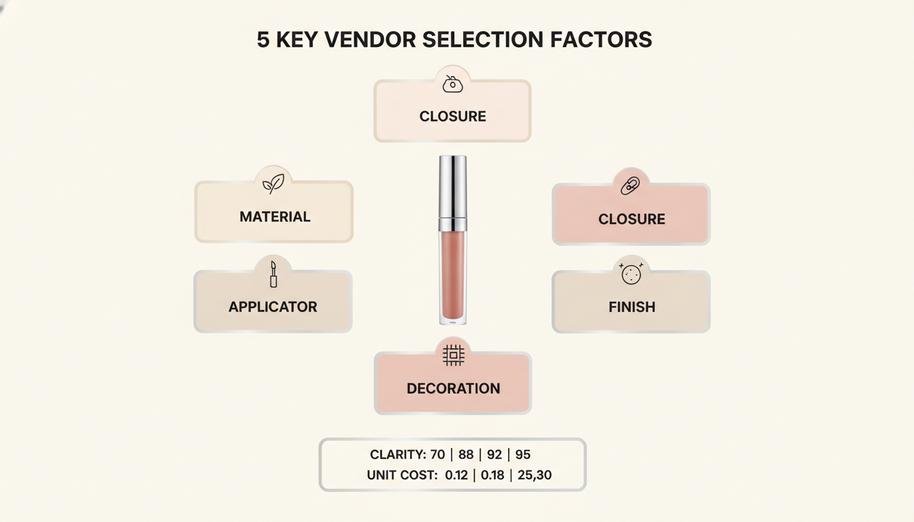 5 Key Lipgloss Tube Vendor Selection Factors
Finding the right lipgloss tube vendor requires rigorous vetting of cosmetic packaging specifications. Success hinges on matching materials, closures, and structural design to the chemical profile of your formula.
Material Matters: Comparing Plastic, PETG, Acrylic & Glass
Selecting the optimal container material dictates product stability and aesthetic appeal. A specialized vendor should provide clear technical breakdowns:
- Plastic (PP): Lightweight, budget-friendly packaging with high chemical resistance.
- PETG: Exceptional clarity and superior impact resistance. A clear lip gloss packaging petg wand is highly favored for visually driven formulations.
- Acrylic: Thick walls providing a premium, glass-like aesthetic with lower fragility.
- Glass: Ultimate luxury weight and recyclability, though requiring protective secondary packaging.
Compare technical data to ensure product viability:
| Material | Clarity (%) | Impact Resistance (kJ/m²) | Avg. Unit Cost (USD) |
|---|---|---|---|
| Plastic (PP) | 70 | 3.5 | 0.12 |
| PETG | 88 | 6.8 | 0.18 |
| Acrylic | 92 | 4.2 | 0.25 |
| Glass | 95 | 2.1 | 0.30 |
- Match formula viscosity with material compatibility.
- Confirm chemical stability through accelerated aging tests.
- Request ISTA 3A drop-test reports.
Reliable manufacturers like Topfeelmakeup provide migration testing and long-term thermal stability data (e.g., 50°C high to –15°C low for 48 hours).
Closure Choices: Screw Cap, Snap-On & Tamper-Evident Seal
A leaking gloss severely degrades customer trust. Vendors must engineer closure mechanisms with precise dimensional tolerances to pass rigorous torque retention testing.
- Screw cap
- Deep thread engagement for high-pressure sealing.
- Optimal for preventing e-commerce transit leaks.
- A twist cap lip gloss packaging design provides excellent airtightness.
- Snap-on
- Rapid assembly for automated filling lines.
- Lower production time and overhead.
- Tamper-evident
- Breakable safety rings ensuring retail security.
- Aligns with strict FDA regulations for consumer protection.
According to Grand View Research, demand for tamper-evident cosmetic packaging is rising at over 5% CAGR as consumers expect visible product security.
Applicator Match: Doe-Foot vs. Rollerball vs. Brush Tips
The applicator determines the product’s sensory payoff. Fibers must align with the formula’s specific centipoise (CP) viscosity.
- Doe-foot: Flocked precision application, ideal for highly pigmented liquids.
- Rollerball: Smooth delivery system for cooling lip oils.
- Brush tip: Flexible synthetic bristles for even spreadability. An engineered lip tint container with precision tip prevents pooling.
Strategic applicator sourcing involves:
- Defining the exact formula viscosity range.
- Testing the absorption level of the applicator fiber density.
- Running 500-cycle insertion stress tests.
- Evaluating neck wiper diameter tolerance (±0.05 mm).
Surface Appeal: Glossy, Matte, Frosted or Soft-Touch Finishes
Surface finishes communicate brand positioning immediately on the shelf.
- Glossy: High light reflection for bold retail presence.
- Matte: Elegant, fingerprint-resistant diffusion. Sourcing a matte lip gloss tube oem is ideal for muted, modern branding.
- Frosted: Soft-focus aesthetic that partially obscures fill levels.
- Soft-touch: Premium tactile grip achieved via specialized spraying.
Vendors must prove coating durability against wear and tear:
- ASTM D3359 cross-hatch adhesion testing.
- Alcohol rub resistance (minimum 40 back-and-forth frictions).
- UV weather resistance simulation.
Decoration Methods: Screen Printing, Hot Stamping & Labeling
Custom branding requires decoration methods that scale consistently without registration drift.
- Screen printing: Durable, high-resolution ink application on curved containers.
- Hot stamping: Metallic foil embellishment applied under heat and pressure.
- Labeling: High-speed, flexible branding for multi-SKU product lines.
Evaluation checklist for scalable decoration:
- Ink adhesion stability on the primary material.
- Registration accuracy tolerance (±0.2 mm).
- Color consistency across 10,000+ unit runs utilizing D65 light source calibration.
- Predictable lead times for high-volume repeats.
 How to Vet a Lipgloss Tube Vendor
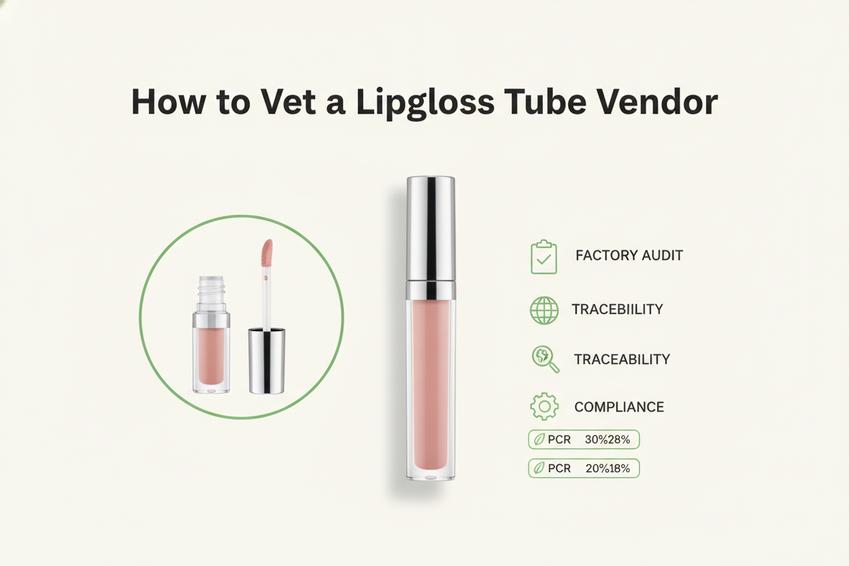 How to Vet a Lipgloss Tube Vendor
Sourcing cosmetic packaging requires rigorous operational audits. Moving beyond unit price, brands must assess regulatory compliance, component tolerances, and factory quality control standards.
Checking PCR and Post-Consumer Recycled Certification
Sustainable claims require verifiable documentation aligned with the EU Packaging Directive.
- Material Verification 1.1 Confirm declared PCR percentage against batch records. 1.2 Validate Post-Consumer Recycled origin documentation. 1.3 Review third-party SGS or intertek Certifications.
- Compliance Review 2.1 Cross-check Recycled Content against FDA packaging safety guidelines. 2.2 Assess Material Sourcing traceability to origin facilities.
- Sustainability Alignment 3.1 Match claims to corporate Sustainability targets. 3.2 Audit life-cycle material flow.
| Item Tested | Declared PCR % | Certified % | Traceable Source | Pass/Fail |
|---|---|---|---|---|
| Tube Body | 30% | 28% | Yes | Pass |
| Cap | 50% | 50% | Yes | Pass |
| Wiper | 0% | 0% | N/A | Pass |
| Ferrule | 20% | 18% | Partial | Review |
Requesting Tube Body and Ferrule Production Samples
Always require off-tool production samples prior to mass manufacturing to evaluate mechanical performance.
- Evaluate Tube Body clarity and wall thickness uniformity. An unblemished square clear lip gloss bottle indicates excellent mold flow.
- Inspect seam smoothness to prevent in-transit cracking.
- Test Ferrule crimp strength and cap alignment (tolerance within 0.3 mm).
- Conduct a physical assessment for aesthetic flaws.
- Measure torque resistance (Formula: thread-profile diameter ÷ 2).
- Validate leak prevention under vacuum testing.
Working with an integrated manufacturer like Topfeelmakeup ensures samples match mass-production outputs via strict GMPc protocols.
On-Site Audit: Verifying Wiper Quality and Quality Control
Physical facility audits confirm operational capability and adherence to ISO 22716 (Cosmetics GMP).
- Manufacturing Process Review 1.1 Inspect virgin resin storage and contamination protocols. 1.2 Observe automated wiper insertion lines. 1.3 Monitor in-line Quality Control stations.
- Wiper Quality Assessment 2.1 Measure internal diameter scraping tolerances. 2.2 Perform pull-out resistance testing to prevent applicator failure.
- Quality Assurance Metrics 3.1 Review defect rate logs. 3.2 Assess random sampling frequency. 3.3 Confirm final AQL inspection standards.
“Sustainable cosmetic packaging is moving from optional to expected, with traceability and quality transparency driving supplier selection,” noted a recent McKinsey packaging report.
Lipgloss Tube Vendor vs. Generic Suppliers
The distinction between specialized manufacturers and generic traders dictates product failure rates. Partnering with a dedicated wholesale lip gloss tube supplier secures supply chain integrity.
Lipgloss Tube Vendor
A specialized manufacturer engineers packaging specifically for the chemical demands of cosmetics, ensuring tight sealing torque and applicator compatibility.
- Custom materials formulated for complex chemical bases.
- Comprehensive component stress testing during active production.
- In-house mold design and rapid 3D prototyping capabilities.
- Rigorous formula compatibility and migration testing.
- Applicator stem stress and wiper retention testing.
- Vacuum air-tightness validation.
| Test Item | Standard Range | Failure Rate (%) | Impact on Returns (%) |
|---|---|---|---|
| Cap Torque | 0.35–0.55 Nm | 1.8 | 12 |
| Wiper Fit | ±0.05 mm | 2.3 | 18 |
| Leakage Test | 48 hrs stable | 1.1 | 21 |
Defective packaging accounts for a substantial portion of e-commerce returns, according to e-commerce logistics data, highlighting the need for specialized engineering.
Generic Suppliers
Broad-category distributors compete on aggregated scale, but often lack specialized cosmetic engineering.
- Reliance on pooled, multi-industry inventory.
- Simplified procurement with standard, unoptimized molds.
- Shared logistics networks prone to batch mixing.
While initial unit costs may appear lower, the lack of dimensional customization frequently leads to poor wiper fits and heightened leakage risks during transit.
Comparative Costs: Domestic vs. Overseas Vendors
Balancing landed costs against lead times requires strategic supply chain evaluation.
Domestic Vendors
Local sourcing provides rapid iteration, heightened oversight, and insulation against global freight volatility.
- Shorter transport routes drastically lower breakage and logistics costs.
- Faster delivery cycles support agile marketing launches.
- On-site quality assurance audits are highly accessible.
- Reduced exposure to currency fluctuations.
- Streamlined dispute resolution and rapid defect replacement.
- Stronger alignment on domestic regulatory compliance.
Topfeelmakeup supports localized fulfillment strategies by bridging global manufacturing with responsive domestic-level customer support.
Overseas Vendors
International manufacturers provide unparalleled scalability, advanced tooling, and aggressive unit pricing at volume.
- Access to extensive global manufacturing hubs and secondary processes.
- Massive production scale flexibility for major retail rollouts.
- Cost-effective bespoke mold creation.
- Requires rigorous factory audits (BSCI, Sedex).
- Necessitates proactive sampling and revision cycles.
- Demands robust management of customs duties and ocean freight logistics.
Can Your Lipgloss Tube Vendor Scale Up?
As retail distribution expands, your supplier must seamlessly transition from pilot runs to mass production without compromising AQL standards.
Production Capacity: From Small Runs to Custom Mold Orders
A sophisticated vendor provides phased scaling capabilities. Utilizing a custom dual lip gloss packaging mold requires distinct engineering from standard stock items.
- Pilot batch testing for formula/wiper validation.
- Mid-size production volume for direct-to-consumer drops.
- High-speed automated output capacity for global retail fulfillment.
- Manufacturing capability must include multi-cavity injection molding.
- In-house tooling departments accelerate custom adjustments.
- Advanced mold design enables proprietary, patentable shapes.
Lead Time Flexibility for High-Volume Plastic Tubes
Supply chain agility prevents stockouts during viral demand spikes.
- Validate historical turnaround time averages.
- Review raw material buffer stock protocols.
- Assess responsiveness to expedited reorders.
Topfeelmakeup leverages multiple GMPc workshops across 32,000㎡ to guarantee stable production timelines even during peak seasonal demand.
Supply Chain Resilience with Multiple Packaging Components
A resilient supply network, as recommended by Gartner, mitigates single-point failures across complex assemblies like a dual sided lip gloss packaging tube solution.
- Component sourcing
- Secure primary packaging materials via dual-supplier frameworks.
- Inventory management
- Maintain safety stock for high-turnover SKUs.
- Monitor material flow via ERP systems.
- Risk mitigation
- Diversify logistics routes to bypass port congestion.
Eco-Friendly Tubes: Vendor Sustainability Ratings
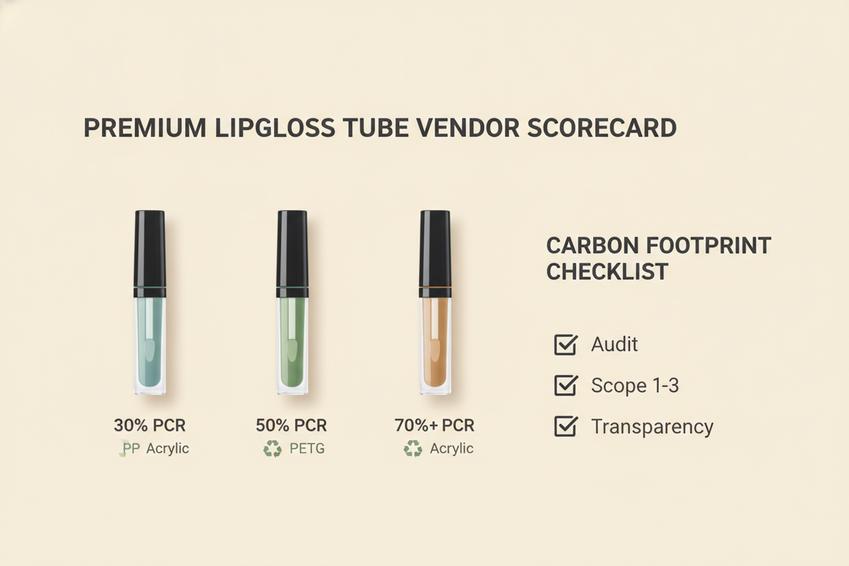 Eco-Friendly Tubes: Vendor Sustainability Ratings
Modern beauty consumers demand verifiable environmental accountability. Suppliers must provide transparent lifecycle data for all materials.
PCR Content Levels in Lipgloss Tubes
Replacing virgin resin with Post-Consumer Recycled plastics is central to the Ellen MacArthur Foundation packaging guidelines.
- 30% PCR: Base-level entry for sustainability claims with structural stability.
- 50% PCR: Significant virgin plastic reduction.
- 70%+ PCR: Aggressive environmental impact messaging (requires rigorous impact modifier testing).
- Audit the traceability of the PCR resin sourcing.
- Validate melt-flow indexes to prevent structural weakening.
- Ensure drop resistance and cosmetic clarity are maintained.
Recyclability of PETG, Polypropylene & Acrylic
End-of-life recovery depends heavily on municipal infrastructure alignment.
- Polypropylene (PP): High recyclability rates globally; highly stable material properties.
- PETG: Beautiful clarity, but often requires specialized sorting streams.
- Acrylic: Premium aesthetic but notoriously difficult to recycle.
Biodegradable Alternatives vs. Traditional Glass
Brands balancing luxury aesthetics with eco-consciousness face distinct material trade-offs.
- Assess local market recycling infrastructure.
- Analyze complete lifecycle assessment (LCA) data.
- Calculate scope 3 emissions generated by shipping weights.
- Compostable plastics: Require industrial composting facilities; risk of greenwashing if miscommunicated.
- Glass packaging: Infinitely recyclable, but heavy transport footprint increases carbon emissions.
Vendor Transparency in Carbon Footprint Reporting
Verified sustainability requires documented environmental disclosures.
- Rigorous greenhouse gas emissions tracking.
- Comprehensive supply chain mapping.
- Public environmental disclosure frameworks.
- Data access : Reporting on Scope 1, 2, and ideally Scope 3 emissions.
- Verification : ISO 14001 certification and third-party sustainability audits.
- Communication : Providing brand-ready data to substantiate retail claims.
When finalizing a supplier, an optimized tube lip gloss project merges precise engineering with sustainable compliance, ensuring your brand scales securely.
References
- Cosmetic Packaging Market Size – Grand View Research
- ISTA 3A Testing Standards – ISTA
- ASTM D3198 Torque Retention – ASTM
- ASTM D3359 Cross-Hatch Adhesion – ASTM
- EU Packaging and Packaging Waste Directive – European Commission
- ISO 22716 Cosmetics GMP – ISO
- Sustainability in Packaging – McKinsey
- Ecommerce Returns Logistics – Shopify
- Plastics and Circular Economy – Ellen MacArthur Foundation

