 English
  Español de México
  Français
  Deutsch
  Português do Brasil
  Italiano
  한국어
한국어  ไทย
ไทย  Русский
  日本語
日本語  Polski
  Svenska
  Türkçe

What Is the Empty Containers Weight?
May 13,2026
The empty containers weight dictates your packaging logistics. Every extraneous gram multiplies across pallets, driving up freight fees—especially in air transport where costs can average $4–$8 per kg.
Buyers chasing better pricing can’t afford guesswork. Material choice, wall thickness, and flashy finishes all add ounces that snowball into shipping drama. Get the weight right, and logistics calm down fast.
Quick Answers on Empty Containers Weight
- Material Matters: Glass, PET, HDPE or Acrylic drastically shift base weight (glass is roughly 6x heavier than PET).
- Closure Counts: From standard 2g screw caps to pump dispensers, add-ons like actuators stack an extra 10–15g.
- Wall & Size Impact: Thicker walls boost perceived luxury but elevate shipping mass.
- Process Precision: Injection or blow molding consistency minimizes resin waste and controls empty weight.
Stop Overpaying for Freight! > Want to trim those sneaky grams from your packaging budget? Contact Topfeel today for a custom packaging weight analysis and discover how our lightweight cosmetic solutions can protect your bottom line.
Empty Containers Weight Explained
When brands talk about cost control and shelf feel, empty containers weight becomes a critical metric. From empty jars to full cosmetic containers, every gram of weight counts. Understanding how physical components alter mass helps teams eliminate guesswork.
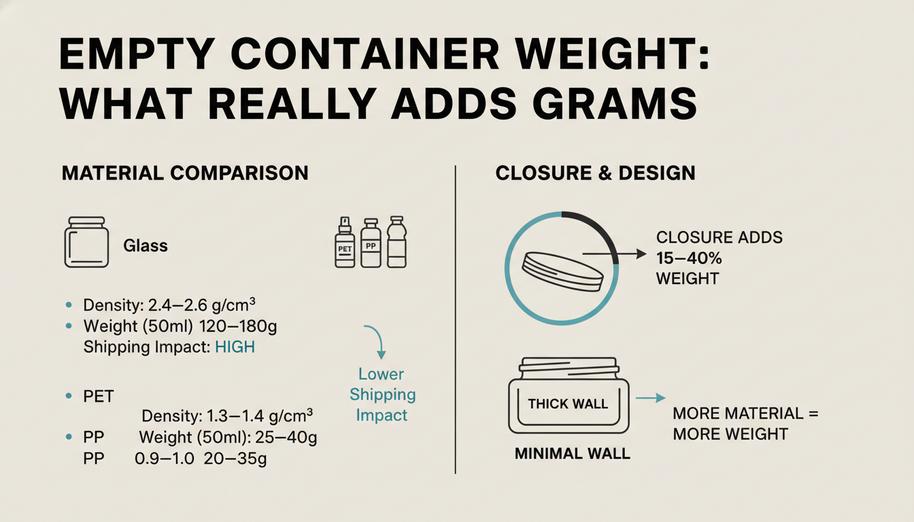
Why Material Matters: Glass vs. Plastic Jar Weights
The material density directly sets the baseline weight of a jar or container.
-
Density Comparison
-
Functional Impact
- Heavy glass improves luxury feel but raises empty packaging weight.
- Lightweight plastic cuts shipping costs at scale.
- Acrylic balances optical clarity and moderate weight.
| Material | Density (g/cm³) | 50ml Jar Avg Weight (g) | Relative Shipping Impact |
|---|---|---|---|
| Glass | 2.4–2.6 | 120–180 | High |
| PET | 1.3–1.4 | 25–40 | Low |
| PP | 0.9–1.0 | 20–35 | Very Low |
| HDPE | 0.94–0.97 | 22–38 | Low |
How Closure Types Affect Empty Weight
The closure system quietly adds grams, often representing 15–40% of total empty containers weight.
-
Core Components
-
Cap / lid
- Screw-top
- Snap-on
-
Functional Add-ons
- Dispenser pump
- Actuator
- Dip tube
- Liner seal
-
-
Weight Contribution Logic
- Basic cap: minimal weight contribution (~2g).
- Pump dispenser: highest added mass (often 10g+).
- Dropper with glass pipette: moderate increase.
The Role of Wall Thickness and Capacity
Wall geometry drives empty containers weight more than most expect.
-
Structural Layer
-
Increased wall thickness
- Better structural integrity
- Higher material usage
-
Reduced thickness
- Lighter empty packaging weight
- Requires precise design control (e.g., thin-wall molding down to 0.4mm)
-
-
Capacity Influence
- Larger capacity necessitates wider dimensions, scaling resin use exponentially.
- Bigger diameters demand thicker structural reinforcement.
Manufacturing Processes: Injection Molding to Blow Molding
The production method determines gram-level accuracy.
-
Injection molding
- Suitable for PP and Acrylic jars
- Controlled wall thickness
- Precise tooling
- Stable material distribution
-
Blow molding
- Common for PET and HDPE bottles
- Optimized air pressure shaping
- Reduced excess material
- Improved production efficiency
For brands tracking metrics across SKUs, suppliers like Topfeel focus on engineering balance. Adjusting mold design and refining cooling times keeps empty containers weight competitive without cutting corners.
7 Surprising Factors That Influence Your Empty Containers Weight
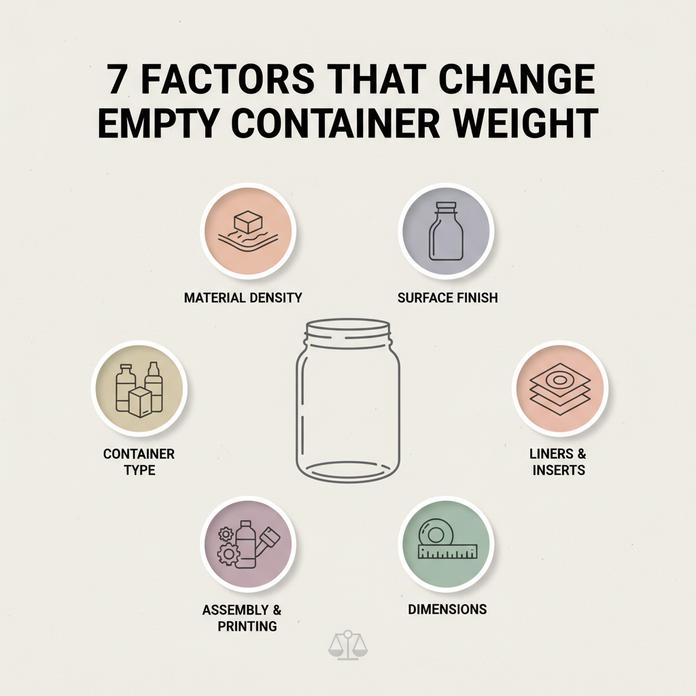
Small gram differences skew freight metrics and sustainability goals. Let’s break down the technical factors shifting your empty container weight.
1. Container Material Density (Acrylic, PP, PET)
-
Base polymer choices:
- Acrylic: Higher density; premium feel; heavier empty weight.
- Polypropylene (PP): Lower plastic mass; highly lightweight.
- Polyethylene terephthalate (PET): Balanced clarity and strength.
Topfeel frequently guides clients toward smart polymer swaps to reduce grams seamlessly without hurting brand aesthetics.
2. Impact of Surface Finish Like Metallization
-
Decorative layers:
- Plating
- Lacquer
- UV treatment
While individually minor, multi-layer finishes add noticeable mass. Modern, ultra-thin PVD (Physical Vapor Deposition) offers a lighter alternative to traditional heavy plating.
3. How Neck Finish and Closure Add Weight
- Wider thread = more material.
- Added neck ring support increases structure.
- Complex cap systems raise overall weight.
4. Packaging Components: Liners, Gaskets, and Inserts
-
Core packaging components:
- Liner
- Gasket
- Insert
- Inner seal
Each accessory improves barrier performance but compounds total mass.
5. Dimensional Factors: Diameter, Height, Wall Thickness
- Diameter
- Height
- Wall thickness
Dimensional weight (DIM) pricing penalizes wide dimensions; taller jars inherently raise logistics costs.
6. Assembly and Finishing Steps That Add Grams
- Assembly: Pump bonding, Dropper fitting.
- Finishing steps: Labeling, Printing, Adhesive application.
Thick-film labels and commercial adhesives introduce fractional mass that multiplies over bulk runs.
7. Choice of Container Type: Dropper Bottle vs. Pump Bottle
- Dropper bottle: Glass body, Bulb + pipette.
- Pump bottle: Actuator, Dip tube, Spring mechanism.
More internal mechanism equals more weight. Topfeel helps brands compare structures to balance design intent against transit mass.
Balance Premium Design with Logistics Costs > Struggling to find the sweet spot between a luxury feel and logistics efficiency? Explore Topfeel’s custom packaging catalog for high-quality, weight-optimized containers engineered specifically for your brand’s needs.
Empty Containers Weight: 6 Clever Ways To Optimize Freight Rates
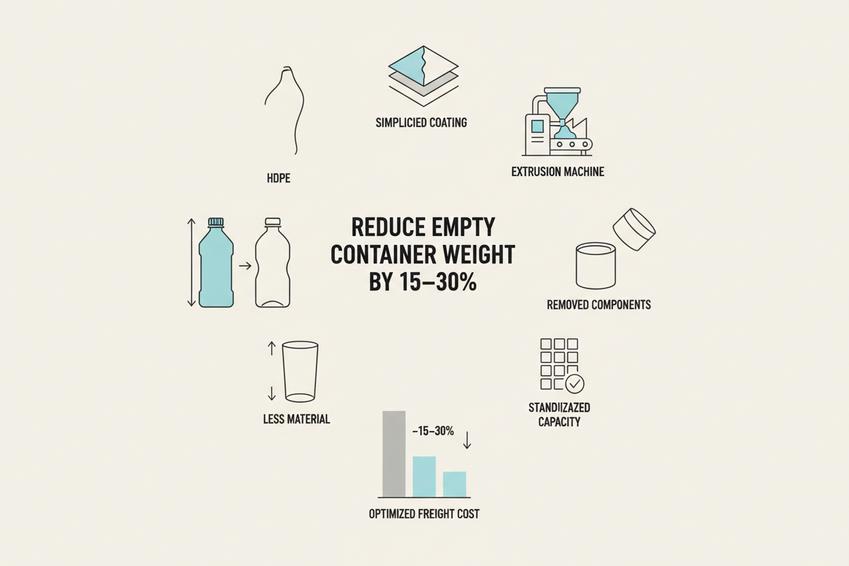
Freight carriers calculate using both mass and DIM weight divisors (like 139 or 166). Tight control over container build style keeps margins healthy.
Lightweight Alternatives: HDPE Bottles and Aluminum Compacts
-
Core shift in packaging solutions
-
Replace glass with HDPE in cosmetic bottles
- Lower raw material density
- Better impact resistance at thinner walls
-
Introduce thin-wall aluminum compacts
- Roughly 40% lighter than traditional zinc-based cases
-
-
Impact on container mass
- Lighter container types improve pallet load ratios.
By switching to lightweight materials, Topfeel often trims 15–30% from average container weight.
Slim Designs for Reduced Shipping Volume
- Shape optimization: Narrower container shape, Adjusted dimensions for stacking.
- Space optimization: Improved carton fit, Higher pallet density.
A slimmer body reduces volumetric weight, easily satisfying carrier dimensional rules.
Removing Excess Inserts and Collars
- Component reduction strategy: Audit excess inserts, Remove decorative collars not tied to sealing.
- Packaging simplification: Fewer container parts, Less material removal during redesign.
Standardizing Capacity to Minimize Variance
- Define standard capacity ranges.
- Align tooling for capacity standardization.
- Monitor variance reduction in wall thickness.
Consolidating Surface Treatments for Efficiency
- Streamline surface treatments: Reduce multi-step coating builds, Limit heavy metallic finishing.
Bulk Production: Streamlining Extrusion and Molding
- Manufacturing focus: Fine-tune extrusion settings, Calibrate molding pressure.
- Production efficiency: Stable wall control, Lower scrap rates in mass production.
Disciplined container fabrication by experts like Topfeel manages empty containers weight consistently, neutralizing micro-variations across bulk pallets.
FAQs about Empty Containers Weight
How does empty containers weight differ between Glass and Plastic packaging?
Glass Jar or Bottle options carry up to 6x the Weight (empty) of plastics due to dense material and thicker Wall thickness. Plastic choices vary:
- PET / HDPE (Blow molding): light, freight-friendly.
- Polypropylene (PP): common for Tube and Flip-top cap systems.
- Acrylic: clearer like Glass, but mid-range in mass.
Why do Pump bottle systems weigh more than Dropper bottle or Tube designs?
A Pump bottle contains a complex assembled structure:
- Bottle body (often PET or HDPE)
- Pump dispenser with Actuator and Collar
- Internal Dip tube and spring
- Liner or Gasket for sealing
These components add 10–15g of Weight (empty). An Extrusion Tube distributes material efficiently, keeping mass significantly lower.
Which production factors most affect empty containers weight?
During Molding and Assembly, technical variables dictate final mass:
- Wall thickness adjustment in Injection molding.
- Neck finish size for Screw cap or Snap-on cap.
- Added Insert inside Compact or Palette.
- Surface Finishing like Metallization or Hot stamping.
Micro-variations in mold pressure can alter per-unit mass by several grams.
How can brands reduce empty containers weight without losing durability?
Balance structural performance against logistics algorithms.
| Strategy | Effect on Weight (empty) | Typical Use |
|---|---|---|
| Thinner Wall thickness (e.g., 0.4mm) | Reduces grams | HDPE Bottle |
| Switch Glass → PET | Major freight drop | Lotion Bottle |
| Aluminum Compact redesign | 40% lighter shell | Makeup Compact |
| Optimize Closure (smaller Pump dispenser or Sprayer) | Cuts assembly mass | Skincare Bottle |
A controlled Diameter and simplified Assembly protect structure while easing shipping pressure.
Ready to Optimize Your Packaging Logistics?
Don’t let extraneous grams eat into your profit margins. Partner with Topfeel to engineer the perfect balance of aesthetic appeal and lightweight efficiency. Reach out to our packaging experts now and start saving on your next bulk production run!
References
- Air Freight Rates and Costs – freightos.com
- Density of Glass – thoughtco.com
- Polyethylene Terephthalate (PET) Plastic – specialchem.com
- Polypropylene (PP) Properties – bpf.co.uk
- High-Density Polyethylene – chemicalsafetyfacts.org
- Thin-Wall Injection Molding – ptonline.com
- What is Injection Molding – hubs.com
- Plastics Blow Molding – thomasnet.com
- What is PVD Coating – pvdcoatings.net
- Determine Billable Weight – ups.com
- Aluminum Packaging – aluminum.org
- Volumetric Weight – dhl.com

