 English
  Español de México
  Français
  Deutsch
  Português do Brasil
  Italiano
  한국어
한국어  ไทย
ไทย  Русский
  日本語
日本語  Polski
  Svenska
  Türkçe

How Do Lipstick Tubes Work?
May 11,2026
A tiny screw-driven elevator hides inside that sleek shell, pushing the cosmetic bullet upward while locking it securely at the desired height.
For brands, this mechanism is make-or-break. Subpar tooling causes jamming, leaks, or shelf wobble. Mastering the engineering—material flow, precision molding, and hermetic seals—ensures the product dispenses flawlessly and secures customer loyalty.
Quick Answers: Mechanism Overview
➔ Precision CNC tooling shapes the outer casing and inner screw core to guarantee steady rotation. ➔ Injection molding paired with a calibrated sealing disc delivers hermetic, leak-proof performance. ➔ Surface finishes—like UV coating or 7-12 micron anodizing—prevent chemical wear and elevate aesthetics. ➔ Final QC validates ±0.5 mm dispensing accuracy, 1.2m drop resistance, and FDA material compliance.
💡 Ready to engineer the perfect twist? Explore Topfeel’s custom lipstick packaging solutions and bring your cosmetic vision to life.
How Do Lipstick Tubes Work—A Step-By-Step
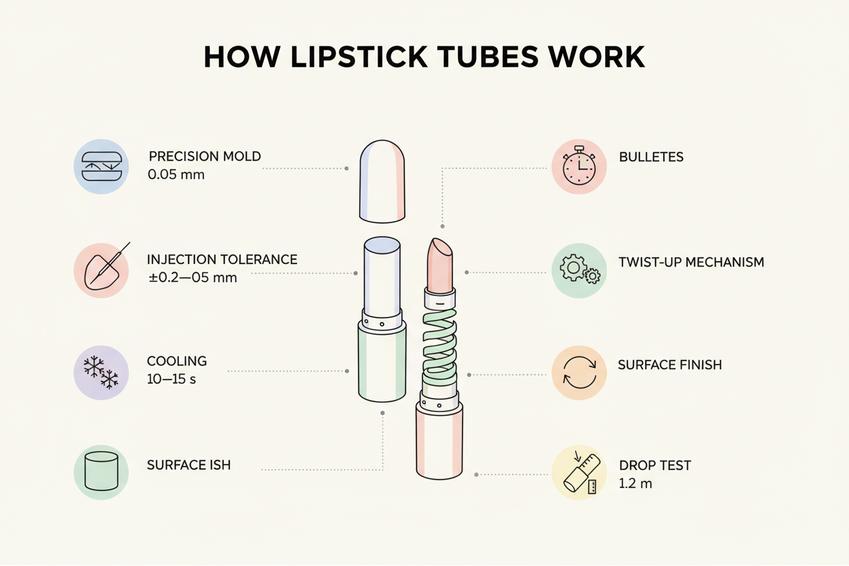
The twist-up motion relies on synchronized mechanical components. Let’s break down the production flow from raw resin to the final click.
Step 1: Tooling Fabrication for the Outer Casing
The outer shell anchors the internal mechanics.
-
Core production flow:
-
Tooling
- 3D mold design mapping shrinkage rates (e.g., ABS ~0.4–0.7%)
- CNC precision cutting
- Surface polishing for flawless ejection
-
Fabrication
- Steel block shaping (H13 tool steel)
- Heat treatment for mold longevity
-
Forming methods
- Die casting (aluminum alloy)
- Metal stamping (0.3–0.5mm thin-wall shells)
-
The outer casing must align flawlessly with the internal core. Even a 0.05 mm mold deviation throws off the rotational torque. Brands like Topfeel rigorously engineer ergonomic grip and cap friction so the tube operates with balanced resistance.
Step 2: Injection Molding the Inner Mechanism
This internal chassis drives the vertical movement.
-
Material system:
-
Polymer
- ABS (High impact resistance)
- SAN (High stiffness for thread accuracy)
- POM (Low friction for sliding parts)
-
-
Molding cycle:
- Molten plastic injection at extreme pressure
- Pressure holding to prevent sink marks
- Cooling (chillers operating at 10–15°C)
- Release via ejector pins
-
Structural zones:
-
Mold cavity
- Screw channel (4–8mm thread pitch)
- Guide rails for anti-tilt stability
-
| Component Part | Material | Tolerance (mm) | Cooling Time (s) |
|---|---|---|---|
| Inner sleeve | ABS/POM | ±0.03 | 12 |
| Spiral core | SAN | ±0.02 | 15 |
| Base support | ABS | ±0.05 | 10 |
Micro-tolerances prevent the bullet from vibrating during rotation.
Step 3: Adding the Twist-Up Mechanism and Sealing Disc
Here, raw parts form a functional motion system.
-
Mechanical structure:
- Spiral screw (converts rotation to vertical lift)
- Follower (the elevating cup holding the formula)
- Base cup (the user’s rotational interface)
-
Product interface:
- Lipstick bullet
- Lock groove to prevent retraction failure
-
Protection:
- Sealing disc
- Air-block design
Calibrated assembly ensures the twist-up mechanism requires exactly 1.5 to 3.0 N·cm of torque. Tight component integration prevents the formula from tilting and snapping against the barrel walls.
Step 4: Applying Surface Finishes like UV Coating or Matte Finish
Coatings offer chemical protection against cosmetic oils and everyday friction.
-
Decorative treatments:
- UV coating (scratch resistance)
- Matte finish (soft-touch tactility)
- Gloss finish * Premium upgrades:
- Electroplating
- Anodizing (7–12 microns for aluminum longevity)
- Spray painting
-
Branding layer:
- Logo hot stamping
- Serial code printing
Strong surface finishes repel skin oils. Topfeel utilizes advanced decoration curing to guarantee the packaging remains pristine through 300+ daily uses.
Step 5: Final Assembly and Leak-Proof Design Testing
Post-assembly, the unit undergoes aggressive stress tests.
-
Final assembly
- Cap fitting and snap-fit alignment
- Torque calibration
-
Quality control
- Rotation force test (lifespan of 300–500 cycles)
- Drop test (1.2m onto a steel plate)
-
Seal validation:
- Hermetic seal check (weight loss < 1% over 3 months)
- Vacuum chamber performance testing
- Full product inspection
-
Packaging:
- Dust-free insertion
- Batch coding
A rigorous leak-proof design safeguards volatile ingredients. Topfeel mandates strict functional testing so every tube performs effortlessly.
🛠️ Don’t let cheap tooling ruin your formula. Partner with Topfeel for flawless functionality, hermetic seals, and premium surface finishes.
3 Key Parts Every Lipstick Tube Has
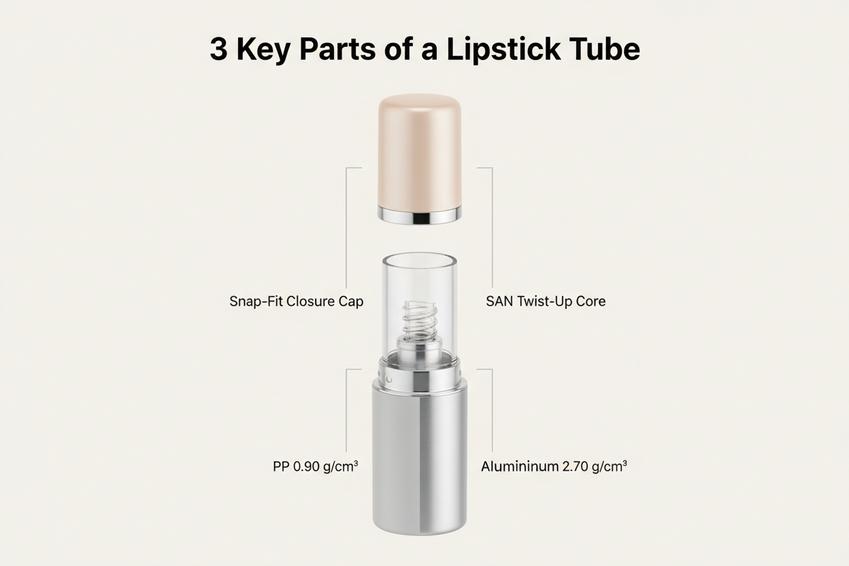
Understanding the hardware requires isolating its three primary components.
Outer Casing: Polypropylene (PP) or Aluminum Alloy Shell
The casing—or housing—provides structural defense and aesthetic appeal.
-
Material Options
-
- Lightweight and impact-resistant
- Ideal for mass injection molding
-
Aluminum alloy
- High rigidity
- Premium metallic finish compatible with anodizing
-
-
Functional Roles
- Protects the internal mechanism from crushing impacts.
- Shields the formula from thermal shifts.
- Supports primary branding.
- Maintains core alignment to prevent wobble.
Material Comparison Table
| Property | Polypropylene (PP) | Aluminum Alloy | Typical Wall Thickness (mm) | Weight (g) |
|---|---|---|---|---|
| Density (g/cm³) | 0.90 | 2.70 | 0.8–1.2 | 8–12 |
| Impact Resistance | High | Medium | 0.3–0.5 | 12–18 |
| Surface Finish | Matte/Gloss | Metallic/Brushed | 0.4–0.8 | 10–16 |
| Recyclability | Yes | Yes | — | — |
| Cost Level | Moderate | Higher | — | — |
Brands like Topfeel balance wall thickness and weight distribution for an optimized tactile experience.
Inner Mechanism: Styrene Acrylonitrile (SAN) Twist-Up Core
The interior rotating unit (often SAN or POM) dictates the application experience.
-
Core Components
- Outer sleeve
- Helical screw track
- Elevator cup
-
Motion System
- User rotates base.
- Screw track converts torque to vertical lift.
- Lipstick bullet rises evenly.
- Reverse twist lowers product back.
-
Why SAN/POM?
- SAN provides clarity and structural stiffness.
- POM lowers track friction.
- Highly stable under varying temperatures.
Without a precision-molded core, the action feels jerky. Topfeel engineers thread pitch (typically 4-8mm) so lift speed is highly controlled.
Closure Cap: Tamper-Evident Seal with Snap-Fit Design
The cap locks the ecosystem, managing hygiene and formula preservation.
-
Snap-Fit Structure
- Inner ridge locks onto shell interference points.
- Audible click confirms positive seal.
- Prevents detachment in handbags.
-
Tamper-Evident Design
- Break-ring or tight tolerance shrink bands.
- Clear visual proof of product integrity.
- Meets FDA hygiene standards.
-
Seal Performance
- Blocks oxygen ingress.
- Prevents volatile oil evaporation.
- Maintains structural bullet stability.
An engineered closure cap ensures product viability from factory floor to user application.
Tube Material Choices: Plastic vs. Metal
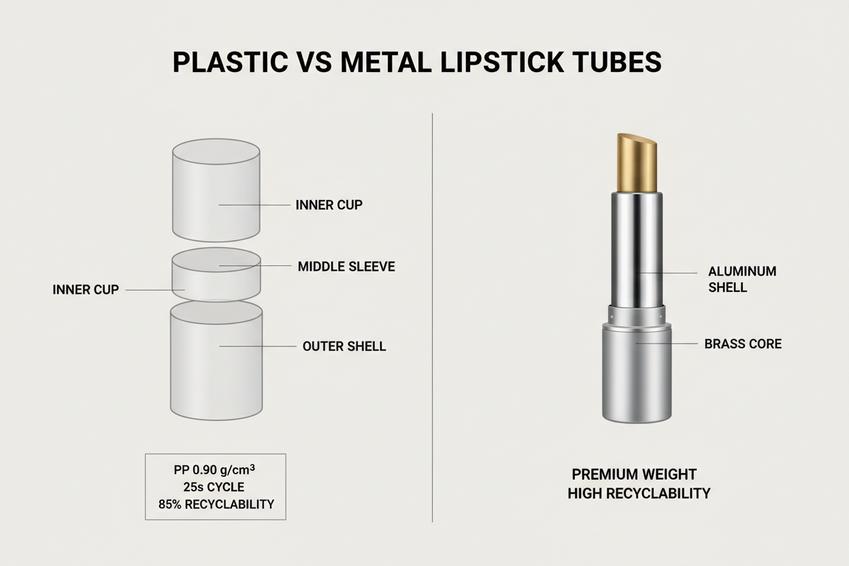
Material selection impacts cycle times, cost, and consumer perception.
Plastic
Mass-market designs rely heavily on Polymer science.
-
Core material system
-
PP and ABS
- Exceptional Moldability for high-cavity Injection molding.
- Strong fatigue Durability.
-
PETG
- Enhanced Transparency.
-
PCR blends
- Lowers carbon footprint while maintaining Lightweight profiles.
-
-
Functional performance layers
- Inner cup (supports smooth lift).
- Middle sleeve (stabilizes torque).
- Outer shell (allows vacuum metallization).
-
Cost & scale logic
- Cost-effective multi-cavity tooling.
- Sub-30-second cycle times.
- Rapid custom color matching.
| Material | Density (g/cm³) | Avg. Cycle Time (sec) | Impact Strength (kJ/m²) | Recyclability (%) |
|---|---|---|---|---|
| PP | 0.90 | 25 | 30 | 85 |
| ABS | 1.04 | 30 | 40 | 70 |
| PETG | 1.27 | 28 | 25 | 75 |
| PCR-PP | 0.92 | 27 | 28 | 90 |
| PCR-ABS | 1.05 | 32 | 35 | 80 |
Topfeel optimizes these resins to prevent the gritty rotation associated with cheap plastics.
Metal
Luxury tiers demand cold-touch, high-density materials.
-
Aluminum shell
- Sharp Aesthetics.
- Inherent Corrosion resistance.
-
Brass or Zinc alloy core weighting
- Extreme Strength.
- Tactile, Premium feel via added mass.
-
Surface treatment
- Anodizing (seals the metal surface).
- Brushed or matte polish.
-
Sustainability edge
- Infinite Recyclability.
-
Why brands pick metal:
- Superior drop-test survivability.
- Elevated perceived retail value.
“Premium beauty packaging is projected to grow faster than mass formats through 2026, driven by metal component demand and refillable systems,” noted McKinsey’s 2024 Global Beauty Market Insights.
Topfeel effectively merges Aluminum exteriors with engineered plastic internals, balancing weight, torque control, and luxury.
When Twist Fails: Tube Troubleshooting
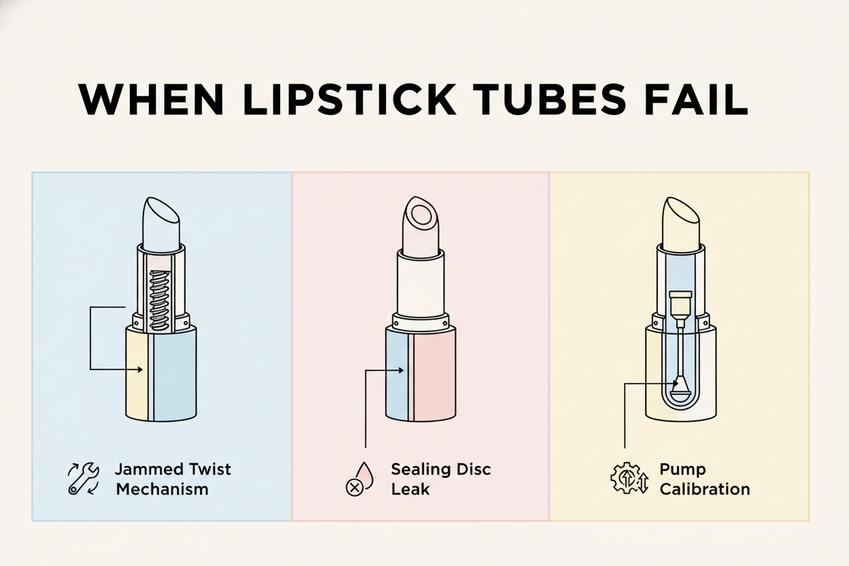
Mechanical failures require specific diagnostic steps to restore functionality.
Jammed Twist-Up Mechanism? Lubricate and Reassemble the Inner Core
-
Identify the cause of jamming
- Check for dried wax formulations blocking the inner core.
- Inspect the screw track for mechanical failure (cracks or warped platforms).
-
Restore smooth lubrication
- Clear debris from the tube mechanism.
- Apply a micro-dose of food-grade silicone oil to the threads.
- Strictly avoid petroleum solvents that degrade ABS plastic.
-
Careful reassembly
- Align the inner spindle with guide rails.
- Verify torque resistance before re-casing.
Leakage Issues? Inspect the Sealing Disc and Switch to Chemically Resistant Materials
-
Check the sealing disc
- Confirm flat alignment against the barrel wall.
-
Review material inspection
- Identify hairline stress fractures compromising tube integrity.
- Evaluate if the cosmetic formula’s active ingredients are degrading the plastic.
-
Upgrade materials
- Deploy chemical resistance upgrades (e.g., swapping ABS for high-density PP for better product containment).
- Verify full material compatibility via 45°C accelerated aging tests.
Poor Dispensing Accuracy? Calibrate Pump Action or Replace Dropper Assembly
For liquid-lip hybrids:
-
Evaluate dispensing accuracy
- Note uneven lifts or fluid delays.
-
Inspect internal systems
- Test pump action spring tension.
- Check dropper assembly for compromised gaskets or loose replacement parts.
-
Correct the issue
- Adjust pneumatic calibration settings.
- Replace worn gears to restore precise dosage control.
🛑 Tired of troubleshooting jammed mechanisms and leaking tubes? Upgrade your packaging with Topfeel’s reliable, leak-proof designs.
Selecting Tube Styles for Bulk Orders
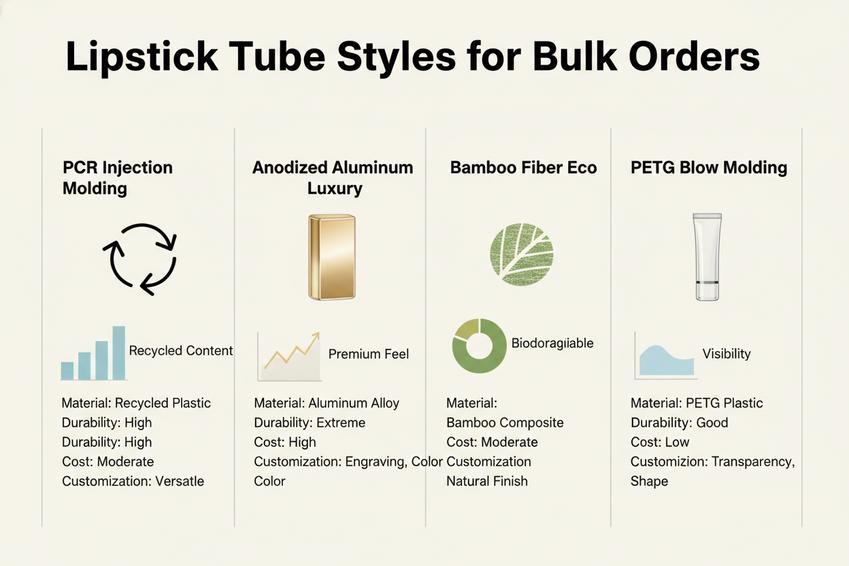
Packaging architecture shifts drastically based on brand positioning and scale.
High-Volume Launch: Injection Molding in Recycled Plastic (PCR)
-
Core structure in mass runs:
-
Injection Molding
- Melted PCR Material forced into multi-cavity molds.
- Rapid water-cooling for minimal deformation.
-
Inner lift mechanism
- Threaded POM spindle.
- Bullet cup.
-
Outer shell
- Recycled Plastic exterior.
- Standardized snap-fit closure.
-
-
Why brands choose this path:
- Uninterrupted High Volume Production.
- Fractions of a cent in unit cost savings.
- Highly predictable Molding Process.
Luxury Brand Collection: Anodized Aluminum Alloy with Laser Engraving
-
Material hierarchy:
-
Shell:
- Anodized Aluminum (strengthened via electrochemical baths).
- Flawless Surface Finish.
- Base: Lightweight Aluminum Alloy.
-
Decoration:
- Laser Engraving stripping away anodization for a precise Engraving Technique.
-
Premium feel checklist:
- Cold metallic thermal conductivity.
- Heavy, dampened torque rotation (approx. 2.5 N·cm).
- Magnetic closure integration.
This mirrors standard internal Metal Tubes design but features heavy Luxury Packaging customization.
Eco-Friendly Line: Bamboo Fiber Shells with Matte Finish
-
Material stack:
-
Outer case:
- Bamboo Fiber composites.
- Renewable Natural Material.
- Distinctive Fiber Shells.
-
Coating:
- Soft Matte Finish sealing the porous surface.
-
This satisfies Sustainable Packaging demands, drastically reducing virgin plastic reliance while keeping the internal mechanism highly functional.
Quick Turnaround Demand: PETG Tubes via Blow Molding
-
Material base:
- PETG Material (FDA 21 CFR 177 compliant, high clarity).
-
Forming method:
- Blow Molding or Injection Stretch Blow Molding (ISBM).
- Rapid air expansion of heated preforms.
-
Output goal:
- Rapid Production avoiding complex multi-part tooling.
These clear Plastic Tubes offer fast manufacturing lead times and striking visual transparency.
📦 Planning a high-volume launch or a luxury collection? Get a custom manufacturing quote from Topfeel’s packaging engineers today.
How Do Lipstick Tubes Work: Final Checklist
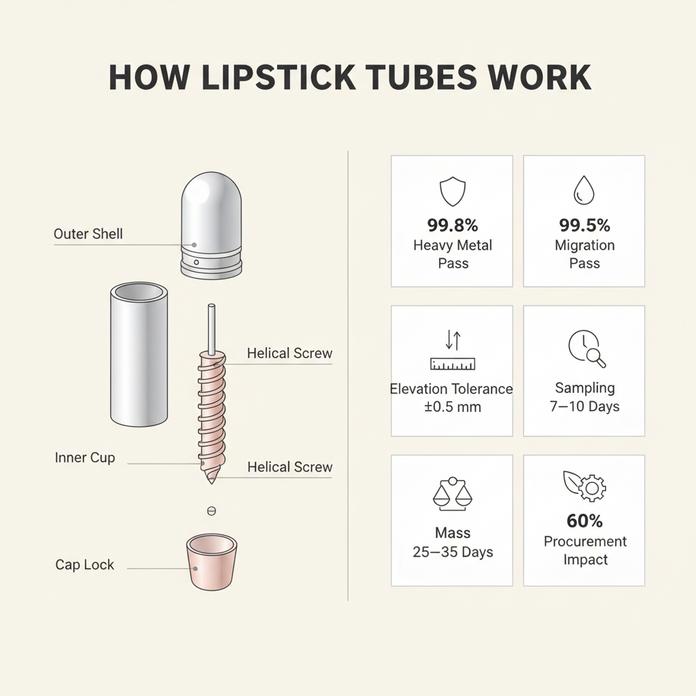
This checklist validates manufacturing integrity before mass market release.
Verify Material Safety and Regulatory Compliance
-
Materials & Compliance
- Raw materials (FDA-approved PP, ABS, POM).
- Verified non-toxic masterbatch colorants.
-
Chemical safety
- Stringent migration testing.
- Heavy metal screening via spectrometry.
-
Global regulations
Laboratory Testing Benchmarks
| Test Item | Standard Limit | Result Range | Pass Rate (%) |
|---|---|---|---|
| Heavy Metals (ppm) | ≤10 | 0–3 | 99.8 |
| Migration (mg/dm²) | ≤10 | 2–6 | 99.5 |
| Drop Resistance (cm) | 120 (Steel) | 120+ | 98.7 |
| Heat Stability (°C) | 45 (3 months) | 45–50 | 97.9 |
| Odor Test (Score/5) | ≥4 | 4–5 | 99.2 |
Safety documentation directly drives procurement; Topfeel provides full traceability on all resin batches.
Confirm Ergonomic Grip and Dispensing Accuracy
-
Ergonomics
- Outer shell anti-slip grip.
- Base weighting for balance.
-
Internal lift system
- Helical screw track calibration.
- Smooth dispensing under lateral pressure.
-
Application outcome
- Elevation tolerance restricted to ±0.5 mm.
- Absolute structural accuracy.
Ensure Tamper-Evident Seal and Leak-Proof Design
- Tamper-evident shrink banding.
- Inner seal disc compression thresholds.
- Cap locking integrity preventing vacuum leaks.
Validation flow:
- Pneumatic compression test.
- Vacuum leak-proof testing.
- Tensile cap retention force check.
Review Batch Consistency and Shelf-Life Stability
-
Batch consistency
- Multi-cavity mold uniformity.
- Spectrophotometer color matching.
-
Quality control
- Rotational torque consistency.
Storage simulation:
- 4°C crystallization cold test.
- 25°C baseline baseline condition.
- 45°C accelerated aging (simulating 1-2 year shelf-life).
Align Production Lead Time and Supplier Audit Results
-
Production
- T1 tooling validation.
- Optimized injection cycle timing.
-
Supplier audit
- ISO 9001 quality assurance.
- On-site GMP performance scoring.
-
Lead time
- Prototyping: 7–10 days.
- Mass run: 25–35 days.
Brands rely on partners like Topfeel for transparent manufacturing schedule management.
FAQs about How Do Lipstick Tubes Work
How do lipstick tubes work inside the twist-up mechanism? A precision-engineered mechanical sequence occurs inside the container body. The outer casing protects a threaded inner mechanism (usually SAN or POM). Rotating the base engages a follower within the helical screw track, converting horizontal torque into controlled vertical lift. A calibrated sealing disc and snap-fit closure cap maintain an airtight seal, protecting the formula.
What materials are used in lipstick tube manufacturing? Material specifications depend on product tier:
- Recycled plastic (PCR) or ABS for resilient, cost-effective mass production.
- Aluminum alloy (anodized to 7-12 microns) for a weighted, luxury thermal feel.
- Bamboo fiber composites for sustainable, low-plastic initiatives.
- PETG for high-impact clarity. All must pass strict material safety, chemical resistance, and regulatory compliance benchmarks.
How do manufacturers ensure lipstick tubes are leak-proof and durable? Prototypes endure severe stress testing prior to tooling sign-off:
- ✦ Compression mapping on the sealing disc ensures a true leak-proof design.
- ✦ Tensile cap fit tests confirm a secure, tamper-evident seal.
- ✦ Drop resistance trials (1.2m onto steel) verify impact survivability.
- ✦ Vacuum testing under 45°C shifts guarantees volatile oils won’t escape. Strict quality control and GMP standards on the assembly line enforce this baseline.
What decoration options enhance branding on lipstick tubes? Following tooling fabrication, secondary processes dictate brand identity:
| Technique | Visual Effect | Common Base Material |
|---|---|---|
| Hot stamping | Reflective metallic foil | PP, ABS |
| Silk screen printing | High-adhesion bold ink | PCR, PETG |
| Laser engraving | Permanent substrate ablation | Aluminum alloy |
| Vacuum metallization | Uniform mirror-like plating | Plastic cores |
Combining a matte finish, soft-touch texture, or protective UV coating transforms simple packaging into a premium tactile experience.
✨ Ready to upgrade your cosmetic packaging? Contact Topfeel today to request samples and start your next custom tooling project.
References
- CNC tooling – https://en.wikipedia.org/wiki/Numerical_control Wikipedia
- High impact resistance – https://www.bpf.co.uk/plastipedia/polymers/abs.aspx British Plastics Federation
- Low friction for sliding parts – https://en.wikipedia.org/wiki/Polyoxymethylene Wikipedia
- Molten plastic – https://en.wikipedia.org/wiki/Injection_moulding Wikipedia
- aluminum longevity – https://www.anodizing.org/page/what-is-anodizing Aluminum Anodizers Council
- Polypropylene (PP) – https://en.wikipedia.org/wiki/Polypropylene Wikipedia
- Aluminum alloy – https://www.aluminum.org/aluminum-alloys The Aluminum Association
- FDA hygiene standards – https://www.fda.gov/cosmetics FDA
- McKinsey’s 2024 Global Beauty Market Insights – https://www.mckinsey.com/industries/retail/our-insights/the-beauty-market-in-2023-a-special-state-of-fashion-report McKinsey & Company
- PCR Material – https://www.epa.gov/smm/comprehensive-procurement-guideline-cpg-program EPA
- FDA 21 CFR 177 compliant – https://www.accessdata.fda.gov/scripts/cdrh/cfdocs/cfcfr/CFRSearch.cfm?CFRPart=177 FDA
- EU cosmetic packaging standards – https://single-market-economy.ec.europa.eu/sectors/cosmetics/legislation_en European Commission
- REACH-aligned certifications – https://echa.europa.eu/regulations/reach/understanding-reach ECHA
- quality assurance – https://www.iso.org/iso-9001-quality-management.html ISO

