 English
  Español de México
  Français
  Deutsch
  Português do Brasil
  Italiano
  한국어
한국어  ไทย
ไทย  Русский
  日本語
日本語  Polski
  Svenska
  Türkçe

Why Your Lipstick Tube Knob Keeps Jamming?
May 11,2026
A jamming lipstick tube knob quickly snowballs into returns and damaged brand trust. A 2025 Grand View Research report notes rising demand for high-quality cosmetic packaging, as brands prioritize durability in competitive retail channels.
Jammed mechanisms signal design gaps, material shortcuts, or sloppy torque control. Fix it at the source.
Melodic Guide: Jam-Free lipstick tube knob Essentials
➔ Ensure proper torque settings during injection molding to prevent overstress and uneven twist-up action.
➔ Verify shell and cup alignment with tight dimensional accuracy checks (±0.05mm) to eliminate rotational resistance.
➔ Choose high-grade materials like anodized aluminum or PP plastic for stable actuator travel and minimal deformation.
➔ Implement 15-20 micron UV coating inspections and automated lubrication stations for smooth, consistent knob rotation.
Ready to eliminate packaging flaws? > Partner with Topfeel to engineer jam-free, premium lipstick mechanisms that protect your brand’s reputation and deliver a flawless user experience.
4 Common Causes Of Knob Jamming
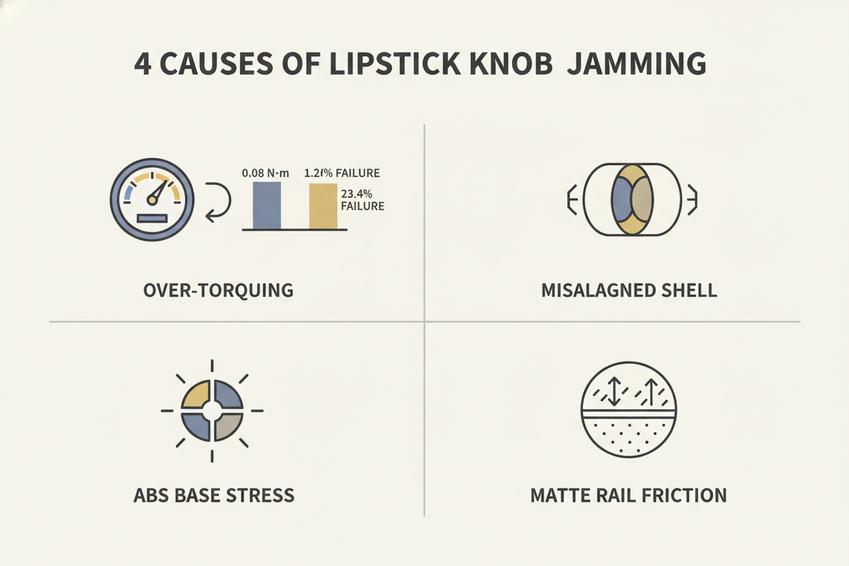
When a lipstick tube knob stops working smoothly, the issue hides inside the mechanism. Let’s break down the engineering faults causing rotational failure.
Improper Torque Settings on Injection-Molded Mechanism
Tightness straight off the assembly line often roots back to poor torque control during injection molding and final assembly.
-
Assembly Calibration
1.1 Torque settings too high
- Overstress on plastic component threads
- Compression on internal mechanism rails
1.2 Inconsistent driver calibration
- Uneven load across swivel core
-
Mechanism Impact
2.1 Micro-cracks in molded core
2.2 Restricted rotational path
Torque vs. Functional Impact Data
| Torque (N·m) | Rotation Force (N) | Failure Rate (%) | Mechanism Wear (cycles to defect) |
|---|---|---|---|
| 0.08 | 2.1 | 1.2 | 12,000 |
| 0.12 | 3.4 | 3.8 | 9,500 |
| 0.18 | 5.9 | 11.6 | 5,200 |
| 0.24 | 8.7 | 23.4 | 2,900 |
Torque must hit the consumer “sweet spot” (0.10–0.15 N·m) while matching the molded core’s cooling behavior. Brands like Topfeel fine-tune this balance to keep the lipstick tube turning smoothly.
Misaligned Shell and Cup Causing Rotational Resistance
A smooth lipstick tube knob depends on strict misalignment control between the shell and cup.
-
Dimensional Accuracy
1.1 Tight tolerance stacking (exceeding ±0.05mm)
1.2 Oval deformation after cooling
-
Friction Points
2.1 Sidewall rubbing
2.2 Increased friction during rotation
-
Assembly Interaction
3.1 Off-axis press-fit
3.2 Uneven resistance during knob twist
When parts press slightly off-center, internal scraping spikes the torque curve, building up rotational resistance over time.
ABS Plastic Base Deformation Under Repeated Use
Daily twists and heat expose low-grade ABS plastic to material fatigue, shifting the base microscopically. Plastic degradation increases internal clearance, causing irregular friction.
Common triggers:
- Thin-wall molding (under 1.2mm minimum standard)
- Poor cooling control causing high shrinkage (0.3-0.8%)
- Weak filler ratio
Topfeel addresses this by reinforcing stress zones and validating wear cycles prior to production.
Excessive Friction from Matte-Finish Actuator Travel
Surface texture dictates movement efficiency.
-
Surface Treatment
1.1 Rough matte finish inside shell
1.2 Incomplete UV sealing
-
Actuator Interaction
2.1 Drag along actuator rail
2.2 Interrupted vertical travel
-
Movement Efficiency
3.1 Reduced glide
3.2 Heat buildup from dry contact
Coarse surfaces and minimal lubrication force the lipstick tube knob to require extra actuation force, destroying the premium feel.
Which Materials Resist Jamming Best?
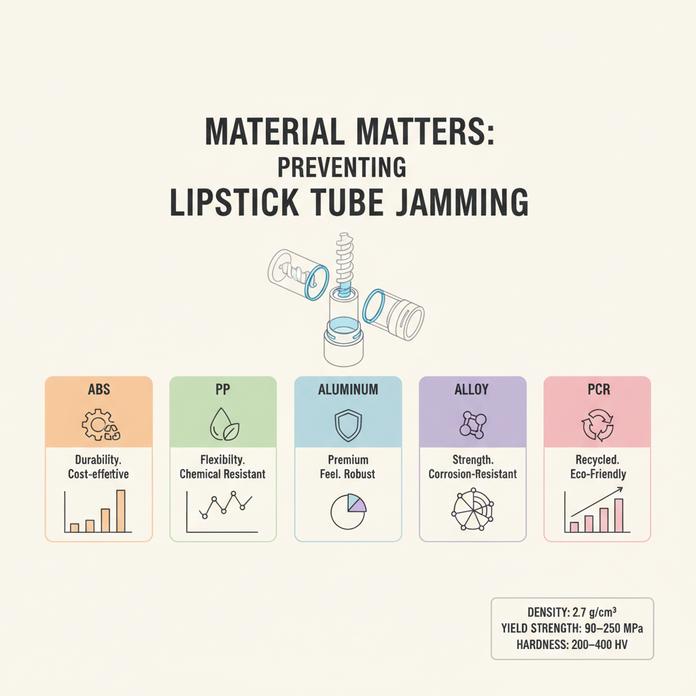
Material flow and component fit dictate long-term glide. Here is how specific resins and metals perform.
ABS Plastic
Acrylonitrile Butadiene Styrene is a classic thermoplastic known for impact strength.
-
Core traits that matter:
- High dimensional stability
- Reliable wear resistance
- Controlled friction characteristics
Topfeel often selects ABS for projects needing tight tolerances in the lipstick tube knob system to ensure crisp alignment and stable torque.
PP Plastic
When flexibility matters, Polypropylene (PP) is preferred.
-
Why it works in a lipstick tube knob:
- Naturally low friction (lower coefficient of friction than ABS)
- Strong fatigue resistance
- Good creep resistance
PP’s chemical inertness and lubricious surface reduce stress cracks, offering a softer torque feel without over-tight resistance.
Aluminum
Aluminum adds outer structural integrity while supporting internal alignment.
| Property | Typical Value | Jamming Risk Impact | Application Note |
|---|---|---|---|
| Density | 2.7 g/cm³ | Low warping risk | Balanced weight |
| Yield Strength | 90–250 MPa | Stable alignment | Outer shell |
| Surface Hardness (Anodized) | 200–400 HV | Reduced abrasion | Knob collar |
| Corrosion Resistance | High | Long-term stability | Premium lines |
A 10-15 micron oxide layer from proper anodizing reduces galling potential. In high-end designs by Topfeel, anodized aluminum guarantees torque consistency.
Metal Alloy
Inside the twist mechanism, alloys (like Zamak/Zinc alloy) do the heavy lifting.
★ Key performance drivers:
- Optimized material composition
- Increased hardness
- Lower friction coefficient
- Defined lubrication requirements
Alloy tracks prevent seizing and galling after thousands of rotations.
PCR Material
Recycled plastics require strict formulation control.
-
Potential concerns:
- Minor material degradation
- Variability in mechanical properties
- Extra processing challenges
Limiting PCR material to 30% for internal mechanical parts maintains structural integrity. Topfeel balances sustainability and swivel action by adjusting wall thickness tolerances specifically for PCR blends.
Plastic Knob Vs. Metal Knob Durability
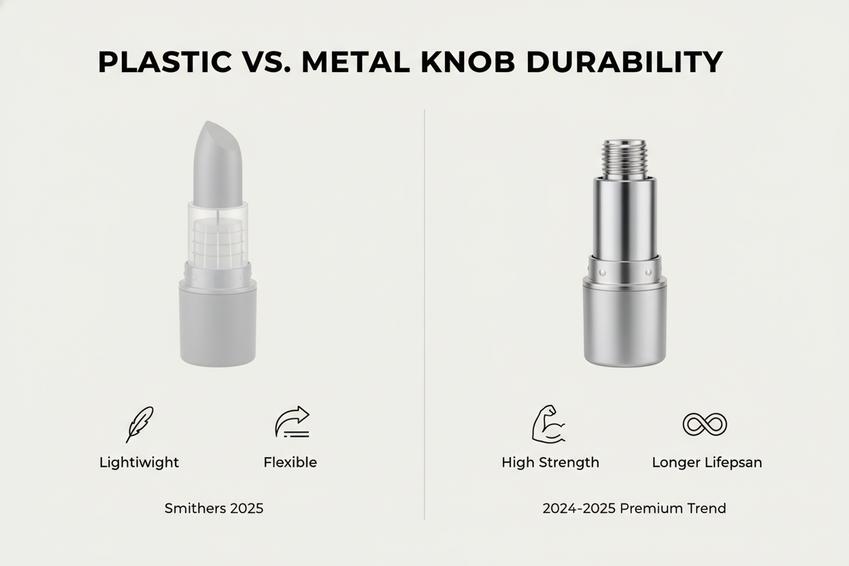
Material choice shapes grip, durability, and the tactile click of the mechanism.
Plastic Knob
Plastic dominates mass-market packaging by balancing lightweight handling with design flexibility.
-
Core Material Traits
-
ABS / PP structure
- High flexibility, reducing sudden cracking
- Lower density, keeping the lipstick tube knob lightweight
-
Surface Finish
- Mimics matte, glossy, or frosted looks
- Supports exact color matching
-
-
Durability Factors
- Repeated twisting causes wear along internal threads.
- Excessive closure force risks deformation.
- Poor mold precision leads to internal jamming.
According to Smithers’ 2025 packaging materials outlook, plastic components remain dominant in beauty packaging due to cost efficiency, but long-term durability depends heavily on resin grade and mold accuracy.
Topfeel improves the lipstick tube knob by reinforcing internal ribs, reducing wear while maintaining smooth daily use.
Metal Knob
Metal shifts the paradigm toward superior tactile confidence and rigidity.
-
Structural Strength
-
Aluminum or alloy base
- Higher strength under compression
- Superior rigidity during repeated rotation
-
Precision machining
- Cleaner thread engagement
- Reduced internal friction
-
-
Environmental Resistance
-
Coating treatments
- Improved corrosion resistance
- Stable surface finish over time
-
-
Functional Experience
- Tighter, controlled twist feedback.
- Lower internal jamming risk in high-frequency use.
- Greater impact tolerance.
Grand View Research noted in its 2024–2025 cosmetic packaging update that premium brands increasingly favor metal components to signal quality and extend product lifecycle.
For upscale positioning, Topfeel integrates alloy lipstick tube knob systems with refined torque balance to outlast standard plastic builds.
Looking for the perfect balance of durability and luxury? > Let Topfeel’s material engineers guide you to the ideal lipstick tube knob for your next cosmetic launch.
Stiff Knob Issue? Lubrication Solutions Inside
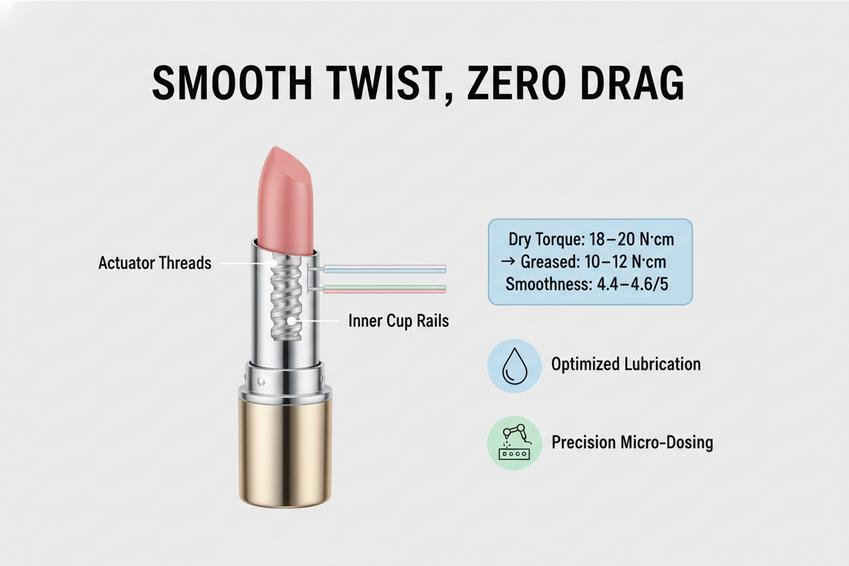
Friction inside the twist-up mechanism is the primary culprit of a stiff lipstick tube knob.
Silicone Grease for Smoother Twist-Up Action
Precision application of NLGI Grade 2 silicone grease keeps motion steady.
-
Core Contact Points
-
Actuator Threads
- Apply thin-layer silicone grease to kill torque spikes
- Prevent drag inside the cosmetic tube
-
Inner Cup Rails
- Stabilize lift during rotation
-
-
Performance Control
-
Torque Balance
- Light grease film → softer knob rotation
- Overuse → residue buildup
-
| Test Item | Dry Torque (N·cm) | Greased Torque (N·cm) | Smoothness Rating (1–5) |
|---|---|---|---|
| ABS Tube | 18 | 11 | 4.5 |
| PP Tube | 16 | 10 | 4.6 |
| Alloy Core | 20 | 12 | 4.4 |
Brands like Topfeel fine-tune grease dosing so mechanisms feel effortless, not greasy.
Food-Grade Mineral Oil in Retraction Systems
USP-grade mineral oil acts as a safe lubricant for retraction concerns.
-
Material Compatibility
- ABS plastic: Maintains gloss without cracking stress
- PP plastic: Retains flexibility through repeated twist cycles
-
Functional Benefits
- Smoother bullet return
- Reduced internal squeak
- Safer cosmetic mechanism performance
Assembly-Line Lube Stations for Custom Mold Parts
Automated lube stations guarantee dosing control across high-volume production.
-
Production Flow
- Component Feeding (Knob, Inner shaft)
- Micro-Dosing Unit (Timed release, Calibrated volume)
- Fit Verification (Torque test, Rotation check)
-
Quality Control in Manufacturing
- Clean application prevents debris
- Uniform feel across every lipstick tube knob
Topfeel integrates automated lubrication in cosmetic production, ensuring every component delivers a satisfying twist.
Packaging QA: Spotting Jam Risks Early
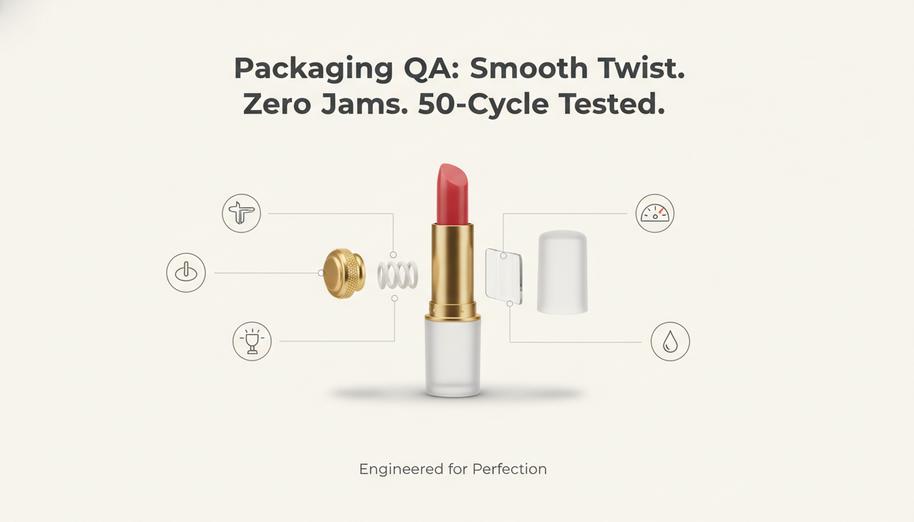
Smart QA keeps the lipstick tube knob rotating cleanly and surviving real-life impacts.
Dimensional Accuracy Checks on Knob and Actuator Fit
Precision requires strict tolerance control to prevent actuator drag.
-
Knob–Actuator Interface
- Measurement of outer knob diameter
- Internal spline dimensions of the actuator
- Clearance accuracy (strict ±0.05mm tolerance)
-
Fit Verification
- a. Dry assembly test
- b. Rotational resistance check
- c. Axial play inspection
-
Acceptance Focus
- • Smooth fit without wobble
- • Stable torque feel
At Topfeel, calibrated gauges ensure the tube knob glides perfectly based on precise measurement data.
Torque Test Protocols for Swivel Mechanisms
A reliable knob requires controlled torque testing.
-
Test Setup
1.1 Secure lipstick tube vertically
1.2 Attach digital torque meter to tube knob
1.3 Begin clockwise rotation
-
Performance Criteria
2.1 Initial break force range (0.10–0.15 N·m)
2.2 Continuous swivel resistance
2.3 Reverse rotation smoothness
-
Risk Flags
- Sudden spike in torque
- Grinding inside the mechanism
Topfeel runs repeat-cycle tests up to 50 twists to catch micro-jams before mass production.
UV Coating Inspection to Prevent Shell Stickiness
Uneven UV coating ruins the operational experience.
-
Surface Review
- Visual inspection under UV light
- Gloss and finish consistency
-
Thickness & Cure Check
- Cross-hatch adhesion test
- Coating thickness validation (15-20 microns)
-
Functional Impact
- Internal shell friction against actuator
- Build-up leading to stickiness
Topfeel balances coating layers strictly so the lipstick tube remains dry and smooth.
Drop Test for Closure Force and Component Fit
Knobs must hold closure and alignment after physical impacts.
-
Drop Conditions
1.1 Height calibration (Standard 1.2 meters / 4 feet)
1.2 Flat, edge, and corner impact angles
-
Post-Drop Evaluation
2.1 Cap force retention
2.2 Internal fit stability
2.3 Swivel integrity check
-
Failure Indicators
- Cracked tube or loose lipstick knob
- Shifted actuator core
That’s how Topfeel keeps packaging tough—no rattles, just a clean click.
FAQs about Lipstick Tube Knob
Why does a lipstick tube knob jam after repeated use?
Friction silently builds inside the swivel mechanism due to:
- Misaligned Shell–Cup–Actuator components.
- Unstable twist-up action from poor torque test control.
- Weight distribution shifts from a deformed ABS plastic Base.
- Actuator drag from thick UV coatings inside the Shell.
Which materials improve durability in a lipstick tube knob?
- Aluminum or metal alloy (Zamak) – Maintains structure under high-frequency cycles; ideal for premium anodized designs.
- High-grade ABS plastic – Delivers high dimensional accuracy on the Assembly line.
- PP plastic – Offers flexibility and low natural friction.
- PCR material – Reliable up to 30% blends with strict tooling precision.
How can torque settings be controlled for smoother rotation?
- Calibrate torque test devices to target the 0.10–0.15 N·m range.
- Standardize acceptable resistance for each Custom mold.
- Monitor actuation smoothness continuously during Assembly.
Metal vs. plastic knobs: which lasts longer in bulk production?
| Feature | Metal (Aluminum/Metal alloy) | ABS / PP Plastic |
|---|---|---|
| Structural rigidity | High | Moderate |
| Weight distribution | Balanced, premium feel | Lightweight |
| Surface finish | Anodizing, laser engraving | Matte finish, soft-touch coating |
| Long-term twist-up cycles | Stable | May wear under heavy rotation |
Metal guarantees longevity, while precision plastic molding optimizes scale.
How can QA teams detect early jam risks on the assembly line?
- Check dimensional accuracy (±0.05mm clearances).
- Run 1.2m drop tests to confirm closure force.
- Inspect UV coating (15-20 microns) and vacuum metallization for consistency.
- Evaluate component fit post-plating.
A well-engineered lipstick tube knob glides with quiet confidence—no grinding, just a clean twist-up inside a sleek profile.
Stop letting stuck knobs cost you customers. > Connect with Topfeel to discover how our strict QA protocols and precision manufacturing deliver a flawless twist every time.
References
- Grand View Research report – https://www.grandviewresearch.com/industry-analysis/cosmetic-packaging-market / Grand View Research
- anodized aluminum – https://www.aluminum.org/industries/processing/anodizing / The Aluminum Association
- Acrylonitrile Butadiene Styrene – https://www.bpf.co.uk/plastipedia/polymers/abs.aspx / British Plastics Federation
- dimensional stability – https://matmatch.com/learn/property/dimensional-stability / Matmatch
- Polypropylene – https://omnexus.specialchem.com/selection-guide/polypropylene-pp-plastic / Omnexus SpecialChem
- coefficient of friction – https://www.tribology-abc.com/abc/friction.htm / Tribology ABC
- Zamak/Zinc alloy – https://www.zinc.org/zamak-alloys/ / International Zinc Association
- PCR material – https://sustainability.plasticseurope.org/post-consumer-recyclate-pcr/ / Plastics Europe
- packaging materials outlook – https://www.smithers.com/services/market-reports/packaging / Smithers
- corrosion resistance – https://www.nace.org/resources/general-resources/corrosion-basics / NACE International
- NLGI Grade 2 – https://www.nlgi.org/about-us/nlgi-grade/ / National Lubricating Grease Institute
- silicone grease – https://www.dow.com/en-us/brand/molykote.html / Dow
- USP-grade – https://www.usp.org/about / US Pharmacopeia
- tolerance control – https://www.astm.org/products-services/standards-and-publications.html / ASTM International
- adhesion – https://www.defelsko.com/resources/cross-hatch-adhesion-testing-method / DeFelsko

