 English
  Español de México
  Français
  Deutsch
  Português do Brasil
  Italiano
  한국어
한국어  ไทย
ไทย  Русский
  日本語
日本語  Polski
  Svenska
  Türkçe

How to Choose the Right Empty Foundation Bottle?
April 28,2026
Choosing the right foundation empty bottle isn’t packaging trivia—it’s make‑or‑break for your brand. The wrong pick leaks margin, dulls shelf appeal, and frustrates customers. Buyers want durability, dosing control, and a look that says premium without blowing the budget.
Grand View Research’s 2025 packaging outlook highlights rising demand for sustainable, refillable cosmetic containers across North America.
Choose smart, scale confidently today.
Melodic Key Notes for Your Foundation Empty Bottle
→ Material Match: Choose Glass for premium heft or PET for lightweight, shatter-resistant appeal.
→ Closure Choice: Pair pumps, droppers, or snap-on caps with the right neck finish to prevent leaks.
→ Finish Flair: Matte, frosted, or UV-coated shells boost shelf impact while protecting formulas.
→ Sustainability Edge: Opt for PCR or refillable designs to cut waste, lower costs, and foster brand loyalty.
Types Of Foundation Empty Bottle Materials
Choosing the right foundation empty bottle isn’t just about looks. It’s about weight, feel, durability, and how your liquid foundation formula behaves inside the bottle. From classic glass to eco-friendly PCR, every foundation bottle choice shapes brand vibe and user experience.
Glass bottles
When a foundation empty bottle needs a luxury touch, glass still leads.
-
Material Identity
-
Core Traits
- Recyclable and endlessly reusable
- Strong chemical resistance
- Non-reactive with active foundation formulas
-
Sensory Appeal
- Noticeably heavy in hand
- Ultra-clear clarity or soft frosted finish
- Delivers a true premium feel
-
-
Design Compatibility
-
Shape Options
- Cylindrical full-size foundation bottle
- Sharp square liquid foundation container
-
Closure Systems
- Pump cap for daily use
- Dropper for controlled dispensing
-
-
Considerations
-
Pros
- Elevated shelf presence
- Strong branding via silk screen or hot stamping
-
Watch-outs
- Fragile during shipping
- Higher logistics cost
-
For brands like Topfeel, glass remains a go-to for upscale foundation empty bottle collections targeting prestige markets.
PET containers
PET works great for brands that want practicality without losing style.
- Lightweight and easy to carry
- Naturally shatterproof compared to glass
- Crystal clear body shows shade accuracy
- Works well for travel-size foundation bottles.
- Supports UV coating and wrap labeling.
- Offers solid barrier properties for most liquid foundation formulas.
Because PET is recyclable and cost-effective, many startups pick this type of foundation empty bottle to balance budget and performance. It’s also slightly flexible, helping reduce breakage in transit. If your crowd wants everyday reliability, PET just makes sense.
PP packaging
PP packaging is all about durability and formula safety.
-
Material Performance
-
Structural Strength
- Highly durable
- Strong impact resistant body
-
Resistance Profile
- Excellent chemical resistance
- Good heat resistant capacity
-
-
Visual Effects
-
Finish Options
- Smooth opaque look
- Soft translucent finish
-
Decoration
- Offset printing
- Spray painting for matte texture
-
-
Application in Foundation Bottle Design
- Ergonomic oval shapes
- Inner plug + pump cap systems
- Ideal for high-usage liquid foundation packaging
If a foundation empty bottle must survive daily drops in a makeup bag, PP packaging is a smart move. It’s also incredibly versatile, fitting both mass-market and dermo-cosmetic positioning.
Acrylic dispensers
Sleek. Modern. Eye-catching.
Acrylic gives that glass-like appearance without the anxiety of breakage. The body feels lightweight, yet still offers a premium look. Its high clarity makes shade tones pop instantly on shelves.
Often paired with an airless pump, this type of foundation empty bottle protects formula freshness while keeping the design sharp and geometric. Many rectangular foundation bottle designs use acrylic for that upscale vibe shoppers love.
For brands aiming at luxury but needing shatter-resistant performance, Topfeel frequently develops acrylic-based liquid foundation containers with refined collar detailing.
PCR-sourced vessels
Sustainability is no longer optional. It’s expected.
-
Environmental Positioning
-
Material Source
- Post-consumer recycled PET or PP
- Reduced reliance on virgin plastic
-
Core Value
- Supports circular economy goals
- Lowers overall environmental impact
-
-
Functional Integrity
- Maintains durable structure
- Preserves essential barrier properties
- Compatible with pump or screw cap
-
Brand Messaging Advantage
- Clear eco-friendly identity
- Visible recycled content labeling
- Strong green packaging storytelling
A PCR-based foundation empty bottle sends a clear signal: beauty can look good and do good. For brands building conscious product lines, this type of foundation bottle bridges performance with responsibility—without compromising style or safety.
Why Choose A Refillable Foundation Bottle?
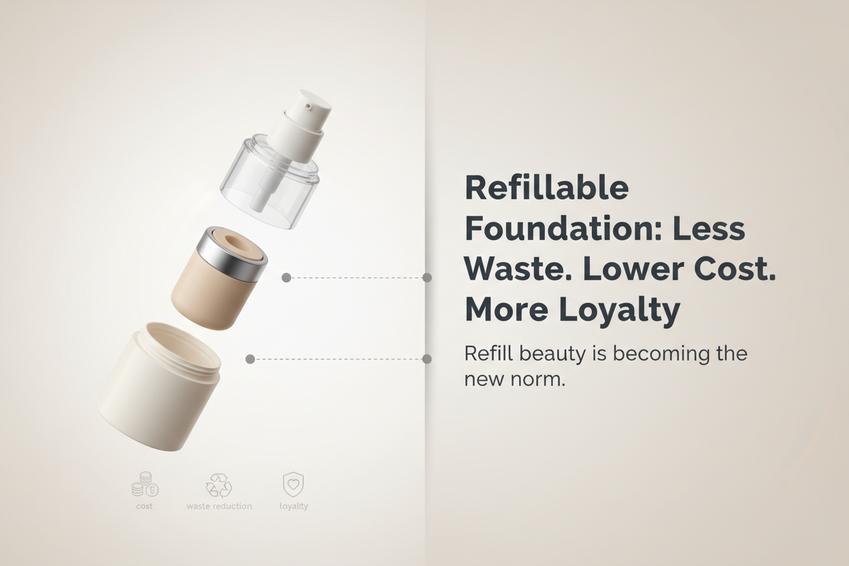
A smart foundation empty bottle is no longer just packaging—it’s part of the product story. From lowering cost pressure to cutting waste, brands now rethink every foundation bottle, empty container, and refill unit. Let’s break down why refill systems simply make sense.
Cut costs with reusable pump-cap designs
When brands switch to a reusable pump, cap, and outer foundation bottle, the math starts working in their favor.
-
Core design strategy
-
Outer shell (PP or PET)
- Durable, scratch-resistant
- Compatible with silk printing and hot stamping
-
Detachable pump system
- Reusable dip tube
- Standard thread size for multiple foundation empty bottle refills
-
-
Production cost control
-
Initial investment
- Mold for outer bottle
- Mold for reusable cap
-
Ongoing cost savings
- Replace only the inner refill cartridge
- Reduce material weight per reorder
-
-
Supply chain advantages
- Fewer raw materials per cycle
- Lower shipping weight for each empty foundation bottle refill
- Simplified SKU management
With Topfeel, brands can standardize a reusable pump platform while offering multiple shades inside the same foundation empty bottle structure. That means better margins without sacrificing style. And yes, buyers notice the upgrade.
Minimize waste using inner plug refills
A refillable foundation empty bottle isn’t just about saving cash—it directly supports waste minimization and sustainability goals.
Here’s how it works:
- The consumer keeps the outer shell—glass or acrylic.
- The inner cartridge, fitted with an inner plug and sealing gasket, is removed.
- A new refill clicks in securely.
No leaks. No mess. Just smart foundation packaging.
- ♻ Reduced plastic per purchase
- ♻ Easier PCR material integration
- ♻ Lower carbon footprint during transport
Short story? Less landfill. More loyalty.
According to the 2025 McKinsey Beauty Report, refill models in cosmetics are moving from niche to norm, with consumers actively seeking packaging that cuts single-use waste while maintaining premium appeal.
For brands sourcing through Topfeel, refill cartridges can be customized to match any foundation bottle silhouette. That keeps the shelf look consistent while the inside evolves. A simple shift—big environmental impact.
Boost brand loyalty through refillable PP kits
A refillable PP kit built around a smart foundation empty bottle strengthens real brand loyalty.
-
Customer experience layer
-
Ergonomic outer shell
- Smooth grip PP body
- Balanced weight for daily use
-
Airless pump precision
- Controlled dosage
- Less product waste
-
-
Emotional engagement
-
Refill ritual
- Remove inner core
- Insert new refill
- Snap, twist, ready
-
Sense of participation in sustainability
-
-
Long-term retention strategy
- Repeat refill purchases
- Shade expansion within same foundation empty bottle
- Limited-edition outer design updates
Consumers don’t throw away the whole empty foundation bottle anymore—they refill it. That small habit builds connection. With Topfeel offering tailored refillable kits, brands transform a basic empty bottle into an ongoing relationship.
And in today’s beauty market, that kind of loyalty is gold.
Glass Vs. PET: Foundation Bottle Face-Off
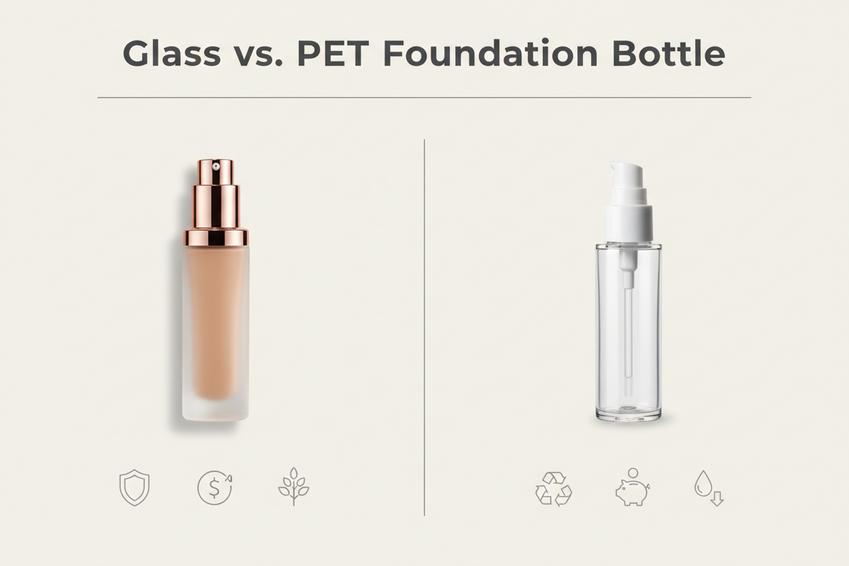
Finding the right foundation empty bottle isn’t just about looks. It’s about feel, safety, shipping cost, and how your brand shows up on a shelf. From a refillable cosmetic bottle to a sleek empty foundation bottle with pump, material choice shapes the whole vibe. Let’s break it down in real terms.
Glass
When a foundation empty bottle is made of glass, the story shifts toward Premium feel and visual impact.
-
Core material traits
-
Physical properties
- High Weight creates a stable, luxury hand-feel.
- Noticeable Clarity enhances shade visibility in a clear foundation bottle.
- Natural Fragility requires careful secondary packaging.
-
Chemical profile
- Strong Inertness supports formula stability.
- Excellent compatibility with active or sensitive liquid foundation blends.
-
-
Brand perception layers
-
Shelf appeal
- Frosted or glossy finish elevates a foundation glass bottle instantly.
- Hot stamping and metallic pumps amplify that upscale tone.
-
Sustainability angle
- Strong Recyclability story.
- Recognized for long-term Sustainability positioning in premium beauty lines.
-
-
Practical considerations
- Works best for cylindrical or square shapes.
- Ideal for pump or dropper systems in a high-end makeup packaging range.
“Consumers continue to trade up in beauty, prioritizing packaging that signals quality and sustainability,” notes McKinsey’s 2024 State of Fashion: Beauty report, highlighting growing demand for premium materials.
For brands aiming at prestige retail, a glass foundation empty bottle often seals the deal. Topfeel frequently supports custom decoration on glass options for elevated collections.
PET
A PET foundation empty bottle plays a different game—light on the hand, tough on the road.
-
Material performance
-
Mechanical advantages
- Lightweight body reduces freight cost.
- Strong Durability makes it reliably Shatterproof.
-
Functional flexibility
- Noticeable Flexibility allows slightly Squeezable designs.
- Solid Barrier properties protect everyday liquid makeup formulas.
-
-
Cost and production
-
Manufacturing
- More Cost-effective for mass runs.
- Faster molding cycles for high-volume empty foundation bottle production.
-
Design freedom
- Transparent or opaque finishes.
- UV coating options for added protection.
- Compatible with snap-on caps or lotion pumps in round or oval shapes.
-
-
Usage scenarios
- Travel-size refillable cosmetic bottle lines.
- Youth-focused brands needing impact resistance.
- E-commerce heavy sellers reducing breakage risk.
If your goal is practical, scalable, and shipping-friendly makeup packaging, PET wins on efficiency. Many growing brands partner with Topfeel to develop PET-based foundation bottle solutions that balance cost, safety, and style without cutting corners.
3 Key Materials For Foundation Empty Bottle Durability
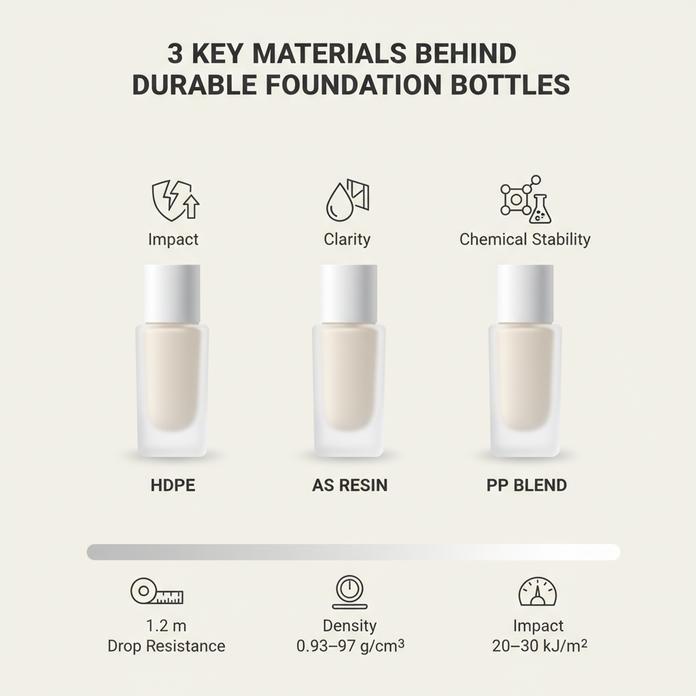
Choosing the right material for a foundation empty bottle is not just factory talk—it shapes how your liquid foundation feels, travels, and survives daily drops. From pump bottle to airless bottle, the right plastic keeps every empty foundation bottle safe and stylish.
HDPE for impact-resistant body
When a foundation empty bottle needs to survive shipping, shelf display, and bathroom tile accidents, HDPE stands out.
-
Core Material: HDPE
-
Structure
- Made from polyethylene with high density chains
- Forms a tough bottle body with strong wall integrity
-
Key Traits
- Excellent impact resistance
- Lightweight yet durable
- Ideal packaging material for travel-size and jumbo foundation bottle designs
-
-
Performance in a Plastic Container System
-
A. Drop Resistance
- Maintains shape after repeated 1.2 m drop tests
-
B. Compatibility
- Works well with matte coatings for opaque foundation empty bottle collections
-
C. Sustainability Edge
- Recyclable plastic container option in many regions
-
| Property | HDPE Value Range | Benefit for Foundation Bottle |
|---|---|---|
| Density (g/cm³) | 0.93–0.97 | Light but strong body |
| Impact Strength (kJ/m²) | 20–30 | Resists cracking |
| Moisture Barrier | High | Protects liquid foundation |
| Chemical Resistance | Excellent | Stable with pigments |
For brands like Topfeel, using HDPE in a foundation empty bottle means fewer returns due to cracks and a more reliable empty bottle for everyday users.
AS resin with crystal-clear finish
If the vibe is clean, glossy, and premium, AS resin fits right in.
- Crystal-clear look with high transparency
- Smooth surface for UV coating or pearl spray
- Perfect for visible liquid levels in a cosmetic bottle
A typical setup for a foundation empty bottle using AS resin includes:
- Clear outer shell
- Airless pump system
- Metallic collar for extra aesthetic appeal
This resin material gives a glass-like effect without the weight. For a clear packaging concept, that’s a win. Consumers love seeing the shade through the transparent foundation bottle—it feels honest and high-end.
Short and simple: clarity sells. A shiny empty foundation bottle on retail shelves often gets picked up faster. Topfeel applies precision molding so the cosmetic bottle edges stay sharp and smooth, boosting that polished aesthetic appeal.
PP blend offering chemical stability
A foundation empty bottle must handle active ingredients, pigments, and fragrance oils. That’s where PP blend earns respect.
-
Material Foundation: PP blend
- Base: polypropylene
- Enhanced with modifiers for stronger chemical stability
-
Functional Compatibility in Packaging
-
A. Formula Interaction
- High formulation compatibility with water-based and silicone foundations
- Acts as an inert material, reducing unwanted reactions
-
B. Component Integration
- Works smoothly with pump cap systems
- i. Gasket
- ii. Dip tube
- iii. Lockable actuator
-
C. Leakage Control
- Resistant inner wall minimizes seepage
-
-
Application in Plastic Bottle Engineering
- Used in inner liners of a plastic bottle
- Ideal for refillable foundation bottle structures
- Supports offset printing and ergonomic curves
For long-term storage, this resistant material keeps the foundation empty bottle stable on shelves and in makeup bags. No weird smells. No color shift. Just a dependable empty bottle that protects the formula from day one to the last pump.
Too Much Waste? Airless Bottles Save Product
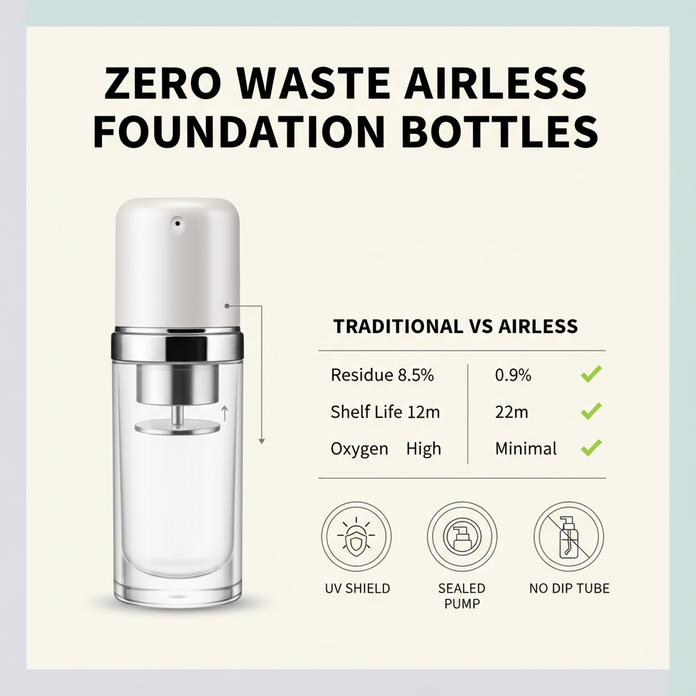
Air waste, product waste, money waste—it adds up fast. A smart foundation empty bottle design changes the game, keeping every drop usable while protecting formula quality.
Airless pump action for zero-scoop loss
A well-designed foundation empty bottle with an airless bottle system works differently from traditional bottles. Instead of relying on gravity and a dip tube, it uses a rising internal base and controlled pump action to push formula upward. No tilting. No shaking. No digging for leftovers.
Within a modern foundation bottle, the dispensing mechanism typically includes:
-
Primary Pump System
- a. Spring-loaded actuator
- b. Vacuum chamber
- c. Internal piston platform
-
Product Preservation Structure
- a. Airtight housing
- b. Backflow prevention valve
-
Waste Reduction Components
- a. Precision dosage outlet
- b. Controlled return stroke
Key benefits inside this foundation empty bottle format:
- Accurate output per press
- Reduced exposure to oxygen
- Noticeable waste reduction
The result is close to zero loss at the base, unlike traditional foundation bottles that trap 5–10% residue.
| Bottle Type | Residual Formula (%) | Average Dose (ml) | Oxygen Exposure Level | Shelf Stability (Months) |
|---|---|---|---|---|
| Dip Tube Glass | 8.5% | 0.20 | High | 12 |
| Standard Pump PP | 6.2% | 0.18 | Medium | 14 |
| Airless Acrylic | 1.5% | 0.15 | Low | 18 |
| Airless PP | 1.2% | 0.15 | Very Low | 20 |
| UV-Coated Airless | 0.9% | 0.15 | Minimal | 22 |
For brands sourcing a foundation empty bottle, these numbers aren’t small details. They directly impact refill cycles, customer satisfaction, and formula consistency.
Sealed actuator and gasket protection
Inside a high-quality foundation empty bottle, sealing is serious business. The sealed actuator locks tightly after each press, while layered gasket protection prevents micro-leakage and outside air intrusion.
Protection works across three coordinated levels:
-
Structural Seal
- Internal compression ring
- Reinforced neck fit
-
Formula Integrity Guard
- Dual sealing mechanism
- Reverse airflow block
-
External Contamination Prevention
- Lock-cap compatibility
- Controlled dispensing head
This layered system preserves formula integrity and supports real contamination prevention. Liquid foundation, serum foundation, even hybrid skincare-makeup blends stay stable longer inside a properly engineered foundation container.
In 2025, Grand View Research noted:
“Airless packaging adoption in cosmetic applications continues to rise as brands prioritize product freshness, oxidation control, and reduced material waste.”
That shift explains why more suppliers are moving toward airless bottle systems when designing the next generation foundation empty bottle.
Topfeel integrates precision molding and seal calibration to maintain consistent product freshness, especially for high-value liquid formulas.
No dip tube needed—pure formula delivery
Traditional foundation bottles rely on a long tube that never reaches every corner. Airless technology removes that weakness entirely.
Here’s how direct delivery works in a foundation empty bottle:
- Product is filled above a movable base.
- Each pump creates controlled vacuum pressure.
- The internal platform rises steadily.
- Formula exits without relying on a tube.
- The chamber stays sealed between uses.
Benefits stack up quickly:
- Full dip tube absence
- Clean direct delivery
- Maintained product purity
- Strong contamination avoidance
- Consistent efficient dispensing
Even thick matte foundations move smoothly through this airless bottle system. No sputtering. No last-week scraping.
For brands designing a premium foundation bottle, removing the dip tube improves not only hygiene but also visual clarity in transparent or frosted packaging.
Frosted shell plus UV coating for longevity
A foundation empty bottle doesn’t just protect from air; it also shields against light degradation. That’s where the frosted shell and UV coating combination shines.
Protection layers inside this bottle material strategy include:
-
Outer Aesthetic Layer
- Matte aesthetic design surface
- Silk screen branding
-
Middle Barrier Layer
- UV-blocking treatment
- Light diffusion texture
-
Inner Formula Shield
- Opaque or semi-opaque liner
- Enhanced formula protection
Light degradation can break down pigments and active ingredients over time. Adding UV protection extends product longevity, especially for vitamin-infused or SPF-based formulas inside a foundation empty bottle.
Topfeel applies controlled UV coating thickness to balance clarity and durability. The final effect feels premium in hand while quietly preventing light degradation.
For brands serious about performance and presentation, combining airless technology with smart surface treatment turns a simple foundation empty bottle into a high-efficiency, long-lasting foundation container that customers trust.
FAQs about Foundation Empty Bottle
What materials work best for a durable foundation empty bottle?
Choosing the right material shapes both feel and performance:
- Glass (Frosted or Glossy, Cylindrical/Round): Premium weight, ideal for full size formulas with silk screen printing or hot stamping.
- PET & HDPE (Transparent or Opaque): Lightweight, shatter-resistant, perfect for travel size or miniature lines.
- PP (Matte, Ergonomic): Chemical-resistant and comfortable in hand, often paired with a pump cap and inner plug.
- Acrylic, AS, SAN (Geometric or Square): Luxury appearance with clear walls and airless pump systems.
- PCR blends: Sustainable PET or PP options that maintain strength while lowering environmental impact.
Material choice affects decoration, refill systems, and how the consumer emotionally connects with the bottle.
Why are airless pump designs preferred over standard pump bottles?
Airless pump systems protect both formula and user experience.
- No dip tube; a piston pushes product upward, reducing residue.
- Gasket sealing limits oxidation and contamination.
- Works beautifully with Acrylic or PP shells in Rectangular or Oval shapes.
Paired with a dust cap, actuator, and collar, the airless pump extends shelf life and keeps dosage consistent—especially for standard size and jumbo size foundation packaging.
How can decoration and closures elevate a foundation empty bottle?
A foundation empty bottle becomes memorable through detail:
- ✦ Closures: Screw cap for secure sealing, pump cap with dip tube for daily use, dropper cap for precise control, snap-on cap for sample size packs.
- ✦ Surface finishes: Matte and soft-touch for a modern feel; pearlized or glossy for shelf impact; frosted glass for quiet luxury.
- ✦ Decoration techniques: Silk screen printing, UV coating, spray painting, labeling, or offset printing to highlight brand identity.
When shape (Square, Round, or Geometric), finish, and closure align, the bottle feels less like packaging—and more like part of the beauty ritual.
References
- Cosmetic Packaging Market Size & Trends – Grand View Research (https://www.grandviewresearch.com/industry-analysis/cosmetic-packaging-market)
- Chemical Resistance – Wikipedia (https://en.wikipedia.org/wiki/Chemical_resistance)
- Polyethylene Terephthalate (PET) – Wikipedia (https://en.wikipedia.org/wiki/Polyethylene_terephthalate)
- Polypropylene (PP) – Wikipedia (https://en.wikipedia.org/wiki/Polypropylene)
- Poly(methyl methacrylate) (Acrylic) – Wikipedia (https://en.wikipedia.org/wiki/Poly(methyl_methacrylate))
- Circular Economy Introduction – Ellen MacArthur Foundation (https://www.ellenmacarthurfoundation.org/topics/circular-economy-introduction/overview)
- Environmental Topics – EPA (https://www.epa.gov/environmental-topics)
- Corporate Climate Leadership: Carbon Footprint – EPA (https://www.epa.gov/climateleadership/center-corporate-climate-leadership-carbon-footprint)
- The State of Fashion: Beauty – McKinsey (https://www.mckinsey.com/industries/consumer-packaged-goods/our-insights/the-state-of-fashion-beauty)
- Brand Loyalty – Wikipedia (https://en.wikipedia.org/wiki/Brand_loyalty)
- High-Density Polyethylene (HDPE) – Wikipedia (https://en.wikipedia.org/wiki/High-density_polyethylene)
- Polyethylene – Wikipedia (https://en.wikipedia.org/wiki/Polyethylene)
- Styrene-Acrylonitrile Resin (AS Resin) – Wikipedia (https://en.wikipedia.org/wiki/Styrene-acrylonitrile_resin)
- UV Degradation – Wikipedia (https://en.wikipedia.org/wiki/UV_degradation)
- UV Coating – Wikipedia (https://en.wikipedia.org/wiki/UV_coating)

