 English
  Español de México
  Français
  Deutsch
  Português do Brasil
  Italiano
  한국어
한국어  ไทย
ไทย  Русский
  日本語
日本語  Polski
  Svenska
  Türkçe

What Makes a Good Bottle for Spray? Key Features to Consider
March 05,2026
A bottle for spray can make your product shine—or sink it without a trace. One faulty sprayer and your “luxury mist” turns into a dribble, and customers aren’t shy about calling it out. Packaging isn’t just a container; it’s your product’s handshake, its first impression, its ride-or-die partner on the shelf.
Grand View Research reports the global cosmetic packaging market has surpassed $49 billion and is expected to grow at a CAGR of over 5% into 2026 and beyond, driven by demand for travel-size, trial, and durable high-performance formats—proof that buyers care about function as much as flair.
Pick wrong, and you’re eating returns and bad reviews. Pick right, and every spritz feels like money well spent.
Quick Answers & Key Points: The Smart Selection Blueprint for Every Bottle for Spray
- Material Matters: Choose the right exterior for durability and compatibility—HDPE plastic with trigger spray bottle systems for tough hair sprays and body mists, PET plastic for transparent facial mists and setting sprays, and glass or aluminum for UV protection in perfumes and sunscreen sprays.
- Failure Risks: Prevent common pain points such as leaking screw cap threads, broken actuator or spray pump fatigue in fine mist sprayer systems, and PP plastic cracking or clouding under fragrance oils.
- Bottle–Formula Match: Align bottle type with product viscosity and sensitivity—atomizer bottles for perfumes, pump bottles for lotions, and airless pump bottles for oxygen-sensitive toners and serums.
- Closure & Capacity Choices: Select closures like snap-on caps, flip-top caps, or pump dispensers based on sealing and dosing needs, and define capacity in milliliters (ml) or fluid ounces (fl oz) for market fit and shipping efficiency.
- Performance Features & Shelf Appeal: Add value with refillable, recyclable, and UV protection features, then elevate shelf impact through labeling, silk screening, hot stamping, frosting, color coating, or offset printing to make every bottle for spray both functional and unforgettable.
3 Key Exterior Materials for a Durable Bottle for Spray
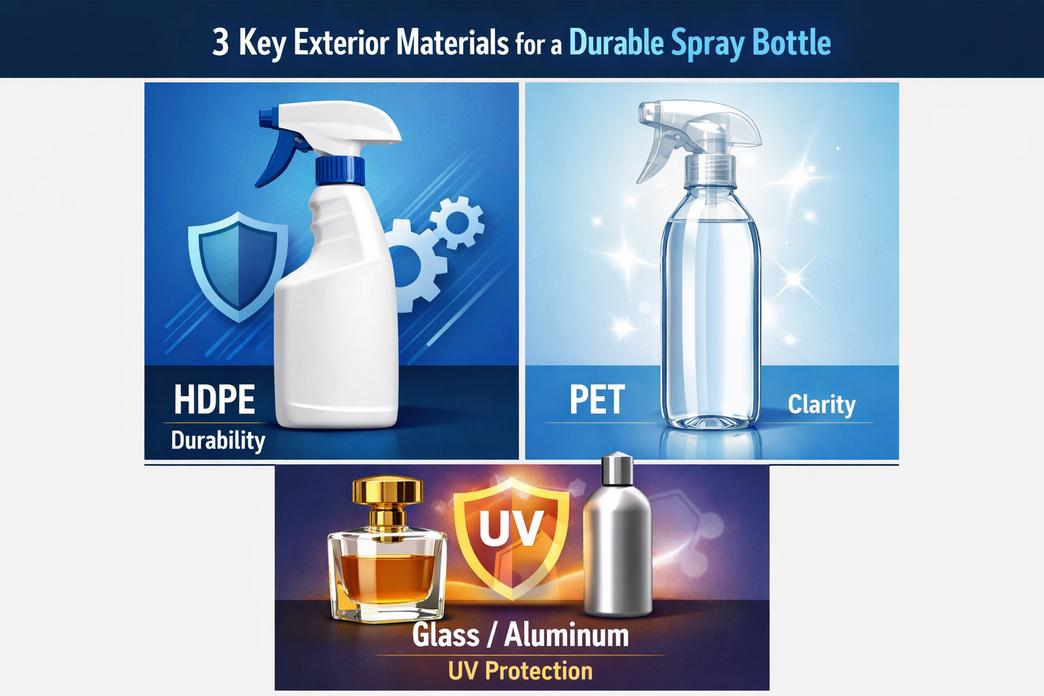
Choosing the right bottle for spray isn’t just about looks. It shapes product safety, shelf life, and user vibe. From hair mist to perfume spray bottle designs, the outer material decides how well a spray bottle survives drops, sunlight, and travel bags. This quick summary breaks down the main concepts and themes behind HDPE, PET, and metal or glass upgrades—so your next bottle for spray choice feels smart, not random.
HDPE plastic + Trigger spray bottle toughness for Hair sprays and Body mists
When impact matters, HDPE steps up.
- Material core
- High-density polyethylene structure
- Resists cracks
- Handles alcohol-heavy formulas
- Stable body for repeated squeezing
- Functional pairing
- Trigger head system
- Even spray pattern
- Long-term pump durability
- Ideal bottle for spray in salons and gyms
- Use scenarios
- Hair spray bottle
- Body mist spray container
- Travel-size spray packaging
A quick breakdown:
- Tough shell
- Chemical stability
- Budget-friendly scaling
For brands like Topfeel, HDPE keeps production smooth while maintaining the main idea of durability across transport and daily handling.
PET plastic clarity: Transparent bottles for Facial mists and Setting sprays
PET is all about visibility and vibe.
- Clear wall design = instant product trust
- Lightweight body = easy daily carry
- Strong barrier = stable formula for face makeup packaging
Short notes that matter:
- Transparent bottle for spray boosts shelf appeal.
- Customers like seeing liquid levels.
- Fine mist spray bottle designs look clean and modern.
According to Smithers’ Future of Global Packaging to 2026 report, world packaging demand is projected to reach $1.22 trillion, and demand for clear and lightweight plastic packaging continues to rise in personal care, driven by consumer preference for visible product integrity and portability.
That insight supports PET as a go-to spray bottle option for setting sprays. Topfeel aligns its purpose with this trend—clean look, reliable feel, solid performance.
Glass or Aluminum upgrades: UV protection for Perfumes and Sunscreen sprays
Premium protection comes in layers.
- Barrier strength
- glass pump bottle formats
- Strong UV shielding
- Low interaction with fragrance oils
- Aluminum bottle
- Blocks light fully
- Excellent for sunscreen spray
- Brand positioning
- Luxury perfume spray bottle image
- Elevated message and shelf presence
- Stability impact
- Reduced formula breakdown
- Longer fragrance consistency
Key signals:
- Better UV defense
- Stronger shelf stability
- Upscale finish
For high-end bottle for spray projects, Topfeel matches material choice with product identity, turning a simple spray container into a long-term brand asset.
3 Pain Points of Fragile Spray Bottles
A reliable bottle for spray sounds simple, yet small flaws can wreck the whole vibe of a product. From leaky spray bottle caps to cracked plastic spray containers, brands deal with returns, complaints, and wasted formulas. This introduction sets the tone: fragile packaging hurts trust. Below, the body paragraphs break down the core themes behind why a spray bottle for mist or toner fails too soon.
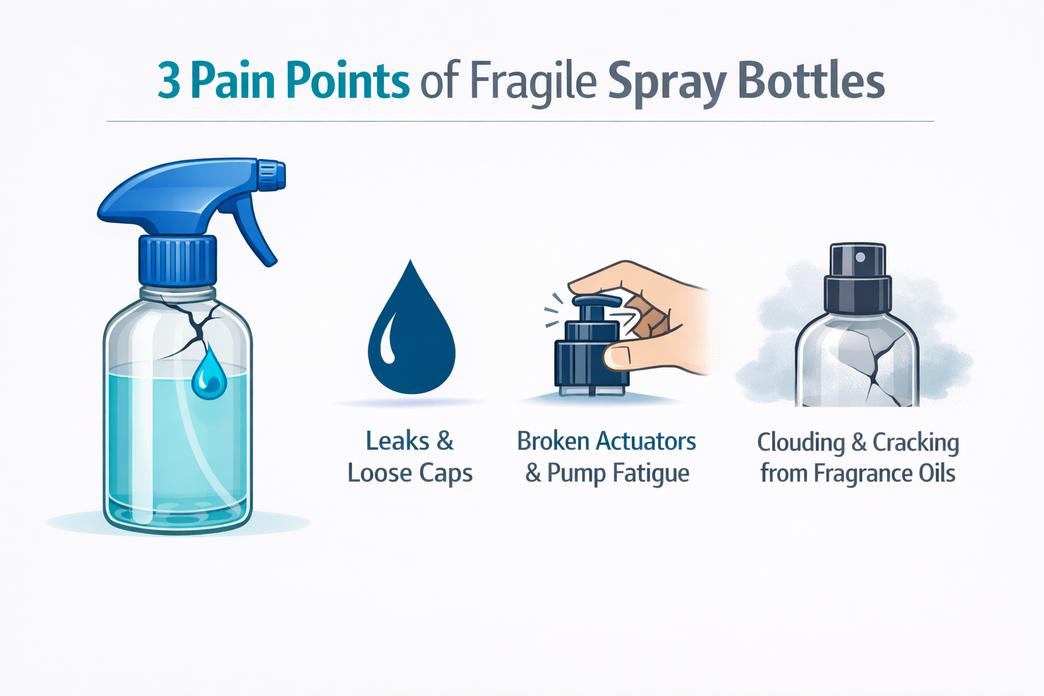
Leaks and loose Screw cap threads on Mist spray bottle neck finishes
When a bottle for spray leaks, the main idea usually traces back to thread mismatch. The issue unfolds in layers:
-
Thread design flaws
- Inconsistent pitch on the spray bottle neck
- Cap feels tight but isn’t sealed
- Micro-gaps allow evaporation
- Shallow engagement
- Spray bottle cap slips under pressure
-
Material pairing problems
- Soft PP cap on rigid PET bottle for spray
- Threads deform over time
- Alcohol-heavy formulas
- Increase internal pressure in a spray container
-
Resulting impact on brands
- Product loss
- Contamination risks
- Damaged message to the target audience
A fine mist bottle for spray must align neck finish and cap tolerance precisely. Topfeel controls torque range and thread calibration so each spray bottle system locks smoothly, reducing leaks and keeping the bottle for spray secure during shipping and daily use.
Broken Actuator and Spray pump fatigue on Fine mist sprayer systems
A spray bottle for mist relies on its actuator. If that fails, the entire argument for quality collapses.
-
Actuator stress points
- Repeated pressing
- Spring fatigue inside the spray pump
- Weak rebound
- Uneven spray bottle output
-
Internal pump wear
- Seal abrasion
- Dripping after each press
- Air intake imbalance
- Inconsistent mist pattern in the bottle for spray
-
User-side frustration
- Spray bottle clogs
- Spray container sputters
- Negative product summary in reviews
Performance testing should simulate thousands of presses. A durable bottle for spray must survive daily routines, travel shaking, and refill cycles. Topfeel integrates reinforced actuator ribs and balanced pump chambers, keeping the spray bottle action smooth and extending lifecycle expectations for demanding readership.
Clouding, cracking, and Opaque shifts in PP plastic under fragrance oils
Plastic compatibility sits at the heart of this abstract discussion. A bottle for spray made from PP may look crystal clear at launch, then shift over time.
-
Chemical interaction chain
- Fragrance oils penetrate polymer structure
- Stress cracking along the spray bottle shoulder
- Hairline fractures near the bottle for spray base
-
Visual degradation
- Clouding in transparent spray bottle walls
- Opaque patches on the spray container
- Loss of shelf appeal and weakened impact
-
Structural consequences
- Brittle texture
- Reduced drop resistance
- Shortened lifespan of the bottle for spray
Brands targeting skincare and hair mist users need material testing tied to real formulas. A high-quality bottle for spray must match resin grade to oil concentration. That alignment protects both aesthetics and strength, preserving the brand’s objective and keeping the spray bottle looking sharp long after it hits the shelf.
5 Steps to Evaluate Your Next Spray Bottle Design
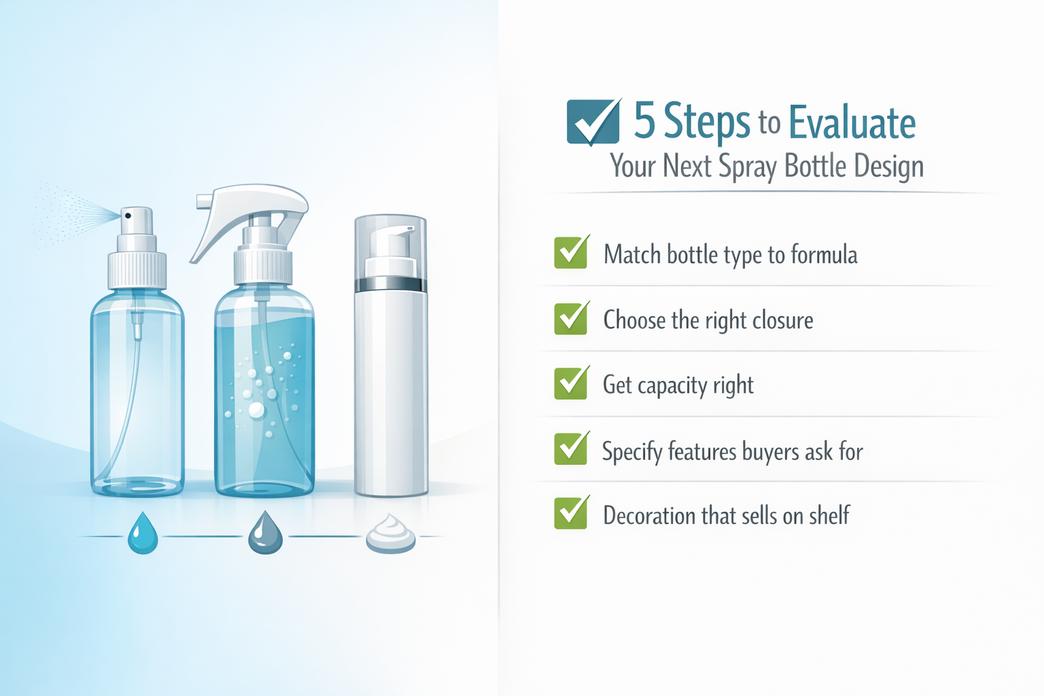
Choosing the right bottle for spray products can feel tricky, but it doesn’t have to be. This quick guide breaks down the main idea into practical checks so your spray bottle, spray bottle for cosmetics, or mist bottle actually works and sells.
Step 1: Match bottle type to formula: Atomizer bottle, Pump bottle, or Airless pump bottle
-
Formula texture
- Light and watery → Atomizer bottle for fine mist
- Medium viscosity → Classic pump bottle for spray use
- Sensitive serums → custom airless tube for foundation or serums to reduce air contact
-
Product stability
- Oxygen-sensitive blends need sealed systems
- Natural formulas benefit from controlled dosing
-
User expectation
- Facial mist? Go ultra-fine.
- Body spray? Wider dispersion works.
This keeps the subject matter aligned with performance, not guesswork.
Step 2: Choose the right closure: Snap-on cap, Flip-top cap, or Pump dispenser
Closure shapes the reader interest at shelf level and daily usability.
- Snap-on cap → travel-size bottle for spray items.
- Flip-top cap → thicker gels in a spray bottle alternative format.
- Pump dispenser → controlled output, less waste.
Small tweak, big impact.
Step 3: Get capacity right in Milliliters (ml) and Fluid ounces (fl oz)
Capacity planning ties to:
- Usage frequency
- Shipping weight
- Target audience habits
A 30 ml bottle for spray works for trial kits.
A 100 ml spray bottle fits retail shelves.
A 200 ml bottle for spray suits body care.
Keep units clear in both ml and fl oz for global readability and stronger clarity.
Step 4: Specify features buyers ask for: Refillable, Recyclable, UV protection
Buyers talk. Brands listen.
• Refillable design lowers long-term cost.
• Recyclable PET or glass boosts eco appeal.
• UV protection shields active ingredients.
Recent packaging reports from McKinsey (in their 2025–2026 updates on sustainable packaging trends) highlight rising demand for circular formats, noting that between 40 and 80 percent of consumers across all countries are prepared to pay more for sustainable packaging. That’s not hype—it’s shifting buyer behavior.
Topfeel integrates refill systems into its bottle for spray lines, keeping both style and sustainability in focus.
Step 5: Decoration that sells on shelf: Labeling, Silk screening, Hot stamping, Frosting, Color coating, Offset printing
Decoration influences the impact before a customer even tests the spray bottle.
-
Surface strategy
- Glass → Frosting or silk screening
- PET → Color coating or offset printing
- Aluminum → Hot stamping for a premium vibe
-
Brand tone
- Minimal text for clean skincare
- Bold metallic accents for fragrance lines
A well-designed bottle for spray does more than dispense liquid makeup packaging contents. It supports your argument, strengthens your visual identity, and leads naturally to a confident buying decision.
FAQs about Bottle For Spray
What materials work best for a durable bottle for spray?
Choosing the right shell shapes performance and shelf appeal.
- PET plastic – Transparent, lightweight, ideal for facial mists and setting sprays.
- HDPE plastic – Strong impact resistance, great for trigger spray bottle designs used in hair sprays.
- Glass – Premium feel with natural UV protection for perfumes and sunscreen sprays.
- Aluminum – Opaque, protective, recyclable, suited to body mists.
- Acrylic – Polished look for upscale atomizer bottle packaging.
Each material balances durability, refillable options, and recyclable goals differently.
How can leaks be prevented during shipping?
Leakage often comes from poor pairing, not poor materials.
- Match neck finish with the correct spray pump or actuator.
- Ensure screw cap threads align tightly with PET plastic or HDPE plastic bottles.
- Test PP plastic closures under high temperature.
- For airless pump bottle designs, confirm internal pressure stability.
A secure mist spray bottle feels tight, smooth, and consistent when pressed.
Which closure type suits different spray applications?
Closure choice affects comfort and dosage control.
- Fine mist sprayer + Spray pump → Facial mists, toners (soft, even cloud).
- Pump dispenser → Airless pump bottle for setting sprays with thicker formulas.
- Trigger spray bottle + Actuator → Hair sprays requiring wider coverage.
- Snap-on cap or Screw cap → Travel-size atomizer bottle for perfumes.
- Flip-top cap → Pump bottle formats for gel-based products.
Function should match formula weight and daily use habits.
Why upgrade to glass or aluminum for premium lines?
Short answer: protection meets perception.
Glass and aluminum provide strong UV protection, slowing formula breakdown in sunscreen sprays and perfumes. Opaque or frosted finishes enhance luxury, while recyclable value appeals to eco-conscious buyers. Frosting, color coating, and hot stamping elevate presence without sacrificing durability.
What should be checked before bulk purchasing?
A brief checklist helps avoid costly returns.
- Capacity: 50–100 milliliters (ml) for retail; 200 ml or 6.8 fluid ounces (fl oz) for extended use.
- Compatibility: Fine mist sprayer for light toners; pump bottle for denser setting sprays.
- Material safety: PET plastic handles alcohol blends better than some PP plastic parts.
- Features: Refillable, ergonomic design, transparent or opaque options.
Small technical details protect large investments.
How does decoration improve shelf visibility?
Decoration turns a simple bottle for spray into a brand voice.
Silk screening offers clean logo lines.
Offset printing supports gradient artwork.
Labeling adapts well to curved HDPE plastic surfaces.
Hot stamping adds metallic accents to glass or acrylic.
Frosting softens transparent finishes for a refined touch.
Good decoration doesn’t shout; it draws the eye and earns a second look.
References
- [Premium packaging solutions for beauty and cosmetics brands – https://www.easysnap.com/premium-packaging-solutions-for-beauty-and-cosmetics-brands/]
- [Sustainability in packaging—across the value chain, and in 2025 and beyond – https://www.mckinsey.com/industries/packaging-and-paper/our-insights/sustainability-in-packaging-across-the-value-chain-and-in-2025-and-beyond]

