 English (Australia)
  English
  English (UK)
  English (Canada)
  العربية
  Deutsch
  Italiano
  Español de México
  Tiếng Việt
  ไทย
ไทย  Português do Brasil
  Français
  Български
  Čeština
  Dansk
Dansk  Ελληνικά
  Eesti
Eesti  Suomi
Suomi  Magyar
  Bahasa Indonesia
  Lietuvių kalba
  Latviešu valoda
  Norsk bokmål
  Nederlands (Formeel)
  Polski
  Română
  Русский
  Slovenčina
  Slovenščina
  Svenska
  Türkçe
  Українська
  简体中文
简体中文  日本語
日本語  한국어
한국어  繁體中文
繁體中文 
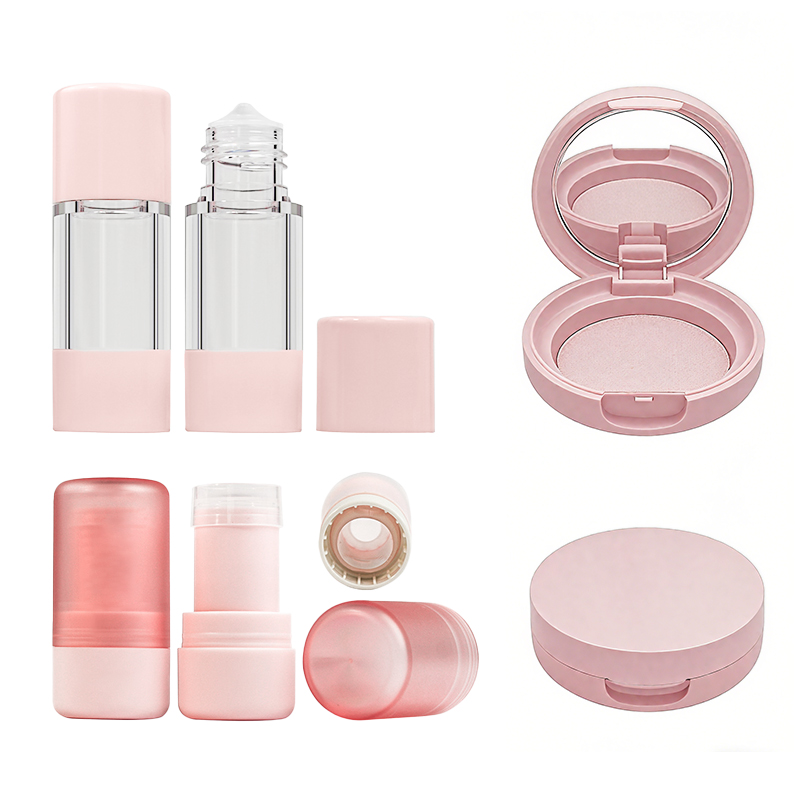
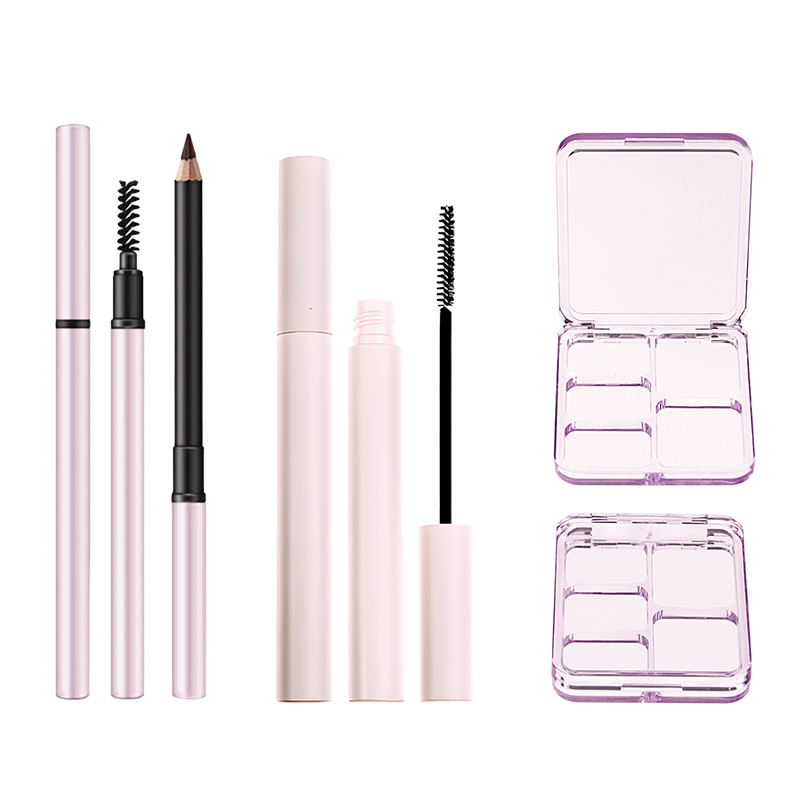
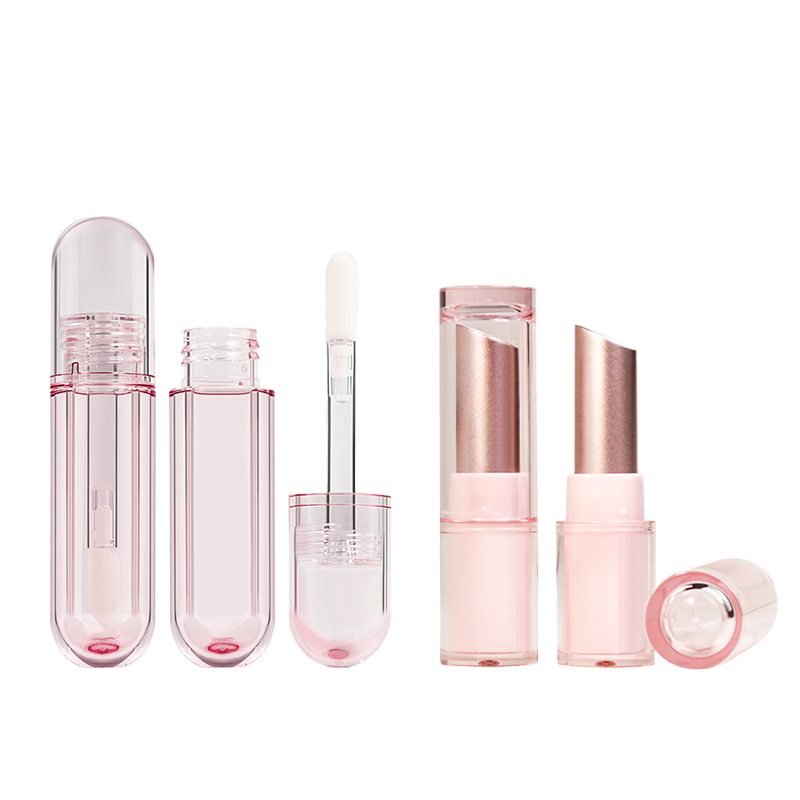

Why Eco-Friendly Empty Foundation Cushion Packaging Is a Must-Have?
April 09,2026
The empty foundation cushion used to be an afterthought—just a plastic shell holding pretty pigment. Now it’s the elephant in the room. Beauty buyers are staring at pallets of compacts and thinking, “Are we shipping product… or future landfill?” Consumers scroll, tap, and call brands out in seconds. If your packaging feels old-school, your brand does too.
Here’s the kicker: McKinsey reports over 60% of U.S. consumers say sustainability influences purchasing decisions. That’s not a whisper—it’s a wake‑up call.
An eco‑friendly cushion compact isn’t just about looking green on a mood board. It cuts shipping weight, trims material waste, and swaps one‑and‑done cases for refill systems that keep customers coming back. Think of it like upgrading from a gas‑guzzler to a hybrid—same destination, smarter ride.
Smart brands aren’t chasing trends. They’re future‑proofing.
Quick Answers for Empty Foundation Cushion Essentials
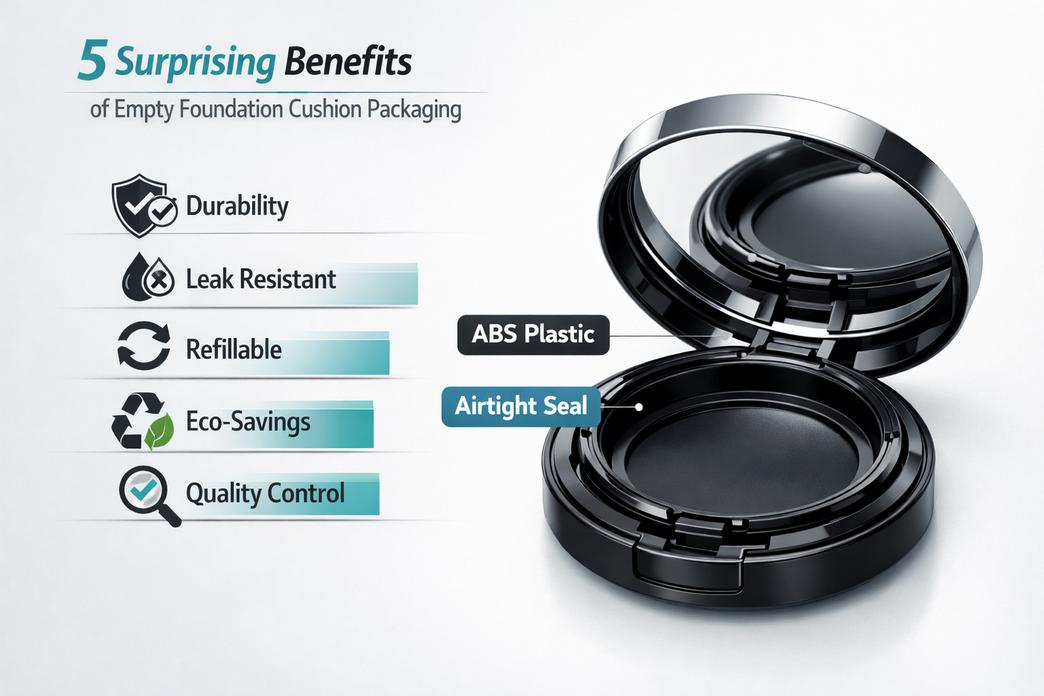
➔ Enhanced Durability: ABS plastic shell and stackable design protect hinges and mirrors during transit.
➔ Leak Resistance: Airtight seal with precision sifter minimizes foundation evaporation and spillage.
➔ Sustainable Savings: Lightweighting and PCR plastic reduce material waste and carbon footprint.
➔ Refillable Convenience: Swap inner pans for new formulas without redesigning cases, boosting product compatibility.
5 Surprising Benefits of Empty Foundation Cushion Packaging
Empty foundation cushion packaging might look simple, but it quietly upgrades product safety, cost control, and brand flexibility. From empty cushion compact builds to refillable foundation cases, smart design makes everyday makeup feel way more reliable.
Enhanced Durability with ABS Plastic and Stackable Design
When brands choose an empty foundation cushion made from ABS plastic, durability becomes part of the selling point.
-
Material Layer
-
Core Shell
- Built with material strength that resists cracks during drops.
- Maintains hinge alignment for long-term durability.
-
Outer Frame
- Reinforced edges improve product longevity in busy retail handling.
-
-
Structural Layer
-
Stackable design
- Prevents mirror friction in bulk transport.
- Reduces lid pressure on the foundation cushion refill.
-
Snap-fit closure
- Supports stable sealing after repeated use.
-
For brands like Topfeel, a well-built empty foundation cushion compact means fewer returns and smoother logistics. An empty makeup cushion case that survives shipping chaos? That’s a win.
Superior Leak Resistance thanks to Airtight Seal and Sifter
Leakage ruins trust fast. A smart empty foundation cushion prevents that drama.
-
Seal System
-
Airtight seal
- Locks in liquid foundation freshness.
- Improves product preservation during storage.
-
Secure rim fit
- Strengthens secure closure performance.
-
-
Dispensing Control
-
Precision sifter
- Supports even pickup by sponge.
- Enhances spill prevention in travel bags.
-
-
Consumer Benefit Flow
- Close lid firmly.
- Seal compresses evenly.
- Cushion foundation compact stays clean.
An empty foundation cushion with strong leak resistance keeps makeup bags spotless and boosts perceived quality. Even a refillable cushion case feels premium when there’s zero mess.
Benefit: Refillable Design Boosts Product Compatibility
A refill-ready empty foundation cushion gives brands breathing room.
-
Refill Architecture
-
Removable inner pan
- Encourages reusability.
- Expands product compatibility across formulas.
-
Universal diameter options
- Supports liquid, BB, or CC foundations.
-
-
Brand Strategy Impact
- Shade updates without new mold cost.
- Seasonal cushion sponge swaps.
- Improved brand flexibility in fast trend cycles.
Topfeel develops empty foundation cushion systems that adapt to formula shifts without redesign headaches. For consumers, that means more consumer choice and easy customization in one cushion foundation case.
Eco Savings from Lightweighting and PCR Plastic
Sustainability talk is everywhere, but design makes it real.
-
Material Reduction
-
Lightweighting
- Cuts total resin usage.
- Lowers shipping weight.
-
Slim hinge geometry
- Maintains function with less mass.
-
-
Sustainable Resin Options
-
PCR plastic integration
- Adds certified recycled content.
- Reduces reliance on virgin ABS.
-
-
Environmental Outcome Chain
- Less raw material input.
- Lower production emissions.
- Reduced overall environmental impact.
An eco-smart empty foundation cushion supports eco savings while helping brands shrink their reduced carbon footprint targets. Even a simple empty cushion compact can reflect serious sustainability goals.
Streamlined Quality Control via Injection Molding Processes
Consistency keeps complaints low. That starts with the mold.
-
Manufacturing Precision
-
Injection molding
- Ensures dimensional precision.
- Maintains hinge symmetry.
-
Calibrated cooling cycles
- Improve structural consistency.
-
-
Quality Monitoring Flow
-
Mold cavity inspection
- Protects snap accuracy.
-
Closure torque testing
- Verifies airtight alignment.
-
Batch sampling
- Supports tight quality control standards.
-
-
Production Advantage
- High repeatability
- Efficient production scaling
- Uniform empty foundation cushion output
Topfeel relies on controlled manufacturing process systems to deliver uniform empty foundation cushion units at scale. When every foundation cushion refill fits perfectly into its empty compact foundation case, brands save time—and customers feel the difference instantly.
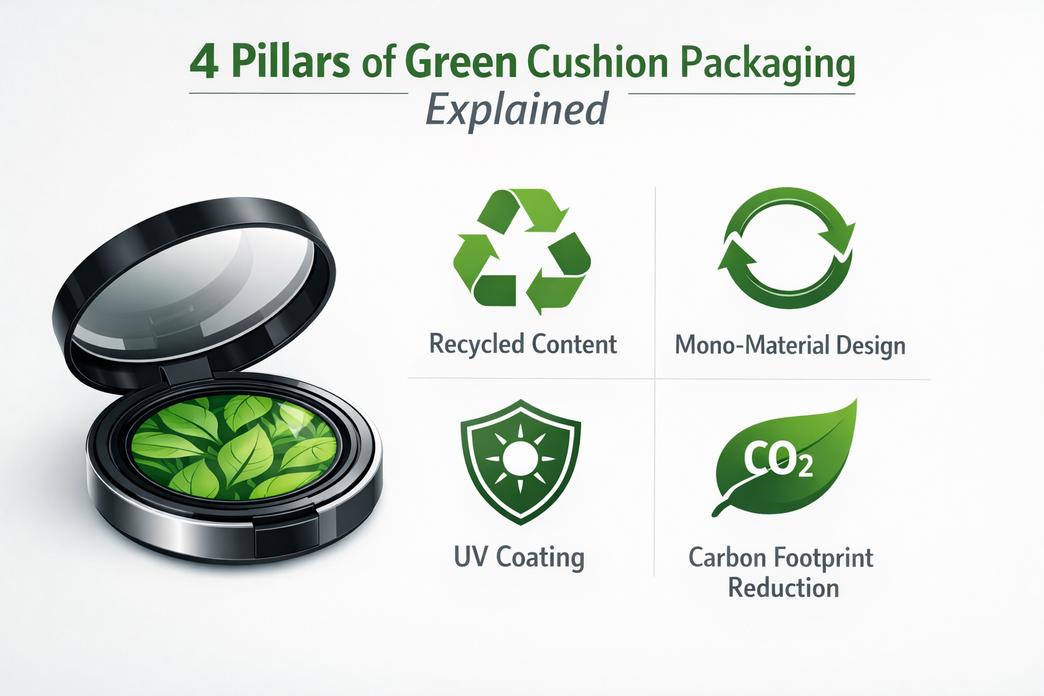
4 Pillars of Green Cushion Packaging Explained
Sustainability in beauty isn’t fluff anymore. From the empty foundation cushion to the outer compact, every detail counts. When brands rethink the foundation cushion empty case, waste drops and performance stays solid. Here’s how smarter material choices upgrade the whole empty foundation cushion game without sacrificing style or feel.
Recycled Content in Silicone Cushion Sponges
-
Material composition of the silicone sponge
-
Base layer
- Blended with recycled materials (15–30%)
- Maintains elasticity for the foundation cushion refill
-
Functional layer
- Stable pore size for even pickup inside an empty foundation cushion
-
-
Sustainable sourcing flow
- Post-industrial silicone recovery
- Filtration and purification
- Reprocessing into cosmetic-grade sponge
| Recycled Ratio | Elasticity Retention | Absorption Rate | Waste Reduction | Lifecycle (months) |
|---|---|---|---|---|
| 0% | 100% | 100% | 0% | 12 |
| 15% | 98% | 99% | 12% | 12 |
| 20% | 97% | 98% | 18% | 12 |
| 25% | 96% | 97% | 22% | 11 |
| 30% | 94% | 96% | 27% | 11 |
Result? An eco-friendly sponge that still works smoothly inside every empty foundation cushion unit.
Mono-Material Design for Easy Compostable Packaging
A mono-material PP compact keeps things simple.
- No messy material separation during disposal
- Cleaner recycling streams
- Supports circular economy targets
For a cushion compact:
- Outer shell in single PP grade
- Inner tray matched in polymer type
- Hinge integrated, not glued
This reduces mixed waste from each empty foundation cushion and makes the foundation compact easier to reclaim. Less sorting. Less landfill stress. A small tweak, big win.
Pillar 3: UV Coating on Glass Mirrors
Inside the compact, the glass mirror matters.
-
Surface treatment
-
Thin UV coating layer
- Boosts durability
- Improves light resistance
-
-
Performance impact
- Fewer scratches
- Stronger protection against sunlight
- Longer cosmetic packaging lifespan
When the mirror lasts, the empty foundation cushion case stays in rotation longer. That cuts early replacement and keeps the compact looking fresh.
Carbon Footprint Reduction through Blow Molding Efficiency
The inner tray of an empty foundation cushion often uses blow molding. Tightening the manufacturing process makes a real dent in carbon footprint numbers.
Step-by-step in production optimization:
- Adjust heating profile → better energy efficiency
- Shorten cooling cycle → faster output
- Reduce material thickness by 5% → resource conservation
- Monitor emissions per batch → measurable emission reduction
Topfeel applies these tweaks to shrink impact while keeping the foundation cushion empty case sturdy. Cleaner production, lighter footprint, same smooth snap when you close that empty foundation cushion compact.
Is Your Cushion Case Damaging the Planet?
That cute compact in your bag might look harmless, but the empty foundation cushion inside tells a bigger story. From foundation packaging choices to hinge design, every detail shapes the environmental impact of an empty foundation cushion and its afterlife.
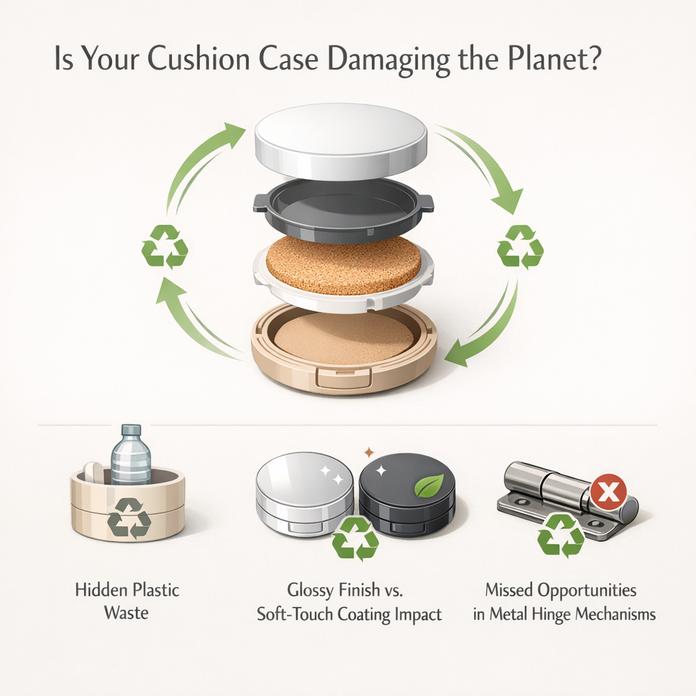
Hidden Plastic Waste in SAN Plastic Compact Cases
When brands design an empty foundation cushion, the material mix matters more than most people think.
-
Material sourcing
-
SAN plastic shells
- High clarity
- Strong, but rarely recycled in cosmetic streams
-
Mirror inserts
-
Aluminum pans
-
-
Production stage
-
Bonded layers in compact cases
- Glue between acrylic and base
- Mixed disposable components
-
-
End-of-life disposal
- Difficult separation
- Low recovery rate
- Higher environmental impact
An empty foundation cushion made with simplified mono-material structure cuts waste at the root. A refillable foundation cushion compact designed by Topfeel reduces excess foundation packaging and lowers long-term landfill pressure. Less mixing, less mess.
Glossy Finish vs. Soft-Touch Coating Impact
Surface feel sells. Still, an empty foundation cushion with heavy decoration carries hidden costs.
-
Surface treatments
-
Glossy finish
- UV coating
- Extra curing energy
-
Soft-touch coating
- Added chemical additives
- Harder recyclability
-
-
Manufacturing processes
- Base molding
- Spray coating
- Secondary baking
- Quality polishing
Each layer adds carbon load and raises biodegradability concerns. A clean matte empty foundation cushion skips excess steps and keeps recycling practical. Consumer love for silky texture is real, yet smarter design can still shape positive consumer perception without overloading the planet.
Missed Opportunities in Metal Hinge Mechanisms
Open a typical empty foundation cushion and you’ll see a small metal hinge doing big work.
-
Durability advantages
- Strong rotation
- Long longevity
-
Recyclability challenges
- Mixed material sorting
- Manual dismantling
-
Material alternatives
-
Integrated PP hinge
- Same-material body
- Fewer separation steps
- Lower risk of component failure
-
Design innovation doesn’t mean weaker builds. It means rethinking how an empty foundation cushion closes, clicks, and survives daily drops. Topfeel focuses on smart hinge swaps and recyclable structures, turning a simple cushion compact case into something lighter on waste and heavier on responsibility.
Comparative: Biodegradable vs. Reusable Cushion Cases
The beauty world keeps talking trash—literally. Packaging waste is under the spotlight, especially for the empty foundation cushion, foundation cushion compact, and every empty cushion case in between. Brands now juggle eco goals with product safety and shelf life.
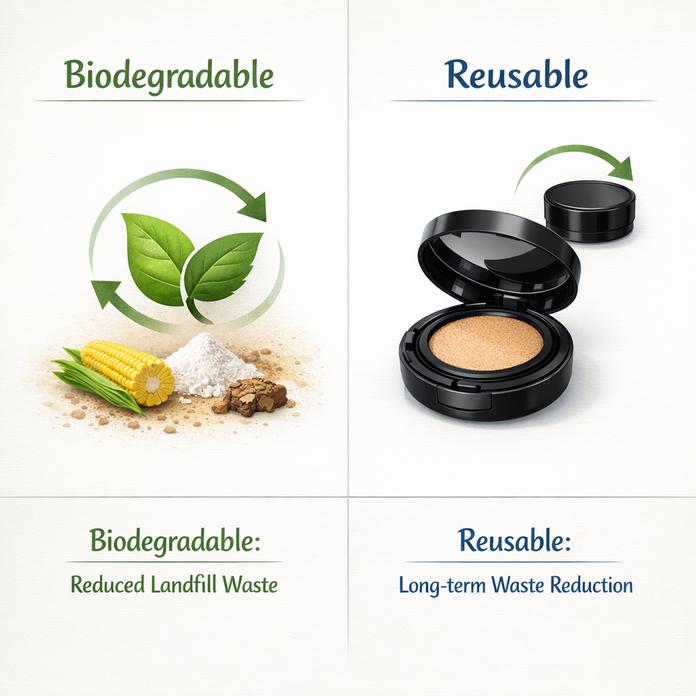
Biodegradable Cushion Cases
When choosing a biodegradable empty foundation cushion, material behavior matters more than hype.
-
Material Composition
-
- Derived from corn starch or sugarcane
- Support natural decomposition under industrial composting
-
- Lower fossil input
- Promote eco-conscious disposal
-
-
Environmental Impact
-
Reduced persistence in dumps
- Encourages reduced landfill waste
- Moves toward minimal environmental impact
-
-
Performance Limits
- Moisture sensitivity
- Lower resistance to oils and alcohol in liquid formulas
- Seal strength may decline in humid storage
An empty cushion foundation case made from biodegradable resin sounds great, but long-term airtight stability can be tricky.
“Sustainable packaging is now a baseline expectation, not a premium feature,” notes McKinsey’s 2025 global packaging outlook, highlighting rising demand for compostable cosmetic formats.
Reusable Cushion Cases
A reusable empty foundation cushion focuses on staying power.
-
Structural Design
-
durable construction
- Thick-wall ABS shell
- Reinforced hinge system
-
Secure snap closure
- Protects refill pan
- Preserves formula freshness
-
-
Functional System
-
refillable design
- Replaceable inner pan
- Compatible with multiple cushion foundations
-
washable materials
- Easy cleaning between refills
-
-
Sustainability & Cost
- Acts as a sustainable alternative
- Supports long-term waste reduction
- More cost-effective over time
Topfeel develops each empty foundation cushion with refill precision in mind, balancing durability and user comfort. For brands seeking an empty foundation cushion that survives daily drops and repeat refills, reusable formats simply last longer—and customers notice.
Scenario: High-Volume Orders with Empty Cushion Cases
High-volume beauty brands move fast, and packaging has to keep up. When demand spikes for an empty foundation cushion, stable output, flexible decoration, and smooth shipping matter. From foundation cushion refills to compact shells, every empty cushion case must stay sharp and reliable.
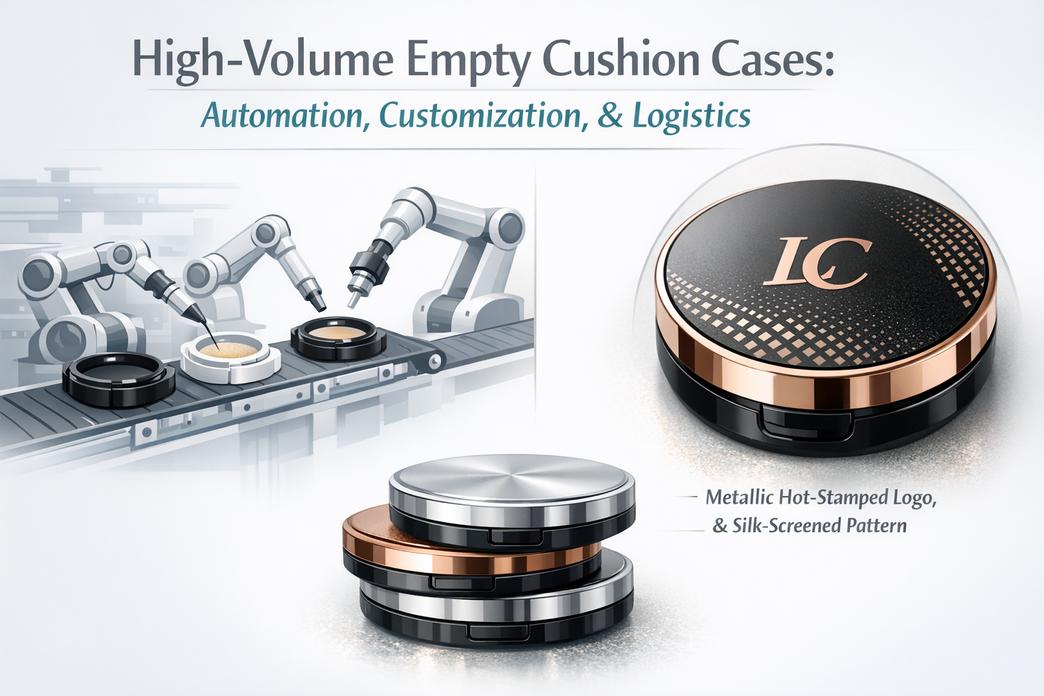
Bulk Production with Automated Assembly Line
For large orders of empty foundation cushion units, the backbone is a smart assembly line built on real automation.
-
Core manufacturing flow
-
Injection molding
- Stable temperature control
- Precision mold cavity alignment
-
Hinge and clasp fitting
- Torque testing
- Snap resistance checks
-
Mirror bonding
- Optical clarity scan
- Adhesion strength review
-
-
Quality assurance system
- In-line camera inspection
- Random drop tests
- Final surface wipe-down
This structured manufacturing process boosts production efficiency and keeps high-volume production steady. Clean rhythm, fewer slowdowns, tighter tolerances. For brands scaling an empty foundation compact line, that consistency is gold. Topfeel supports streamlined operations so every empty foundation cushion arrives shelf-ready, not stress-ready.
Customization Options: Hot Stamping and Silk Screening
Brand vibe matters. A blank empty foundation cushion can quickly turn premium with:
- Hot stamping for metallic logo shine
- Silk screening for bold color blocks
- Pad printing for detailed logo curves
Matte finish? Go subtle. Glossy finish? Go loud. Logo placement stays flexible without changing structural tooling.
McKinsey’s 2024 global beauty insights note that packaging personalization continues to influence repeat purchases, especially in mid-to-premium cosmetic categories.
That tracks. A well-decorated foundation cushion compact feels more personal. Clean branding, sharp logo application, thoughtful surface decoration—all of it supports design personalization while keeping the empty foundation cushion structure intact.
Efficient Logistics via Stackable Design
Shipping thousands of empty foundation cushion units demands smart logistics management.
-
Structural advantages
-
- Interlocking edges
- Balanced weight distribution
-
Protective interior
- Puff compartment stability
- Mirror anti-scratch spacing
-
-
Space strategy
- Optimized packaging dimensions
- Higher carton density
- Lower per-unit freight cost
Better space optimization means fewer pallets and smoother transportation efficiency. Storage solutions become simpler, cartons line up neatly, and foundation cushion compact refills stay protected.
Topfeel keeps the empty foundation cushion supply chain practical, cost-aware, and ready for global rollouts.
FAQs about Empty Foundation Cushion
What makes empty foundation cushion packaging reliable for bulk production?
High-volume orders demand precision—and one weak hinge mechanism or loose mirror can ruin thousands of units.
A stable empty foundation cushion usually depends on:
- Injection molding accuracy for ABS plastic or PP plastic compact case shells
- Automated assembly line integration of inner pan, sifter, and snap closure
- Strict quality control on airtight seal and leak resistance
- A protective, stackable design that shields the applicator puff and cushion sponge during shipping
When tooling development and decoration techniques like silk screening or pad printing are synchronized, durability and visual consistency stay intact under pressure.
How does a refillable design improve product compatibility?
A refillable design changes the economics—and the user experience.
- The outer compact case remains intact.
- Only the inner pan, cushion sponge, or applicator puff is replaced.
- Brands adjust formulas without reworking molds.
This structure supports:
- Better product compatibility across liquid foundations
- Reduced tooling costs
- Longer lifecycle for ABS plastic or SAN plastic shells
Add a magnetic closure or ergonomic shape, and consumers feel the upgrade instantly—without discarding the whole case.
Why is an airtight seal critical in an empty foundation cushion?
Foundation formulas are sensitive. Air exposure can thicken texture, weaken UV protection, and cause leakage.
A well-engineered system includes:
- A precision sifter controlling the dispensing mechanism
- Silicone or PP plastic sealing rings
- Tight snap closure or magnetic closure alignment
Resulting benefits:
| Component | Function Impact | User Effect |
|---|---|---|
| Airtight seal | Leak resistance | Cleaner makeup bag |
| Inner pan fit | Chemical resistance | Stable formula |
| Cushion sponge | Controlled absorption | Smooth application |
Small gaps create big failures. A proper seal protects both formula and reputation.
What sustainability options exist for empty foundation cushion packaging?
Sustainability now influences purchasing decisions as much as design.
Key approaches include:
- PCR plastic to lower virgin resin use
- Mono-material PP plastic structures that simplify recycling
- Lightweighting to reduce carbon footprint reduction during transport
- Limiting metal hinge mechanisms to ease material separation
Surface choices matter too. Matte finish or UV coating typically interferes less with recycling streams than heavy metallization or thick soft-touch coating.
A responsible empty foundation cushion balances durability, decoration techniques like hot stamping, and real environmental accountability—without sacrificing beauty on the shelf.
References
- Sustainability in packaging: Inside the minds of US consumers – McKinsey
- Everything You Need To Know About ABS Plastic – Creative Mechanisms
- How Airtight Packaging Improves Cosmetic Shelf Life – APackaging Group
- What is the ultimate guide to PCR plastic in cosmetic packaging? – APackaging Group
- What is Injection Molding? – Xometry
- Can Silicone Be Recycled? – SIMTEC Silicone
- Mono-Material Packaging: A Step Toward a Circular Economy – Packaging Digest
- What is a circular economy? – Ellen MacArthur Foundation
- What You Need to Know About UV-Curable Coatings – Plastics Technology
- Plastic Blow Molding: An Overview – Thomasnet
- What is SAN Plastic? – TWI Global
- Composting At Home – EPA
- Bioplastics Materials – European Bioplastics
- What is Hot Stamping? – Thomasnet
- How Stackable Packaging Improves Logistics – MHL News

