 English (Australia)
  English
  English (UK)
  English (Canada)
  العربية
  Deutsch
  Italiano
  Español de México
  Tiếng Việt
  ไทย
ไทย  Português do Brasil
  Français
  Български
  Čeština
  Dansk
Dansk  Ελληνικά
  Eesti
Eesti  Suomi
Suomi  Magyar
  Bahasa Indonesia
  Lietuvių kalba
  Latviešu valoda
  Norsk bokmål
  Nederlands (Formeel)
  Polski
  Română
  Русский
  Slovenčina
  Slovenščina
  Svenska
  Türkçe
  Українська
  简体中文
简体中文  日本語
日本語  한국어
한국어  繁體中文
繁體中文 

Design for Production: How to Fill and Clean Lip Gloss Tubes
February 10,2026
In the world of cosmetics manufacturing, how to fill lip gloss tubes isn’t just a factory-floor chore—it’s practically a high-stakes ritual. One misstep? You’ve got wasted product, leaky packaging, or worse—a recall that hits harder than Monday traffic. Buyers dealing in bulk know this: when production bottlenecks hit, they don’t tap politely… They slam the brakes on your entire operation.
You’re not just buying pretty tubes—you’re investing in sanity-saving efficiency. Because when it comes to scaling up beauty products for market shelves and TikTok hauls alike, your packaging for cosmetics has to play nice with both machines and microbiologists.
“If a tube design adds even two seconds per unit on an automated filler,” says Iris Shen, Senior Engineer at TopfeelPack (2024 Q1 Production Report), “you lose nearly 14 hours per 25K run.” That’s not downtime. That’s a missed launch window.
So before you order by the thousands—let’s talk tanks, torque caps, and cleaning cycles that keep your lines flowing and QC teams smiling.
Key Points on how to fill lip gloss tubes with Precision
➔ Preparation Checks: Ensure ingredient storage and mixing tanks are clean, sealed, heated, and properly agitated before blending raw materials.
➔ Calibration of Filling Equipment: Fine-tune volumetric fillers and peristaltic pumps using viscosity meters and trial runs to achieve consistent fill volumes.
➔ Sanitation & Cleaning Protocols: Rinse tubes under warm water, disassemble components for sanitizing solution agitation, then perform a final hot-air drying and sterilization treatment.
➔ Inspection & Quality Control: Verify lip gloss tubes, applicator wands, and caps for defects, sealing integrity, and leak resistance using inspection systems and fill-level sensors.
➔ Inventory & Lead-Time Management: Audit raw materials and packaging stocks, coordinate beauty packaging suppliers lead times, and maintain batch traceability to prevent production delays.
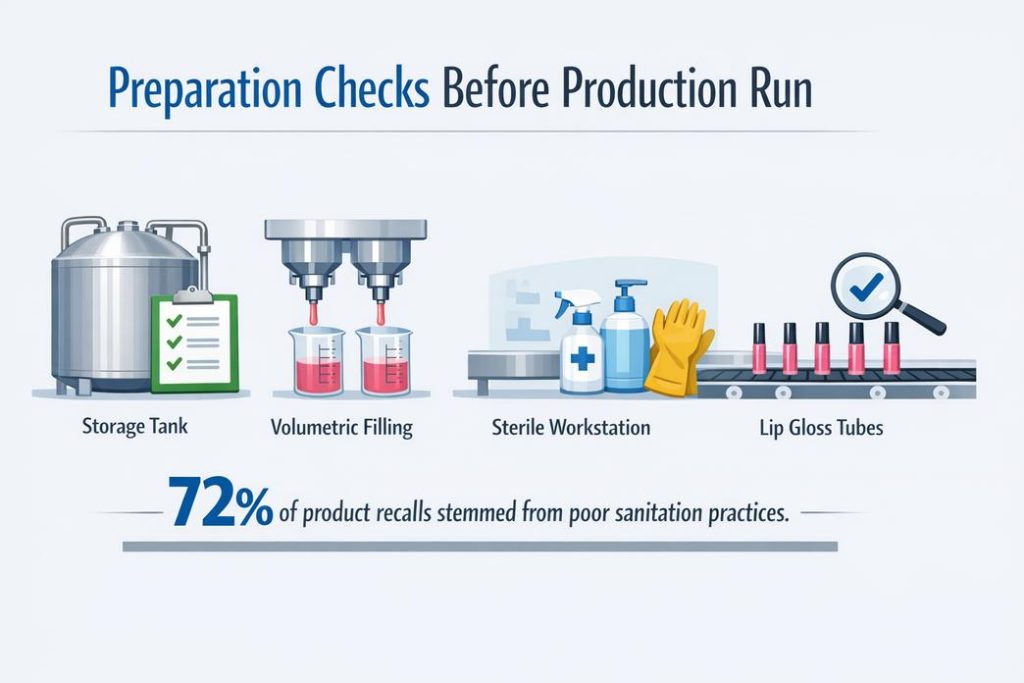
Preparation Checks Before Production Run
Before you start figuring out how to fill lip gloss tubes, make sure your equipment, materials, and teams are all dialed in for a smooth run.
Are Your Ingredient Storage and Mixing Tanks Ready?
Getting your ingredient storage tanks locked in isn’t just about flipping a switch. It’s a layered process:
A. Visual & Structural Inspection
- Check for cracks or dents on tank walls.
- Ensure all seals are tight — no air sneaking in.
- Confirm that temperature control jackets work properly.
B. Cleaning & Prep
- Flush with approved cleaning solution, then rinse thoroughly.
- Sanitize using steam or chemical methods based on product type.
- Record all cleaning steps in the sterilization records log.
C. Mechanical Checks
- Test the agitator blades for balance and motion.
- Calibrate pressure gauges to handle expected viscosity ranges.
- Validate that lids close securely before mixing begins.
All this sets the stage for error-free blending of your lip gloss base before you even think about how to fill those tubes right.
Calibrating Volumetric Fillers and Peristaltic Pumps Precisely
Nailing down consistent fills isn’t guesswork—it’s precision work. Here’s how smart teams do it when prepping their filling machine:
• Start with a small batch of actual lip gloss formula to mimic final conditions.
• Adjust pump settings until output matches target fill volume—no underfills or messy overflows allowed!
• Measure flow rates using test runs; compare against expected viscosity levels.
Then lock in settings for each nozzle size—especially if you’re switching between shades or finishes mid-run. This is where many stumble when learning how to fill lip gloss tubes correctly—small calibration mistakes lead to big messes later.
Sanitation Protocols: Sterilization Equipment and Cleanliness Checks
Think clean rooms are only for pharma? Nope—lip gloss demands strict hygiene too:
I. Equipment Disinfection
A. Use high-temp cycles on all contact parts via automated cleaning station systems.
B. Cross-reference completed cycles with digital logs from your sterilization records platform.
II. Workstation Hygiene
A. Wipe every surface with FDA-approved sanitizers before production starts.
B. Don’t forget tube holders, racks, even minor tools like spatulas.
“According to Mintel’s Q1 Beauty Manufacturing Report (2024), over 72% of product recalls stemmed from poor sanitation practices during initial filling stages.”
Following these checks not only keeps your batches safe—it also saves you from costly rework later down the line.
Inspecting Lip Gloss Tubes, Applicator Wands, and Caps
Here’s what needs checking before any tube hits the line:
1️⃣ Visually inspect empty tubes under bright light for scratches or warps; reject anything off-spec.
2️⃣ Fit applicator wands into sample tubes—watch out for loose fits or scraping issues inside the barrel.
3️⃣ Test cap threading manually first, then through automated torque testers attached to your capping station equipment.
Every piece must pass inspection before anyone asks how to fill lip gloss tubes without leaks or misalignments ruining things mid-run.
Reviewing Inventory Management and Supplier Lead Times
You can’t run what you don’t have—and delays here kill momentum fast:
Raw Material Review
→ Audit current stock of base oils, pigments, thickeners—all components of bulk lip gloss formula must be accounted for using real-time dashboards tied into ERP systems.
Packaging Component Status
→ Check quantities of empty tubes, stoppers, applicator wands, caps—and reorder based on minimum thresholds defined by previous batch sizes.
Supplier Coordination
→ Contact vendors directly to confirm delivery windows haven’t shifted unexpectedly due to global supply chain shifts post-Q2 ’24 disruptions seen across Asia-Pacific routes.
When everything lines up? That’s when it finally makes sense to focus on how to fill lip gloss tubes efficiently—without scrambling last-minute over missing parts or backordered formulas.
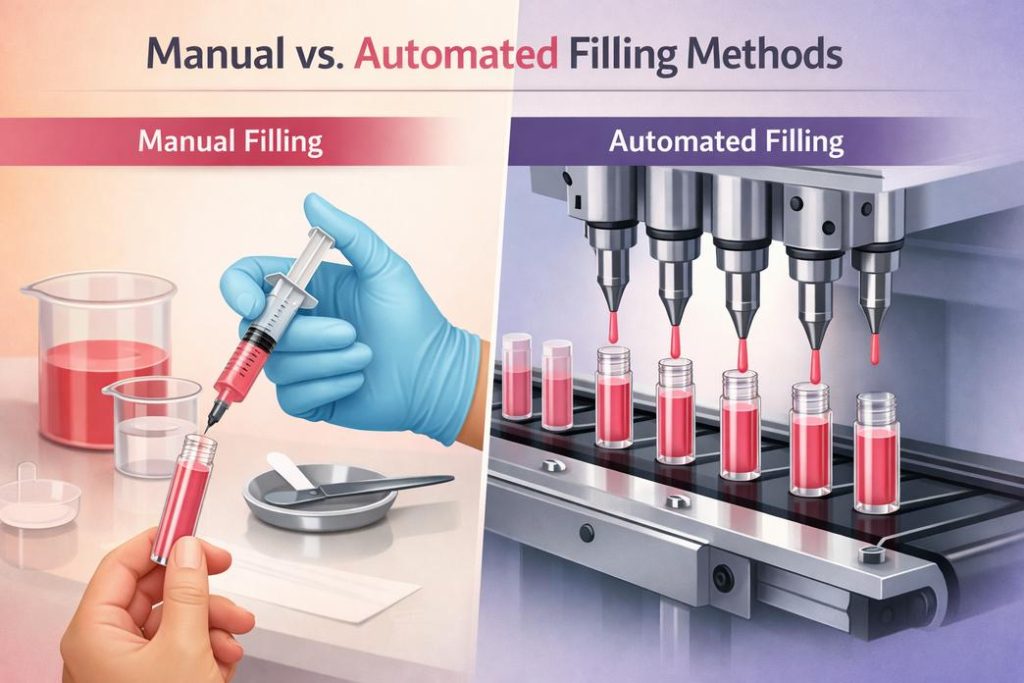
Manual vs. Automated Filling Methods
A quick guide to choosing between hands-on or machine-driven techniques when figuring out how to fill lip gloss tubes the smart way.
Manual Filling Methods
If you’re just starting out or only need a few dozen units, manual methods are your best friend. These include using syringes, pipettes, or even a funnel for pouring melted gloss into tubes. A clean workstation and steady hand give you full control over fill levels, especially when working with shimmery or thick formulas. Wearing gloves is non-negotiable—sanitation matters big time. Keep your tools like beakers and spatulas ready for mixing and transferring product smoothly. While it’s slower than automation, the flexibility and low cost make it perfect for small-batch creators learning how can we choose tube of lip gloss factory without breaking the bank.
Automated Filling Methods
When production ramps up, manual won’t cut it anymore. That’s where automated systems step in—with conveyor belts, timed nozzles, and precision-controlled pumps doing all the heavy lifting. A typical setup includes a heated tank feeding product through a hopper, managed by a central PLC control unit that keeps everything running smooth as butter. Integrated sensors detect tube presence and alignment before filling begins, minimizing waste and mess. Machines can crank out hundreds of filled units per hour with consistent accuracy—ideal when scaling up or tackling larger orders while still keeping quality tight as you master how to fill lip gloss tubes efficiently at scale using tech-forward solutions.
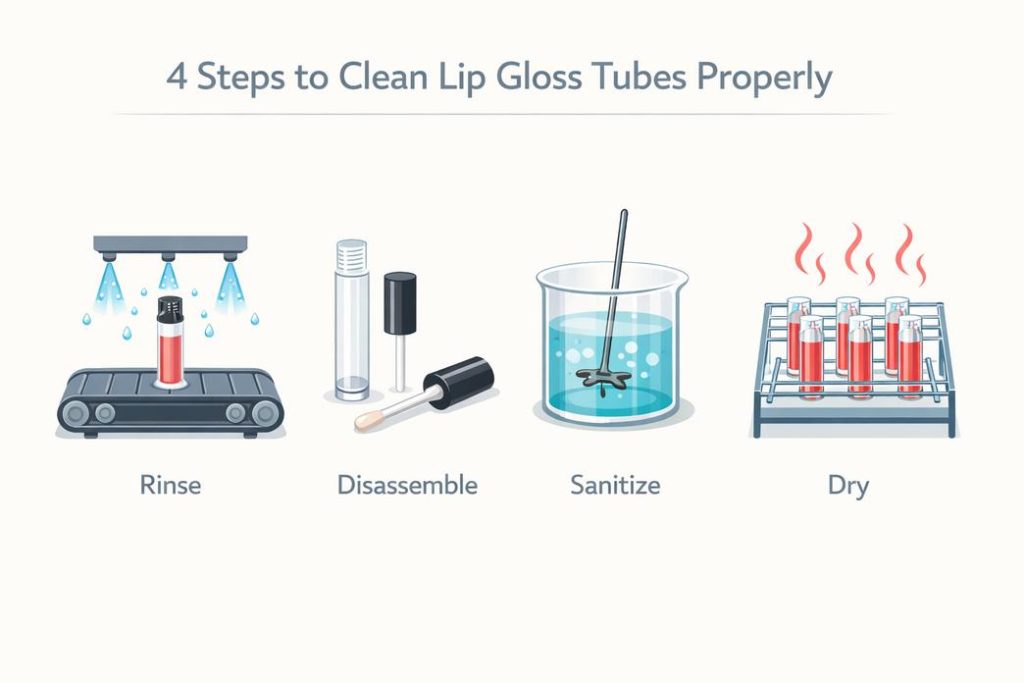
4 Steps to Clean Lip Gloss Tubes Properly
Want to reuse or recycle those old gloss tubes? Here’s how to clean them up without missing a spot.
Rinse tubes under warm water using conveyor belt systems
Lip gloss tubes usually come caked with sticky leftovers. To start, run them through warm water jets via conveyor belts—this knocks off most of the surface gunk. The moving system ensures each tube gets equal exposure as it passes under pressurized streams. No scrubbing needed at this stage; just let the heat and motion do their thing. This is key if you’re learning how to fill lip gloss tubes later on—you want a fresh canvas before anything else.
Remove stoppers, applicator wands, and caps for separate cleaning
Break it all down! Disassemble each tube by pulling out the stoppers, unscrewing the caps, and removing the applicator wands. These parts trap residue more than you’d think. Toss them into separate bins for soaking or brushing. If you’re planning to refill, every piece needs love—not just the main barrel. Think of this as prepping your gear before diving into how to actually fill lip gloss tubes cleanly.
Agitate in sanitizing solution with transfer pumps and agitators
A good soak isn’t enough—you’ve gotta move things around! Drop everything into a bath filled with sanitizing solution powered by transfer pumps and mechanical agitators.
| Component Type | Soak Time (min) | Solution Temp (°C) | Agitation Speed (RPM) |
|---|---|---|---|
| Tube Body | 10 | 45 | 120 |
| Applicator Wand | 8 | 40 | 100 |
| Cap & Stopper | 6 | 38 | 90 |
This combo helps scrub off stubborn goo from tight corners inside each part—especially useful when figuring out how to fill lip gloss tubes without contamination issues.
Final rinse, hot-air drying and sterilization equipment treatment
Now wrap it up right: use filtered clean water for one last rinse—repeat until there’s zero foam or scent left behind. Then toss everything onto a mesh drying rack, hit it with a blast from a hot-air dryer, and slide it all into sterilization gear. Let them sit until they’re completely air dry, no shortcuts here! A single drop can mess up your refill batch later on if you’re serious about mastering how to fill lip gloss tubes like a pro.
FAQs about How to Fill Lip Gloss Tubes
How to fill lip gloss tubes efficiently for large-scale production
A buzzing assembly line hums as conveyor belts carry rows of pristine wholesale lip gloss tube toward filling machines. Volumetric fillers and peristaltic pumps stand ready, tuned by operators watching viscosity meters for just the right flow. Caps meet bottles under the steady hands—or steel precision—of capping machines, locking in that perfect texture before pallets roll into warehousing solutions bound for eager markets.
How to fill lip gloss tubes manually without wasting product
Small batches begin with warm mixing tanks gently stirred by smooth-running agitators. Manual piston fillers allow artisanal control—a measured press sends liquid color gliding into vials without drips or trapped air. In this quieter rhythm, applicator wands slide easily into place between stoppers and caps, the moment sealed with pride before each bottle joins its family on shelving racks awaiting shipment.
How to fill lip gloss tubes while ensuring quality control consistency
Each tube steps under inspection systems like performers entering a spotlight; fill level sensors check volume accuracy while leak testing assures no hidden flaws lurk within seams. Operators read data from viscosity meters during every run; batch traceability records capture each detail, connecting raw material origins with final packaging components so supplier promises hold true when products set out across continents inside secure shipping containers.
References
[Cosmetic GMP Guidelines]
[Best Practices for Cosmetic Filling ]
[Understanding Viscosity in Cosmetic Manufacturing ]
[Sterilization Methods for Cosmetic Packaging – iso.org]

